
Translated material
The pursuit of happiness
The text of Angelina Lucento, an American researcher, an art historian living in Moscow, affects the plot of little -known in the world (and completely unknown in Russia) - the works of African American artists from the times of the great depression and the “new course” in the United States. The Russian reader can appeal to this material to revise the washed attitude to Soviet realistic painting as a single monolith: how to separate the desire to get to the state in it from an attempt to convey the way of labor familiar not to every spectator? What Soviet artists can be compared with the main character of the articles by Lucento - artist Vertis Hayz?
Great depression in the United States began on Black Tuesday, October 29, 1929. In the course of the followed economic crisis, many Americans were left not only without work, but also without food. These circumstances entailed an outbreak of social interest in socialism. The Harlem area in New York was one of several centers of the socialist movement in the United States. The African Americans who lived in the area called for building a new life on the grounds of freedom and a worthy standard of living for everyone - and saw in new forms and genres of fine art, literature, theater and music one of the most important insurance in achieving their tasks. Harlem African Americans showed great interest in the Soviet socialist system. For example, writer Zora Niel Hurston created a department of the International Association of Friends of the Soviet Union in Harlem. Many Harlem inhabitants, including Lanston Hughes, Claude McKay, Dorothy West, Paul Robson and others, traveled to the USSR in the early 1930s to better understand what Soviet socialism is and whether it was possible to apply his experience in the situation in the United States. They were interested in whether the public system, similar to Soviet, would help overcome the remnants of slavery and racism, on which American capitalism was built and which didom the African Americans to be on the economic day of society.
 © Harlem Hospital Center Mural Collection and Angelina Vertis Haze. The pursuit of happiness. 1936
At the same time, the American government, led by Franklin Roosevelt, felt the mass interest of the people in the ideas of socialism. Roosevelt realized that if he and his government did not take special measures, then there is a real risk of popular uprising and turning towards communism. Therefore, in 1933, the Roosevelt administration announced the beginning of a “new course” - that is, formulated a general plan for the complete restoration of the American economy. In 1935, on the initiative of Roosevelt, a program was opened for writers and artists entitled “Public Work Management” (UAR). War lasted until 1943. As in the USSR, writers and artists in UAR could receive orders from the state for various social creative works. African American artists were not excluded from the competition. In Harlem, there was a particularly active group of UAR, which consisted of many artists, including Jacob Lawrence, Aaron Douglas, Charles Alston and Vertis Haze ( Vertis Hayes ) . They began to receive orders for the creation of frescoes and other types of monumental art in Harlem. At the same time, Haze was the only one who had the education of the monumental artist-all the others were the formation of easel. Although Hayza was only 25 years old, in 1936 he, together with Charles Alston, received an important order for painting the walls of the Harlem hospital on 135th Street in New York. So Haze and Alston became the first African American artists who worked for the UAR project on monumental painting. Soon, the works of Hayz turned out to be the most important part of the murals of the Harlem Hospital.
 © Harlem Hospital Center Mural Collection and Angelina Vertis Haze. The pursuit of happiness. 1936
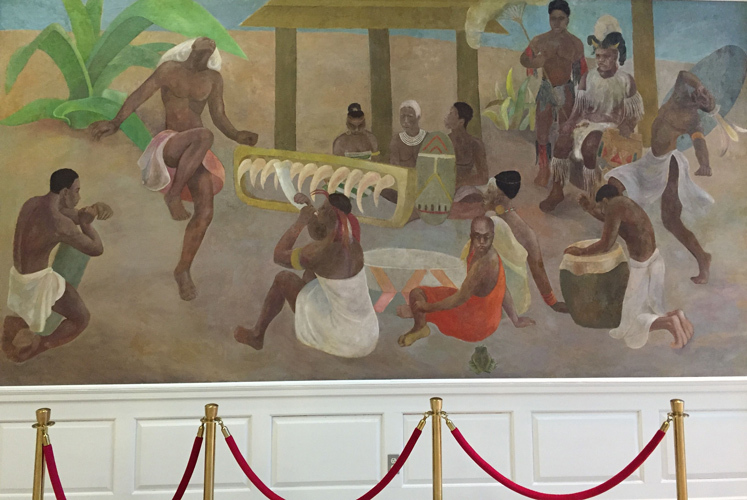
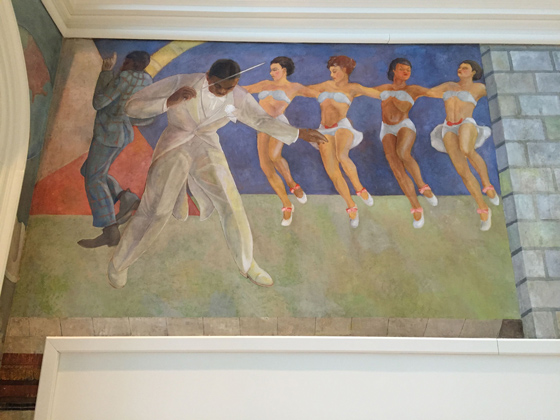
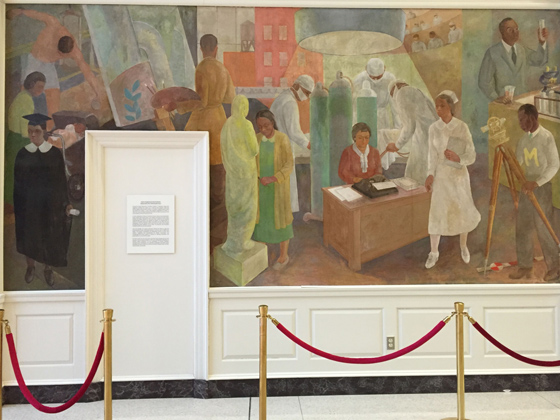
In the corridors of the hostel for nurses on the territory of the hospital, Haze wrote a series of nine frescoes, called by him “The pursuit of happiness” ( “ The Pursuit of Happiness " ). The series shows the history of the life and fate of African Americans in the United States and their ancestors in Africa itself. In his style, Haise's frescoes are an example of “social realism”, popular at that time among American socialists, including African American activists. As those Soviet artists that they admired, American socialists saw in realistic art a means to convey to the audience at least some idea of the unknown to them, completely different from their own life. So, Haze, with his realism, is trying to convey to the viewer a reflection of the experiences of a free African, dancing with joy on his land behind the ocean. But Hayz also seeks to convey the severity of the life of African American workers after their liberation from white slaveholders in the 19th century. At the same time, the creation of the image of labor is much more important than literal realism for Haze.
 © Harlem Hospital Center Mural Collection and Angelina Vertis Haze. The pursuit of happiness. 1936
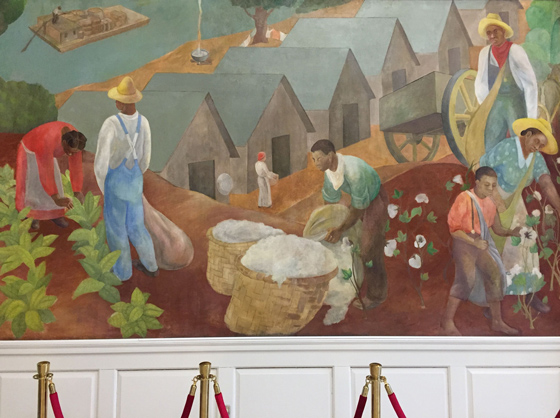
The “pursuit of happiness” begins and ends and ends with images of supposedly free African -American working people. On the first fresco, Haze shows a modern family of miters in the American south. Mother, father, boy and their neighbors work in the fields, collecting cotton. Behind the field there are a number of small wooden houses where they live; The river flows behind the houses. The picture of heavy labor and endless poverty in the 1930s was a reality for many African Americans in the south of the country. Officially, they freed themselves from slavery in 1863, but life for many of them did not improve after that. Due to poverty, discrimination in all areas of life and racist laws, many could not get a normal job, and their only opportunity remained work as a prisoner. Heroes of the fresco Haise receive only their modest housing for their work. The artist shows that such work, in fact, is a legal type of slavery, which takes all power from a living person. All workers on the fresco work with their eyes closed - as if they have nowhere to run away, except inside themselves.
In the following paintings, Haze depicts the joy of free life in Africa and the achievement of a new culture developing in Harlem. He draws musicians, dancers, artists, doctors, nurses, scientists. In these central panels, Haze most emphasizes the joy and dignity of creative work.
Unlike many white artists, who also created wall paintings under the WAR, Haze never lies a direct connection between life happiness or material wealth, the so -called American dream, and serious physical labor. For example, when Haze returns to the topic of physical labor at the end of the cycle of murals, he offers a completely different picture of reality.
 © Harlem Hospital Center Mural Collection and Angelina Vertis Haze. The pursuit of happiness. 1936
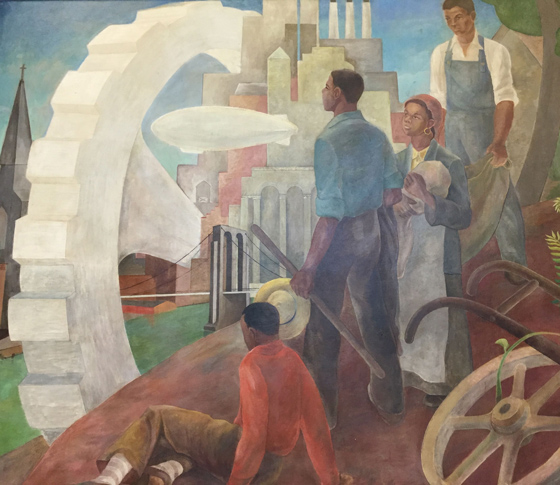
On the last fresco, the artist depicts the same miters as on the first. They now do not work in the field, although they have all the tools for this work. This time they look through a wide river at a large modern American city. There is everything in the city: the church, and skyscrapers, and factories, and bridges - even airship soars above it. But between the African American miters and this wonderful city there is a huge gear wheel. This is an object that does not inspire either joy or hope - but only fear. The metal and power of this toothass wheel as if they can crush the entire group of African Americans looking at it. Here Haze raises the question of the way to the future for African American working people. Having emphasized that their work in the southern villages was, in fact, a variety of legal slavery, the artist also doubts that in a large new city a different, best life will begin for them. On the contrary, Haze suggests that not only the country's agriculture, but also the most modern industrial cities, is kept at the work and poverty of the African American. And this means that, at least, all African -Americans, or maybe even all Americans should look for new ways to a happy future. In addition, Haze puts forward the idea that these new ways should not be built completely on serious physical work. On the contrary, they should give people the maximum possibility of relaxation and creativity: for Haise, the aesthetics of socialism was the aesthetics of creative joy and life passion. Aesthetics, offering the viewer, thinking about the relationship between life and physical strength and demanding that he think about the place of labor slavery in the structure of the American economy.
A series of frescoes Hayz is not the only similar work in the history of American modernism, but so far such works have been studied very, very little.
Download the entire issue of the magazine "Disagreements" (No. 1) "Work, rest, unemployment": pdf , mobi , epube