
Translated material
Diary of February
Gleb Napapenko opens the series “Diaries of the month” on “Disagreements”.
Somehow I got to the event in the Garage- a master class of Kara Miskaryan , who was designed to help listeners learn art criticism. Among the advice of Miskaryan, I remember one thing - that it is necessary to go to all the opening exhibitions, to keep abreast of all the events taking place in the city. I was remembered because I caused conflicting feelings in me. On the one hand, he turned out to be in tune with my own obsessive desire to keep everything under control and not leave gaps in knowledge and impressions. On the other hand, so frankly voiced in the form of an imperative, he caused a protest in me: a protest against the appeal of art into a profession, subordinated to the dictates of quantity, social success and integration, is the problem in line with the theme of this issue of “Disagreements”. Is it possible to expel laziness from art? Is it not sometimes a rejection of going to an obligatory exhibition to a greater extent by an act of art than going to it? It was these thoughts that came to me again, when the idea arose that in “Disagreements” it is worth covering the events of the artistic life of the month, on which the section “Art” Kolta does not have time to focus on. And from embarrassment before the totalness, the format of such lighting arose: subjective and fragmented diary notes - notes of different authors. This month is mine.
We are all people ... Still, this is charming, but a lie.
The main feeling that accompanies me when visiting temporary exhibitions in Russia is dissatisfaction. Dissatisfaction with art, dissatisfaction with the curatorial plan. But I even learned to extract the meaning from this dissatisfaction. For example, raising a lack of satisfaction in the fundamental property of contemporary art: unlike, for example, cinema or theater, art refuses you the total illusion - and this restores you to yourself. The only problem is that not all visitors of these exhibitions live this dissatisfaction and, as a result, a return to the displeased: it remains a purely subjective experience, which I think in vain universal. The truth is that the exhibitions today work perfectly as part of the consumption machine: their attendance is put above any personal experience of the visitor, including criticism - and only attendance is seriously taken into account by institutions.
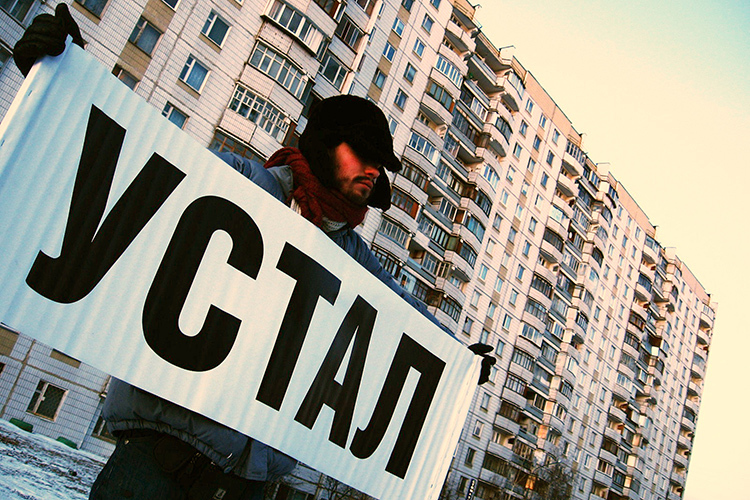
Parallel exhibitions of Andrei Kuzkin and the Mishmash group at the Moscow Museum of Modern Art (MMSI). Why do all the exhibitions in this space seem to me affected by one vice - the vice of coziness? It seems that the reason here is how MMSI itself functions. However, in this case, this coziness was consonant with the art exhibited in the museum: Mishmash and Kuzkin sing local, personal and intimate - as shelter. The shelter accessible to everyone - even the mysterious objects of Mishmash call the viewer to solve and, ultimately, understanding . Turning to the understanding and sympathy of the viewer in Kuzkin’s performan’s performances is even more frank: the artist stands with the poster “Tired” in the middle of the sleeping area, writes his biography on the fence ... Intimate and personal claims to be universal and universal. We are all people ... Still, this is charming, but a lie.
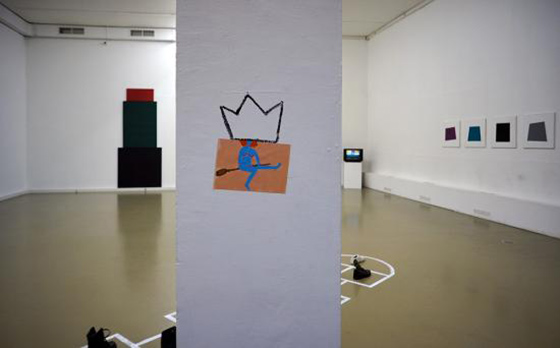 © XL Gallery Alexander Galkin. "Caution, icicles!"
"Caution, icicles!" Alexandra Galkina in the gallery XL . This small exhibition has become for me a kind of antithesis exhibitions of Kuzkin and Mishmash in MMSI. It seems to be also designed for the most simple and democratic reading by the audience by micro -objects and documented on the video a promotion (where Galkina again and again wrote the word “ass” on the wall of the house, and each time it was painted over - all new and new colors). But instead of a universal human here - a very specific human one, at least - gender: a sticker with a naked witch on a broomstick flaunts on a pillar in the center of the exhibition hall. Instead of an invitation to understanding and lyrical sympathy, the viewer is more addressed to the viewer: can you join girlish mischief and impudence? Are you inviting you to this Sabbath?
Exhibition of Evgeny Gradihshchikov “without the name (after defeats)” in the mamm. I missed the opening, but I was next to the museum on Kropotkinskaya and saw many acquaintances of people who went out of the border. Busy with completely different events and deeds, I saw the representatives of the art-world entering the metro through the glass-the effect of removal is quite in the border spirit. But when the next day I still went to the exhibition, there were two friends with me, who did not hear anything about this artist and examined his exposition with skepticism - skepticism of a different elimination than mine the day before. And this removal gave rise to a new wave of extraction in me. As a result, all these effects were not so much responded with somnambulic poetics of Gorolshchikov as they blocked it. Suddenly I began to seem extremely ridiculous and the sterility of this exhibition, where the guide authoritatively explains the group of visitors about the “Ghost” video, where the faces of my friends come up on the screen every now and then. Perhaps it would be more honest if critics, talking about the events they had attended, also reported with whom and in what mood they came there, what they had eaten before and that they really bother them today.
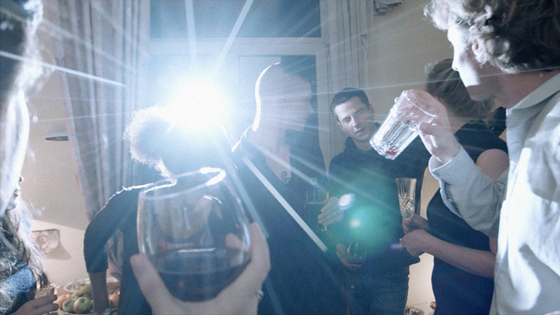 © Mamm Evgeny Gorlshchikov. "Ghost", 2016 Frame from the film
In parallel, the exhibition Tair Salakhov and Fedor Rokotov , passing in the engineering building of the Tretyakov, are in the engineering building. The accidental coincidence of these two exhibitions in time and space pushes to comparison: two artists who made a magnificent career, starting (in the case of Rokotov) by a serf or (in the case of Salakhov) the son of a repressed party leader. At the level of the artistic style, the career recipe is similar: the invention of repeated techniques successfully applied to any material - these are the characteristic haze and elongated eyes of the Rokotov portraits or the Salahov geometrization of industrial landscapes and the workers inhibiting them in the spirit of the “harsh style”. But still, the situations of the XVIII and XX centuries are completely different - and therefore the place of Rokotov and Salakhov in them is different. The life of the aristocracy of Catherine's time is now looking as strange as the rituals of tribes from Levi-Stross's books. Rokotov, inventing his universal techniques, guaranteed to give each model Fleur of a unique individuality, made a breakthrough in the understanding of the human “I” in Russian portrait art, which until recently was at the level of Parsun. Salakhov, in comparison with his brothers in the “harsh style” - Viktor Popkov, Pavel Nikonov, Nikolai Andronov, Heli Korzhev - looks, on the contrary, a conservative. A thaw search for authenticity and truthfulness, which gave an impulse to the “harsh style”, in Salakhov becomes a pure rhetoric and paves the way to turn the initially heretical direction in Soviet art into a new conformist conjuncture.
Are you inviting you to this Sabbath?
The Organizing Committee of the Prize "Innovation" lifted the action "Threat" by Peter Pavlensky from the competition . Media gives rise to the illusion that it is in connection with such loud reasons that especially interesting thoughts should arise: the more significant the scandal, the more people are obliged to express various opinions about it. But no original thoughts come to me here, only a feeling of solidarity with jury members who refused to participate in the voting (at least) nomination “Work of visual art”. And the words revolve in the head: censorship, self -censorship, shame. These words characterize today's behavior of many of our institutions - frames the atmosphere of our prosperous era. The times when the “Innovation” was awarded the “War” group, passed. They would already give this award to Tair Salakhov, by golly.
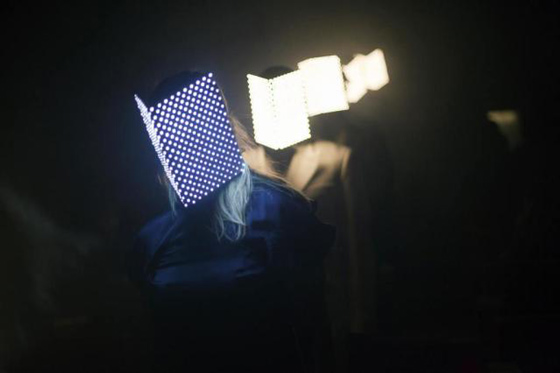 © Courtesy of Marian Goodman Gallery Pierre Yuig. "The Host and the Cloud", 2009-2010.
Showing the film Pierre Yuig “The Host and the Cloud” in the GTSIA. One of the heroes of the last exhibition of the “Document” in Kassel, Pierre Yuig seems to be one of the key artists of the end of the zero-the beginning of the tenths-the time of enthusiasm for the actor-net theory in sociology, speculative realism in philosophy and the refusal to represent in politics in the spirit of the Occupy movement. In his film, Yuig masterfully constructs strange hybrid objects from people, animals, objects and beliefs, weaving them in the space of a museum - the ritual place of modern capitalism. It is the ritual that becomes the main form of connecting various elements in complex constellation in the Yuiga film: whether it is a hypnosis session, viewing a museum exposition or a theatrical coronation. All these rituals in Yuig are equivalent - as if illustration of ideas in the spirit of Deleuz or postoperianists about the rhizomatic nature of today's capitalism or the theses of Joel Reghev about the procrastination and art published in this issue of “Disagreements”. But for some reason, this recent art seems to now almost annoyingly obsolete-as well as hopes for the revolutionary power "occupying." The explanation of this sensation, perhaps, can also be found in this issue of “Disagreements” - in the texts of Maria Chekhonadsky and Andrei Shental , which stating the obsolescence of postoperative terminology in the face of increasingly gross forms of capitalism after the global crisis of 2008, as well as in our Russian situation of economic decline and political reaction.
They would have already given “innovation” to Tair Salakhova, by golly.
Exhibition "Breakthrough. Russian theatrical and decoration art. 1870-1930 ” in the theater museum named after A.A. Bakhrushin. The theater here appears as a universal form of understanding history for public consciousness at least the 19th and early 20th centuries. The architecture of the pseudo -Gothic mansion where the exposition was located is essentially a theater on the stage of which the European Middle Ages appears. However, with the same success, it could be Rococo and ancient Rus' - the architecture of historicism was able to play any era. Each showcase of the museum itself is a small scene for performing the past exhibits. All modernist searches for the universal style in the exhibition “Breakthrough” - from symbolism and modern to Suprematism and constructivism - are also passing through the stage of the theater, playing their claims to the reconstruction of the universe within its conditional borders. No wonder the theater metaphors are full of historiosophical texts from Hegel to Walter Benjamin and our days: advanced and backdrops, tragedies and comic farms are still the tools for thinking about history - and its practical implementation, whether it is the rituals of performing in parliament or the cruel theater of military operations.
Exhibition "Ilyazd. XX century Ilya Zdanevich. From the private and museum meetings of Russia and France ”in the PHMI. Pushkin -and the exhibition "School of Kuzma Petrov-Vodkin" in the Galeev Gallery. The exhibition in Pushkinsky is surprisingly boring, the exhibition in Galeev Gallery is, on the contrary, one of the fascinating examples of the expert exhibition-archival research. For some reason, all the elegant collaborations of Zdanevich in emigration with Picasso, Max Ernst or Miro in work on livre D ' Artiste, it seems sterile and correct: of them, it seems to be erased by human relations and left only professionalism. On the contrary, in the search for students of Petrov-Vodkin in the 1920s-from a stylistic point of view, secondary and often rude-there is a beating of living, rough group relations-and relations with a changing society. Perhaps the point is really in a sense of human connection with history: it is not without reason that the halls dedicated to his early activities in Russia and Georgia and in the first decade after emigration are most interesting at the Zdanevich exhibition. Or maybe I just fetish the revolution and post -revolutionary years? ..
How still a deceiving format of such a public diary: he forces the author to compose his “I” and stick out this composed subjectivity as something genuine and sincere. It seems that this is exactly what the art sometimes manages to avoid - and this is one of the reasons for my sympathy for it.
Download the entire issue of the magazine "Disagreements" (No. 1) "Work, rest, unemployment": pdf , mobi , epube