
Translated material
Training of disappearance
Climbing the small hill on which the house of the famous theoretic physicist, one of the creators of the quantum mechanics of Werner Geisenberg, was located, the guests suddenly noticed a small horseshoe hanging over the gate. “Well, how is it? You, the famous scientist, Nobel laureate, do you really believe that the horseshoe brings good luck? ” “They told me,” answered Geisenberg, “that it works, even if you do not believe.” We do not know whether the physicist’s colleagues who visited him that evening appreciated this joke, but the wit proposed by him echoed the principles of quantum theory and in many respects anticipated its expanded popular interpretation in parasyan circles. His joke has become the slogan of many modern capitalist practices: "Make sure that it works on your own experience." So, in the 1990s in Russia, people suddenly breathed holotropo, began to fight contactlessly, went out for walking and actively visualized their future yachts, houses and cars. All these esoteric operations are purely practical. “I don’t know how, but it works,” Guru say. “The most important thing in our teaching is its practical meaning,” representatives of the Scientology echo.
Today it is not enough just to work, handing over your body for temporary use by the industrial conveyor. Since the factory has been transformed into the company, it is necessary to believe in the projects that you propose, smile to customers, infect colleagues with enthusiasm. Capital managed to overcome the dualism of the soul and body, proposing a new nature of the labor force in which everything that we mean by the “soul” - language, emotions, affects - is mobilized for the sake of benefit. The factory fought with muscles, hands and bodies of workers. The company and the modern office use more mental capabilities, the ability of people to affective service, PR and self -motivation, while the body disappears in front of the monitor screen, scrolling through the “incoming” folder with a finger on the touchpad. Thus, many magical and quasi-religious rituals are sewn into production: among office workers, personal growth, workshops of efficiency and even corporate yoga have become mandatory. Business-city-horums appeared on business sites, and the office space began to remind Rome of the beginning of the first millennium with its syncretic cults, eclectic rituals and gnostic philosophizing.
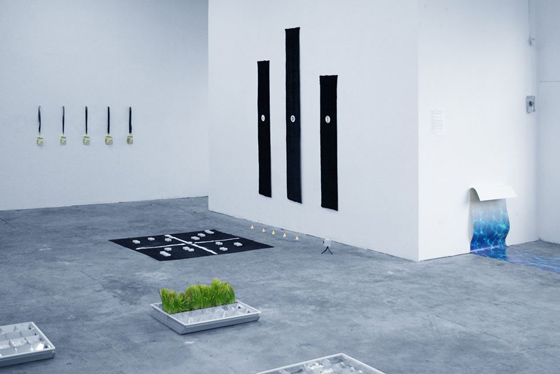 © Alexander Imazumov Alexander Izmumov. "Content is confidential"
The understanding of this “mental” capitalism with its seizure of faith and superstition in Russian art cannot be called popular, but at the turn of 2015-2016 several interesting art projects took it. These include the exhibition of Alexander Imazumov "Content Providifying" in the ISS gallery Mag at the Research Institute Gift and project Kirill Savchenkov Horizon Community Workshop in the framework of the Singular Research Agency in TsTi Factory. These artists borrow rhetoric and form of office life, but do it critically. Their attention is focused, first of all, to what is supplanted from the orthodox capitalist agenda, to what remains on the other side of efficiency, sociability, “creativity and other fundamentalisms” (by apt definition of the theorist and the sociologist of the art of Pascal Gilen).
Image analyzes the common neuroses of modern production, which office life is desperate to close their eyes: it is procrastination, emotional burnout and alarming states. If the 19th -century salon was a trading passage, turned inside out, then, according to Imazumov, the modern exhibition is the wrong side of the office, its dark side, woven by the same means and rules, but freed from the dictatorship of efficiency. His exhibitions are the offices of involuntary, a place where the resistance of designed logic is played, and the type of artist he proposed is a manager without management. Using the strategy of Redi-Mide, the images look at office things as strange magic objects designed to keep the employee in the affective state of trance: motivating posters, flying ups with an arms between employees, raising motivation ... His projects at the “start” and at the Research Institute of Gift show capitalism precisely as a set of esoteric cults based on the blind faith, leaving for the blind. Nowhere. What became the exchange or market, if not blind faith in abstract abstractions at the moment when the gold standard ceased to be relevant? The 2008 crisis is largely a crisis of blind faith that has encountered real contradictions. According to Imazumov, the artist’s task is to analyze these rituals of modern cognitive capitalism and indicate their surreal foundation.
The space of the office began to remind Rome of the beginning of the first millennium.
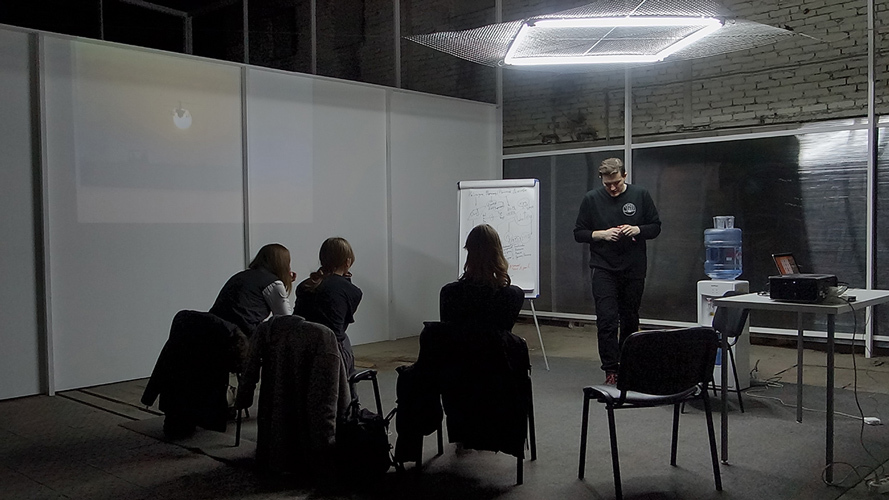
A similar gesture is used in Horizon Community Workshop Kirill Savchenkova. Organized as business training of personal growth, this project actually teaches the opposite. If at classical trainings a business guru teach you to increase your performance, communicate with people important people for business and conduct a diary, then Savchenkov’s training was built mainly on the topic of disappearance and evasion of ties. With the advent of cyber culture, we get the opportunity to exist almost everywhere, but it is much more important that we are the same with the same success. To survive in this situation, it is necessary to learn to disappear, encrypt and build alternative methods of message with like -minded people.
The main thesis of the training is that “non -existence is always produced”, that is, it is not subtracting, but a productive surplus property. Non -existence can be practiced. At one of the seminars, the artist turns to the figure of Yeti. A snowy man is an animal, the main evolutionarily developed feature of which is the opportunity to hide from a person. Yeti analyzes the horizon of his possible observer and builds an optical counterattack, becoming another recognizable object - pony, foliage or wood. The basis of the life of the Yeti is a constant productive production of flight lines from the human gaze. Savchenkov connects this practice with the visual aikido: a snowy man uses the resources of vision of another to turn them into his blindness.
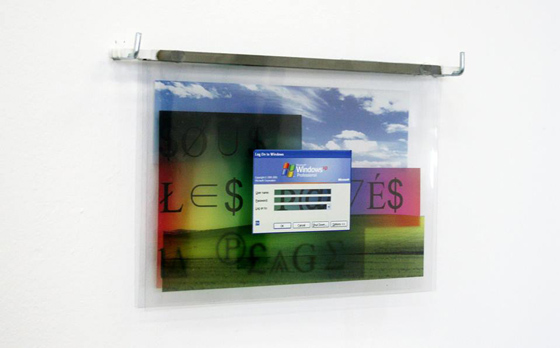 © Alexander Imazumov Alexander Izmumov. "Content is confidential"
Other main training characters are a time traveler John Taitor, who appeared on the Internet in 2001 and said that he arrived from 2036, and pilot John Boyd, a Pentagon consultant, who developed on the basis of quantum physics a method of response to situations that became intelligence, army and business management. The HCW seminar was built on the principles of Boyd: these are four cycles "Observation - Orientation - Solution - Action." In each seminar there is a theoretical part in which the artist mixes the achievements of quantum physics, Agamben's philosophy, research by Boris Porshnev and other mysterious figures. A branched visual material is added to the theory (at some seminars these are pictures from Google and comics, on others - a film of a conspiracy therapy) and practical methods: participants immerse their fingers in granular fluid and charge ions, meditate or arrange objects so that their magnetic fields serve as muffins for electronic devices. The coach himself in a fashionable turtleneck with John’s attributes stands against the backdrop of banners covered with inscriptions made by cetological font, coolers with water and flipcharts, on which physical formulas, diagrams and functions flash. The number of participants is limited, only four people can visit one session. This allows the coach to contact everyone individually and use his personal experience in his own narrative. The artist also uses the methods of cold reading and the auditing of Ron Hubbard, constantly asking personal questions and interpreting them in a scientific manner.
A snow person uses the resources of vision of another to turn them into his blindness.
This strange artistic training, which gives people “specific practices of survival in the modern world”, does not so much call into question the boundary of art and fragmentation, but determines the role of art in the current mechanism of faith. If the exhibition format involves an artistic consensus (that the exhibition and there is art), then the appeal to the format of business training allows Savchenkov to indicate what kind of artistic means the consensus of “Life” is supported. By building logical argumentation and using visual confirmations, the artist forces, first of all, the faith of the viewer participating-and not his aesthetic feeling or training on the recognition of the art in the exhibition space. Even if the participant is still filled with a critical doubt, then he is already included in the game that is in the hand of the coach, in the game “I believe / do not believe”. With something like this almost a hundred years ago, members of the art jury collided, who were offered the pusser of Marseille Dyushan as a contender for the exhibition: it doesn’t matter whether they consider it an art or not, the step has already been made without their knowledge, they have already evaluated it. By the middle of the session of the Savchenkov seminar, the boundaries between reality and fiction, art and life disappear. More precisely, the question of their ratio can no longer be posed, it loses its meaning: the work of the seminar reveals that all life rests entirely on illusory, almost artistic foundations. We do not know how, but it works.
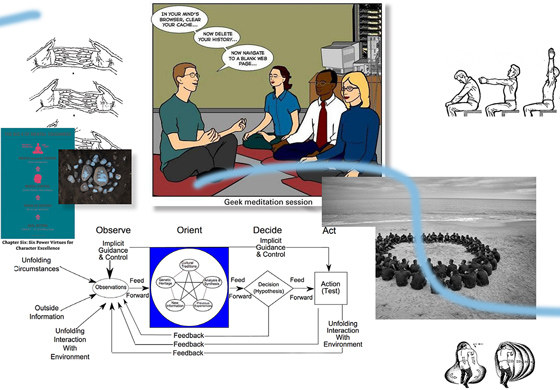 © Kirill Savchenkov Kirill Savchenkov. Horizon Community Workshop
In these two projects, artists analyze everyday office rituals as cults, but it is much more important that they suggest using faith against these cults themselves. The procrastination at image turns into the revolutionary resistance of small affairs trying to undermine the authority of the main, large project. Paying attention to the “office unconscious”, where all mental neuroses were grouped, art offers a mirror alternative to cognitive capitalism, using its principles and foundations. Kirill Savchenkov grabbed the training format from the office industry to find gaps and blind zones in the modern world of total all -seeing. He calls on the participants in his project to practice the yeti and John the Tieator. Image - the wrong side of the manager and Savchenkov - the wrong side of the corporate guru is trying to turn the means of mental capitalism against his own idols in the field of art: against all -consuming energetic, constant mobilization of the mental resource, aggressive creativity, and the violence of sociability.
Download the entire issue of the magazine "Disagreements" (No. 1) "Work, rest, unemployment": pdf , mobi , epube