
Translated material
Very strange "booker"
The new book of Richard Flenagan. And three more post -colonial novels
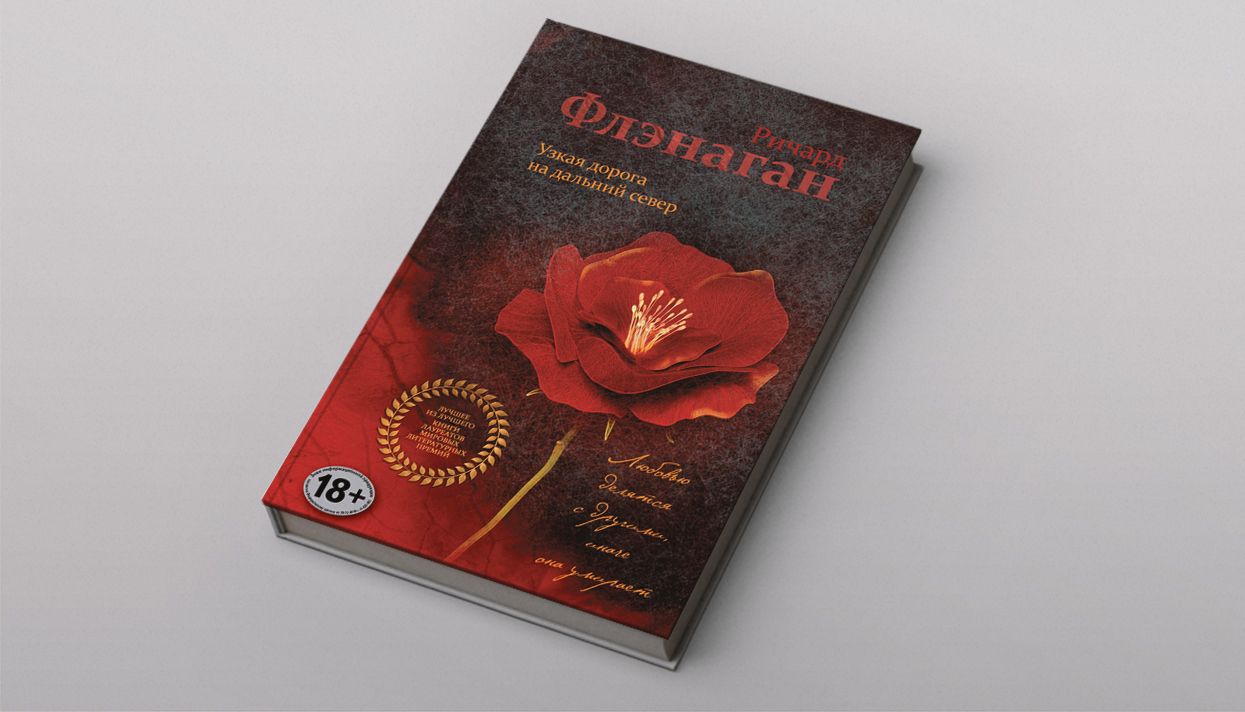
A weekly literary critic Galina Yuzefovich tells at Medusa about the most interesting and important books published in Russia. The current review is dedicated to the book of Richard Flenagan “The narrow road to the Far North”, which received the Buker Prize in 2014, and three more post -colonial novels.
Richard Flenagan. A narrow road to the far north. M.: Exmo, 2016. Translation by V. Misyuchenko
The "narrow road to the far north" of the Australian Richard Flenagan is a very strange book. We are used to the fact that the Buker prize (Flanagan received it for his novel in 2014) sometimes brings us unconditional masterpieces, and in all other cases simply guarantees stable high quality: that is, prose or just good, or - if you are lucky - very good. It is impossible to attribute a hand to the heart, it is impossible to attribute a “narrow road” to any of these categories - perhaps it can be described as a bad (in some places catastrophically bad), but a very important romance with sporadic glimpses of extraordinary talent.
The story that Flenagan tells is infinitely important for the Australian post -colonial identity and is practically not known outside the country. In 1943, a pretty battered 60-thousand Australian expeditionary corps, transferred to Southeast Asia from Syria, is captured by the Japanese. Almost immediately, Australians are sent to the construction of a narrow -blade designed to connect Siam with a burma and thus provide Japan as a bridgehead for a future invasion of India (by that time it is already completely unrealistic and mirage). This road, leading through impassable jungle over the Kwai River, becomes not only a grave for every second Australian who got there, but also the place where hunger, overwhelming labor, beatings and malaria is picked out of the survivors of a certain special brotherhood, united not only by a commonality of fate, but also by a completely new national relationship.
It is in this tropical hell that the protagonist of the novel by Flanagan, the young doctor Dorrigo Evans, is a weak, uncertain and tragically imperfect, but due to circumstances, forced to assume the role of the noble and wise leader of his exhausted countrymen. However, this conflict in the spirit of “how steel was tempered” (amended, of course, for the absence of a revolutionary or any other enthusiasm among the heroes), the content of the novel is not exhausted. The second temporary layer belongs to the last pre -war months, when Dorrigo - a freshly molested groom of a girl from a good family - twists a breathtaking romance with his wife’s wife. And, finally, on the third chronological “floor” of the “road”, the 75-year-old Dorrigo, who, in old age, has become a national hero of Australia, a character of documentary films and a favorite of the press, is trying to comprehend and integrate the experience of his own life.
The narrative jumps between different temporary layers, which is why, after a couple of dozen pages, the reader begins to refuse the vestibular apparatus. With student care, the written out violence scenes (for the Russian reader, a familiar, say, with Varlam Shalamov, unconvincing and some completely children) are replaced by erotic scenes, which were not reasonably claiming for the worst description of sex in literature. The Japanese engineer, responsible for the construction of the road, is predictable as a neurotic, sadist and drug addict; The arrogant scoundrel-colonel, despising the "ignorant Australians", says with an aristocratic-manner of English accent; And the beloved of the protagonist, of course, is a busty blonde with a mole on the upper lip. Stereotypes multiply and reflect in each other, creating the effect of a perfectly streamlined, colorless and airless space without angles inside the novel.
And yet, in spite of everything, in the “narrow road” there is some hidden inner light, which, if not completely compensates for all the shortcomings of the novel, then in any case makes it reading meaningful and even useful. This light is concentrated around a single topic-the experience of experiencing military trauma. Both Dorrigo and his comrades and the disgusting Major Nakamura (the same Sadist-Haro-Haro), for all the formal post-war success, are tragically unable to truly adapt to peaceful life. Inside, each person who has passed the “same road” (it is not so important in what quality), an invisible and incurable ulcer remains: no other experience, no quiet family joys, no sex or professional success is close to the acuteness of emotional intensity to everything they experienced during the war. Inexpressible torment and inexpressible enthusiasm burned in the souls of the dazzling-white strip of alienation-in advance, until the end of their life, devaluing all subsequent joys and sorrows. It is about this secret, rarely discussed side of military trauma, about the spellbound by its own past, about its actual deification, about the underlying and unconscious desire to return to where each of your movements or the word had weight and meaning, and says Flenagan in the first place. And if in order to speak all these important things out loud, he needs endless plot loops, stylistic stamps and post -colonial reflection - well, it is better than at all.
Three more important "Buker" novels on the post -colonial theme

Peter Carey. The true story of the gang of Kelly (Buker Prize 2001)
The perfect western in Australian decorations, stylized for documentary certificate. The main character of the novel Ned Kelly, the Australian Robin Hood, courageously tries to resist the influence of the environment and lead an honest life, but the harsh circumstances and the wrong court forced him to become a robber. After a series of successful robberies of banks, Kelly and his comrades become victims of betrayal - they fall into the hands of the police, and Kelly dies on a scaffold. A powerful multi -layer and polyphonic postmodern statement, and at the same time an indulgent attempt to enter the Australian outback in the world historical and cultural continuum.

Kiran Desai. A inheritance of ruined (Bukerov Prize 2006)
A post -colonial romance from the life of a small town in the mountain state of Darjing. The young beauty of the Sai, brought up in the Catholic Monastery, moves here to his grandfather - the former judge, who was educated in England. Alienation, national and religious enmity (Sai's lover - Nepalez, a participant in anti -Indian resistance) and other problems - from environmental to family, for the most part, inherited from the British colonialists, constitute the main content of the novel. The text is rather a journalistic than artistic, but in this capacity completely outstanding.

Eleanor Katton. Lights (Buker Prize 2013)
An 800-page polyphonic epic from the life of Australian gold miners in the middle of the 19th century. Detective, ethnography, exquisite intellectual game with style, allusion to great Russian literature and astrological charad in the form of a supporting frame - in a word, exemplary, spacious and diverse “Buker” novel, which suggests many options for reading. However, the main pleasure that Eleanor Katton gives to his reader is the pleasure of opening a new world, at the same time surprisingly similar to European and at the same time completely different.
Galina Yuzefovich
Moscow