
Translated material
Google brought a platform to Puerto Rico for launching Internet stratastates
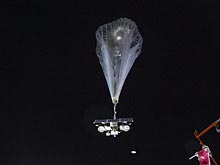
The Google Project Loon team transported and installed in Puerto Rico one of the launchers designed to accelerated the launch of Internet stratum steering. This was reported on the official page of the project on the social network Google+.
The launcher called Chicken Little is a crane with a height of more than 16 meters, which is surrounded by windproof shields from three sides. It takes about 30 minutes to raise, inflate and run into the air for about 30 minutes. The collected installation of Chicken Little has already launched several test balls, reports N+1 .
Similar collapsible installations, representatives of Google notes, allow you to quickly expand the launch point of Internet strata even in hard-to-reach places. Most of the stratostat launch operations are automated, and windproof shields on three sides help reduce the influence of wind on the ball trajectory when starting.
The pilot launch of 30 balls Project Loon took place in 2013 in New Zealand. The purpose of the project is to create a reliable LTE cover in hard -to -reach regions and areas with undeveloped infrastructure. In 2015, representatives of Google agreed with the three largest mobile operators of Indonesia - telecommunication companies will use LOON stratostates to provide the Internet for about 100 million people.
Recall that Google is working on another type of aircraft distributing the Internet - 50 -meter drones. However, with their testing, a hitch occurred after one of the drones last spring collapsed during the flight.
As you know, besides Google, Facebook also works on the problem of Internet access in hard -to -reach areas. In July, the company demonstrated an Aquila drone prototype, with which it plans to provide Internet access through a laser beam. On Facebook, using a neural network according to satellite images, the population density in some countries was estimated and these data is used when launching Aquila.