
Translated material
The regime of the last hope
A truce in Syria, which Vladimir Putin and Barack Obama agreed, is not the first attempt to stop bloodshed. The next chances of success were dismantled by The New Times
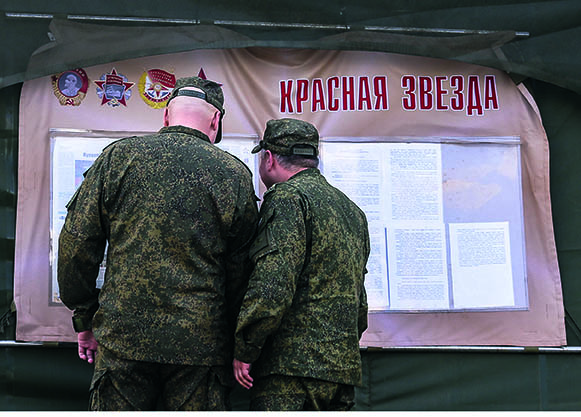
The Russian military at the Khmeimim air base in Syria read the newspaper Red Star, Syria, Latakia, February 24, 2016
For the past few weeks, the situation in Syria has caused a special alarm: the gossip that the civil war in this country is about to splash beyond its geographical borders and cover the entire Middle Eastern region, or maybe even further, overshadowed the reports from the Syrian theater of military operations. The degree of tension grew up and thanks to the ongoing (far, fortunately, political) diving of Russia and Turkey, which, with obvious displeasure, followed the military successes of the Assad army and its allies in battles near Aleppo. And suddenly, at the end of February, it was a world. The leaders of Russia and the United States managed to coordinate the ceasefire from February 27. All participants in the conflict were free to join him or not join him: the deadline for making a voluntary decision became February 26. At the same time, fanatics from the “Islamic state” * and “Jebhat al-Nusra” * were immediately taken out of the brackets-the war will go against them, as before, without the outskirts. Because everyone agreed: this is not an opposition, but terrorists.
The very agreement between Putin and Obama is an unconditional plus, no matter what skeptics say that referring to the fact that all previous attempts to stop fire in Syria failed. But the fact is that now without a truce, it is impossible to continue negotiations on Syria in Geneva. They began on January 29 and almost immediately came to a standstill-the Syrian opposition set a preliminary condition: if we have agreed on something, stop shooting and bombing everything around, including residential quarters and hospitals. Their opponents, headed by Syrian Permanent Representative to the UN Bashar Jaafari, tried to dismiss: they say, our attack on the “terrorists” is not an obstacle for negotiations. It turned out - a hindrance. And Moscow was forced to admit this by persuading the Syrian allies to compromise.
Factor named Rasm An-Nafal
In fact, back in early February it was clear: the diplomats of Russia and the United States are working hard on a new plan for Syria. No, there were no leaks, officials both in Moscow and Washington were typed in his mouth. I had to read between the lines. Here Reuters quotes the representative of the State Department of Mark Toner: "We (USA) would prefer an immediate ceasefire." The conclusion suggests itself: Moscow does not mind, but insists on a certain delay in a truce.
Why a delay - it was possible to understand from the news coming from Syria, where the forces of Bashar al -Assad, with the support of Russian aviation, began the assault on Aleppo. The city was taken to the blockade. In early February, a narrow corridor, according to which a humanitarian (and most likely not only humanitarian) supply of the population and detachments of the opposition was cut from Turkey, was cut. It became obvious: the capture of the city is a matter of the near future. Russia, which agreed with America, naturally, wanted to cease fire, having another strategic settlement who had been repelled with the opposition, where 2.5 million people lived before the war.
The main weakness of the Russian-American plan for Syria is that it is an American-Russian
The United States, apparently, showed a willingness to meet Moscow on the issue of “delay”, but with one condition: the Prosadov forces should stop fire in the near future - no one will wait infinity. Thus, bargaining rested on the question: how much time Russia will require to capture Aleppo. But here the Islamic State intervened in the situation*. An unexpected blow of its formation was captured on February 22 by Rasm An-Nafal, a strategically important settlement near Aleppo, taking control of the heights from which the Hanaser-Aleppo highway was shot-the only way to supply the Assad forces.
As a result, a “symmetrical situation” was created under Aleppo. And the opposition holding the city, and the assadial attacking it lost touch with the rear.
In fact, the attack of the militants “IG” * was more likely psychological significance. Rasm al-Nafal, they held only a day. But Russia and Assad reminded of the main thing: military happiness is changeable and, possibly, it is better to have a tit in hands than a crane in the sky. By chance or not, but on February 22, on the day of the capture of Rasm, An-Nafal, Putin called Obama and finally agreed with him a ceasefire. Moreover, Russia agreed to establish the day of the beginning of the ceasefire on February 27, while only two weeks ago, according to the sources of the Reuters agency, it insisted on another date - March 1.
But in any case, Assad will have to start negotiations with opponents from the worst position - without Aleppo in his pocket.
Loseworms for the war
The task of Russia is to oblige the Assad army and the militia of the Syrian Kurds to cease fire and observe the truce. Both of them, in any case in words, do not mind. For their part, for their part, they must similarly press the Free Syrian Army (SSA) and other groups on the field commanders of the detachments that consider themselves opposition.
The remaining brackets, as already mentioned, “IG” * and “al-Nusra” * have already condemned those who supported Russian-American agreements. In any development of events, they will continue to attack asadites, the Kurds, and observing the truce of the SSA - all who "sold to the crusaders."
Is it possible in practice, that is, in the conditions of a real Syrian war with a difficult line of the front line, to separate the lambs from the goats? If we talk about the “IG” * , most likely yes: the areas that are under their control are isolated, and the caliphate does not share control over them. With the "An-Nusra" * The situation is more complicated. Her militants often act in the same space as the SSA units, and the attacks on the air will inevitably hook them from the air, including those joining a truce. And this means that the continuation of the attacks on the “al-Nusre” * may well put the cross on the whole agreement.
Who controls which territories in Syria (data for February 2016)
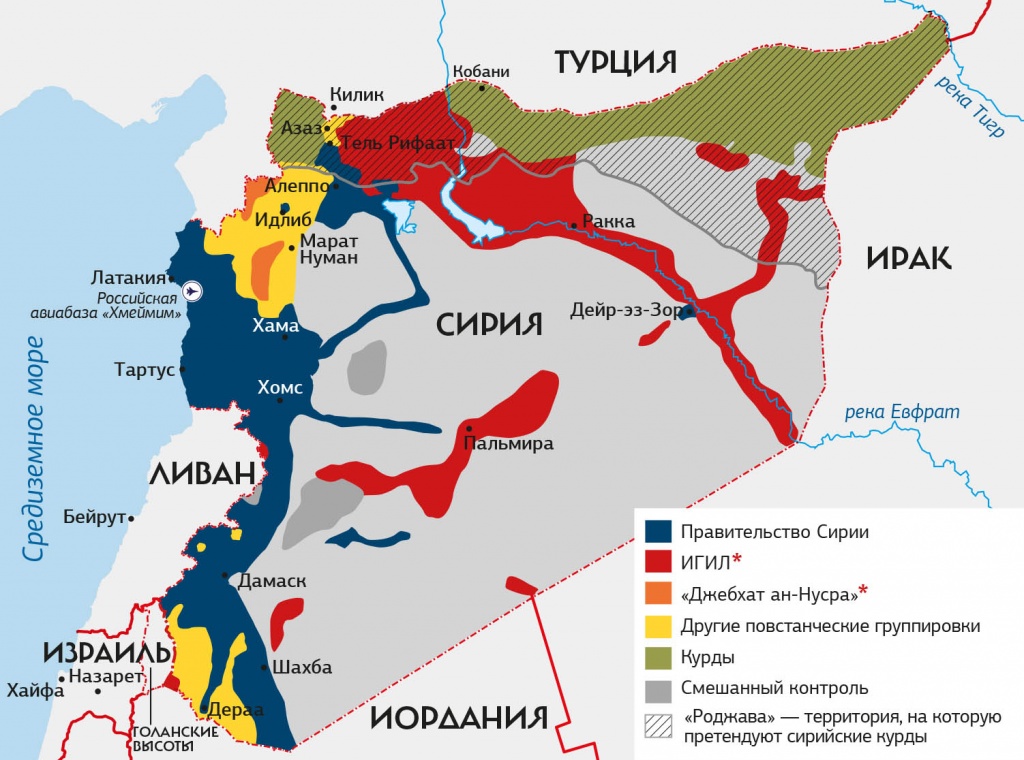

Source: Institute for the Stydy of War, www.economist.com
Moreover, the contracting parties left numerous loopholes to continue the battles, no matter what. For example, according to the conditions of the ceasefire, they reserve the right to a “proportionate answer”. What exactly does this mean is not entirely clear. Most likely, in practice, this may mean the following: ground clashes will continue, but since the opposition has no aviation, the asadites will have to act without Russian support from the air.
By the way, Russia in a paragraph about forces that a truce does not apply to, said not only about the IG * and “al-Nusre” * , but also about “other terrorist groups”. It turns out that Moscow reserved the right to declare any detachment of rebels with terrorists.
It should not be forgotten that, having entered the Syrian war almost five months ago, we initially refused to admit that Assad was opposed by someone besides the “Islamic state” * . When Russia still had to admit this, her position looked like this: "All the same, they are all terrorists." Even in the preparation of Geneva negotiations, Moscow opposed them of such structures as Ahrar Ashham ** and Jaish al-Islam **, saying that he considers them terrorist.
That is, it may well turn out that the ceasefire will not spread to most of the opponents of Assad.
Turkish gambit
The main weakness of the Russian-American plan for Syria is exactly that it is American-Russian. The truce would have more chances to take place if Turkey had also been attracted to negotiations. It is clear that this was hardly possible, given the sharply aggravated relations of Moscow and Ankara. But there is nowhere to get away from the fact that Türkiye is one of the parties to the conflict, moreover, with a point of view, sharply different from both Russian and American.
For the Turks in Syria, the main terrorists are not “IG”* and not “Jebhat al-Nusra”*, but the Kurdish militia, which is under Russian control. The Kurdish Workers Party (KRP) in Turkey, regularly committing terrorist attacks and acting with a separatist program, and Kurdish police in Syria are communicating vessels.
In addition, the Turkish influence on part of the anti -Assad opposition, perhaps, is even more than American. The most famous of the Turkish allies among the Assada opposing Assad is the Syrian Turkmen brigades, the same ones whose fighters shot the Russian pilot after his plane was shot down.
One of the most important tasks of Ankara is to prevent the emergence of the “Kurdish belt” along the entire Turkish-Syrian border. Strictly speaking, the only remaining obstacle to the emergence of such a belt is the pro -Turkish militants, the control area of which extends a strip from the north from the Turkish border south to Aleppo and cuts the “Kurdish belt” into two parts (see map).
Turkish President Recep Tayyip Erdogan has already spoke about Russian-American agreements as “dishonest” and not taking into account the interests of his country. Erdogan could support the ceasefire if the Kurdish groups “Democratic Union” and the detachments of folk self-defense remained outside the agreement, along with the IG * and “An-Nusra” * . But both Russia and America patronize the Kurds. Moreover, Ankara was made to understand that not only Russia will not only be reckoned with its interests in Syria, but also the senior partner in NATO - the United States, and in the event of further intervention in the Syrian Civil War, Turkey will remain one -on -one with Russia.
Whether Türkiye is ready to directly introduce troops into Syria in this situation is a big question, but it can certainly torpedo the Russian-American agreement on the ceasefire.
Between "a" and "b"
The Syrian “peaceful breakthrough”, as they already managed to name an agreement on the ceasefire, and the closest consideration is too many Achilles spots. This is well understood by all the contracting parties, including those who initiated this breakthrough. On February 24, US Secretary of State John Kerry in three days “up to an hour of x” (February 27) spoke about a certain “plan B”, which Washington de has been displayed in case of the failure of the current “Plan A”. At the same time, the Americans expect a catch not only from Erdogan, but also from Putin.
So far, it is only known about the spare version of “B” that it implies the rejection of the integrity of Syria in favor of, most likely, some zones of external occupation.
Perhaps for Turkey such a layout is acceptable, because it will be able to claim control of the Syrian North. For Russia, which was prepared to add another, Middle Eastern, this, of course, was not the pinnacle of dreams - to the peak of Damascus, Latakia and Homs - but nevertheless this is a certain exit from the situation, to its many protectors (South Ossetia, Abkhazia, Donbass).
So far, it is only known about the spare version of “B” that it implies the rejection of the integrity of Syria in favor of, most likely, the zones of the external occupation
The very fact that the presence of a plan “B” is voiced at such a high level means that the old concept of solving the Syrian problem-according to the formula “Give any of the parties to win”-is practically exhausted. It turned out that for external participants it is not so important which of the parties would win. The United States without much resistance abandoned the idea of “Assad must leave first,” and Russia should remain from “Assad”.
But the essence of the Syrian problem was precisely that none of the parties could win a military victory. So the current truce is something like the last chance, which is also very, very small.
* “Islamic State” (ISIS, IG, Daish), “Jebhat al-Nusra”-terrorist organizations prohibited in the Russian Federation.
** “Ahrar al-Sham” and “Jaish al-Islam”-terrorist organizations prohibited in the Russian Federation.
Photo : Valery Sharifulin/TASS