
Translated material
Experts recorded the growth of autocratic trends in Russia
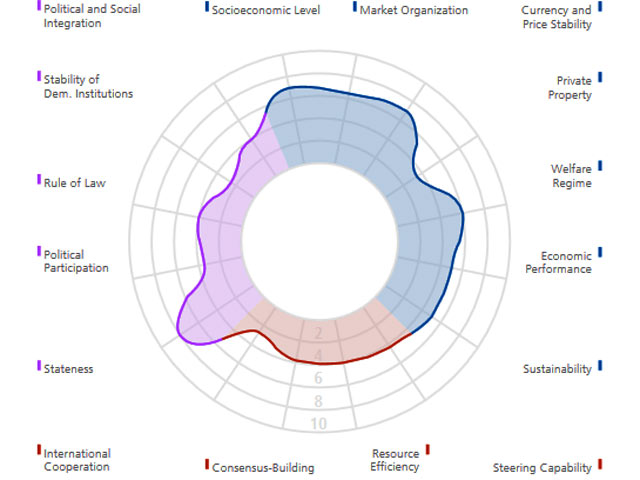
The Bertelsmann Foundation with headquarters in Germany published a rating of transformation of political regimes in 129 countries of the world. The study studies democratic and market-economic trends in developed and transforming states. The experts of the fund concluded that in Russia over the past few years, autocracy has intensified. For four years, the country sank in the ranking of 21 positions.
The Bertelsmann transformation index (BTI), published on February 29, is dedicated to the trends of 2014-2016. In general, experts concluded that political and social contradictions are growing around the world, authoritarian trends intensify, conflicts are aggravated, and the influence of religion on politics is growing, DW reports.
Russia took 81st place in the ranking among 129 countries. Compared to last year, the country sank into four lines. At the same time, in 2012, Russia ranked 60th.
In terms of the BTI study, dedicated to changes in the political regime in the Russian Federation, it is noted that in 2012 Vladimir Putin again took up the presidency of the President against the backdrop of "mass public protests ." After that, the country began economic and "political transformation" with the strengthening of autocracy, "provoked by these protests."
In addition, according to experts, the change of power in Ukraine, which began with protests on the Maidan in Kyiv in 2013, the Kremlin “regarded the Western conspiracy against Russian interests”, responding to it annexation of Crimea and supporting separatists in the Donbass. Moscow justified these actions under the slogan of the defense of the "Russian world." Since the beginning of the conflict in the east of Ukraine, the relations of Russia and the West have "deteriorated sharply" to a level comparable to the Cold War, BTI notes.
According to experts, domestic policy in Russia is based on authoritarian methods, including pressure on private business, non -state media and non -governmental organizations. Trying to consolidate power and strengthen control over the elites, Putin became "more like a king than the president, effectively helping the creation of an authoritarian and bureaucratic nomenclature system" in Russia, the study notes.
They compiled the index listed the main features of the current political regime in Russia: the dependence of individuals on their official position and the support of their immediate supervisor; hasty, hierarchical decision -making processes; the dominance of vertical connections over horizontal, which, in particular, is caused by frequent bureaucratic rotation at the regional level; the predominance of temporary, not constant forms of ownership, which is supported by the patronage system; wider moral and legal norms for those in power than for ordinary citizens; Strengthening the role of security forces against the background of a decrease in the significance of the judicial system.
It is worth noting that most Russians a couple of years after large-scale protests of 2011-2012 were not seen in Putin an authoritarian leader. As the Levada Center survey showed in 2014, the level of trust in the president increased, and most of the respondents said that the President’s personality cult in Russia was not.
In addition, experts are not waiting for a new wave of protests in Russia against the backdrop of the economic crisis and the upcoming parliamentary elections in 2016. Economists believe that Russians will respond to disasters within the country by apathy, not a revolution . According to experts, the probability of a political uprising decreased compared to 2011 because of a worsening relationship between the Russian Federation and several neighboring countries, which can force Russians to rally and support their government.
The transformation index of political regimes was prepared by the German Bertelsmann Foundation (Bertelsmann Stiftung). The study is based on a survey of 250 international experts.