
Translated material
In defense of books. Anyone
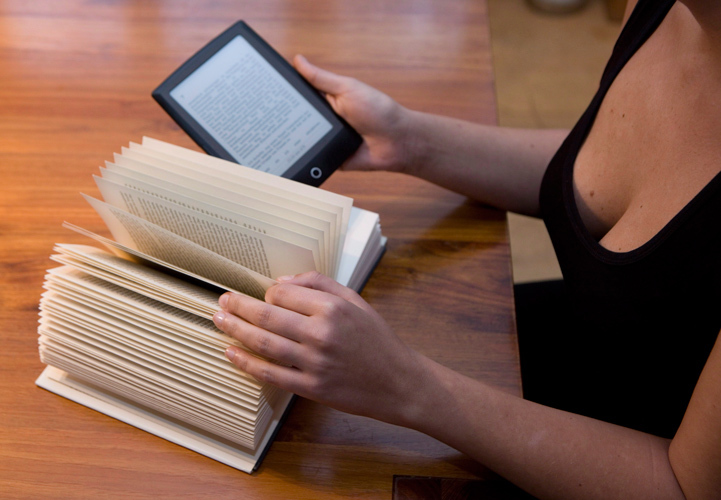
In recent months, they started talking about the revival of the Paper Book. In the English -language world, the unexpected successes of large book -trade networks like WaterStones are discussing, which have recently been on the verge of ruin, and now not only make ends meet, but even have a small profit. In the fall of 2015, a message appeared that WaterStones removes electronic readers from some strategically important windows and puts Hard Copies instead; A number of experts, Vosmelev, announced the inevitable death of electronic books. Surely the situation is much more complicated, although at the moment the trend seems to be exactly that. In this media hype I was interested in only one detail, which, it seems, no one noticed. Not even a detail, but intonation. Gloat. As if the audience - including those who look at the matte screens of the Kindlov or gleaming quadrangles of iPads - only waiting for the moment when it will be possible to throw their favorite device away and enjoy reveal the good old paper book. So I thought: what prevents all him/we do it right now, without waiting for a change in the global trend?
No, no, I have no desire to read morality and blame the audience of hypocrisy. Let the publicists do this. I am interested in something else - the origin of this gloating, which is actually completely unresolved, spontaneous. And this means that the internal conflict with the electronic book is deep and even partially recessed in the collective subconscious. Moreover, it seems to me that from the very beginning the fact of using electronic readers caused a considerable part of the public something like remorse, suppressed, replaced by the voice of common sense, economic and environmental expediency - but nevertheless, these remorse were! And now they suddenly went outside, turning around gloating. Like, we know these electronic books - they are also fake .
Naturally, the issue of Paper Renaissance is actively discussed, especially the left intellectual press. The British “Gardian” published the essay of Robert McCrum , who is trying to link the return of hard copies with a new flourishing-it would seem, already many times buried-“serious novel” and even with the onset of the era of modernism version 3.0. “A hundred years ago, a literary environment broken into mysteriously parallel elements (the decline of the Victorian novel, a telegraph and telephone revolution, the rapid development of the press, especially the magazine) inspired a new type of consciousness and, in the end, a new approach to imagination. This phenomenon will then become known as “modernism”, the literary dividends of which will be “Ulysses”, “Fire Earth”, “Mrs. Dalloway” and a whole library composed of the works of literary inventors from Faulkner to Beckett. ” The reasoning is awkward, I would say, logically untidy. How the telegraph with the phone could lead to the decline of the Victorian novel and influence Joyce’s transition from the aesthetics of Dublin to the aesthetics of Ulysses - it is impossible to say. It is possible to trace the subtle lines of dependencies, talk about the change in the CETGIST, or even try to explain in Marxistly explain all the above by the transition from classical capitalism from the times of “free trade” to the state-monopoly stage. But to do this carefully, trying to really find out what you want to say, and in no case up to mix the appearance of the conveyor with the invention of the literary “stream of consciousness”. By the way, the journalistic omnivorous of the Columnist, who was forced to feed on a weekly lifting - she is also part of the current “literary environment”, which, according to Robert Maccrama, gives rise to modernism 3.0 before our eyes. And the peculiarity of this environment - in contrast to what happened a hundred years ago - in universal connectedness, in the fact that one can easily, using purely technical, external methods, go to another. And so to infinity. I also note the sacred faith of McCham in historical analogies. If at the beginning of the last century, some technical and sociocultural changes should give rise to modernism 1.0, today more revolutionary changes will certainly make modernism 3.0. So, everything is interconnected and everything resembles everything. This is the current environment - and it will certainly return the demand for paper books. But how else? At the end of the slurred Maccrama essay, you can read a funny addition from the editorial office. It says that after the first electronic publication, changes were made, as the author called the sensed in 2015 Marlon James not “A Brief History of Seven Killings” , but “A Short History of Seven Killings” . In the paper version of "Gardian", the error, of course, has been preserved. On paper, history cannot be corrected.
And a couple of weeks before this article, I read a collection of small essays Italian Roberto Kalasso. Kalasso is one of the most really interesting writers of today's world; His books about Kafka, Baudelaire and French painting, his unusual, complex, built with Hindu philosophy Apology of Talleyrand and some other works adorn my modest (paper) library. It’s really difficult to read Kalasso - because it is better to do it from the paper page, and not from the screen, since there is always a danger of falling asleep, and Pocketbook , falling out of weakened hands, is not so painful as an iPad. The last book of the 74-year-old Kalasso is not like the previous ones. This is a collection of random texts of different times devoted to book publishing and editorial business: Roberto Kalasso has been working in the famous Adelphi Edizioni from its very founding in 1962, starting to work as an editor, and now he is the chairman of the company's board. The book is called “The Art of the Publisher” , I read it, of course, in the English translation of Richard Dixon, since I don’t know Italian. The book was published by the British Penguin Books impeccably-a pocket edition in a soft yellowish-white cover, on which the name and name are squeezed red. Perfect handwriting in the spill; It looks like divine prescriptions.
So, the two most interesting essays in this book are Singular Books and A Letter to a Stranger . There, Kalasso tells how Adelphi Edizioni was created, describes the publishing-and generally cultural and political-the environment in the Italy of the Border of the 1950-1960s, explains how slowly, the main principle was found-the principle of separately published book, Singularity . No matter what series of the book is united, no matter what departments they put them in bookstores, each should be self -sufficient, separate, phenomenon, enclosed in - it does not matter, hard or soft - cover with the branded logo logo. Each volume - whether it is the novel of the beloved Kalasso Joseph Rot or the ancient Tibetan biography of Milarepa - not only has a book in its own (and only its own!) Rod : it has its own history. The history of writing, the story of reading and - we add from ourselves - the story of life after it has left the printing house or book shop. Developing the thought of Kalasso: the “singularity” of the book is not even so much a consequence of its some “artistic” or “cultural” “quality” (or even “meanings”); No, it is separate, if it has its own history - and this story is associated with other stories and the general history. It is important that such a connection is unique and proceed from special to general, and not vice versa. Having briefly telling the story of Adelphi , Kalasso moves to a polemic with Kevin Kelly , the founder of the famous Wired magazine, one of the main gurus of our Google Epo -Epo. Kelly is an endless electronic optimist, he dreams of times when all books in the world will be digitized and laid out - for free! - To the network. Then, with the help of countless hyperlinks, all books in the world will be interconnected. Not even connected, but simply will flow smoothly one into the other - in the middle, at the beginning, at the end, regardless of their real content, obeying only the whimsical will of the electronic editor and the electronic reader. That is, it will be one book. Kalasso cannot imagine anything worse.
It would seem that you only need to rejoice. All knowledge of the world - here it is, in front of you, on the screen, at a distance of one click by the mouse, one touch to the screen of the smartphone. Utopia has been realized - well, or realized, not today, so the day after tomorrow. All at once and in one package. Alas, in fact, all this is completely not necessary. For it is not interesting.
Of course, I will not protect the idiotic legislation on copywriting, because, for example, until recently, the Ulysses specialist did not have the right to quote the passage from the novel under study in his study, until the academic publisher pays a decent amount to Joyce’s heirs (by the way, there were no children crazy for the childless daughter). Knowledge should be available - like education. But it should be available only to those who know what exactly he wants and why , and, accordingly, understands the value of the desired. And value grows from history, from the intersection of various contexts. If you, in the lazy search for reading, come across a network on the “Radetsky” company, run through your eyes a couple of electronic pages, and then along the hyperlink you follow the word “plum” to the Vinokurov website, after which, seduced by the Bohemian forest photos there, wander around Google Map , then trying to understand the origin of the Bohemia word, spend a couple of minutes in a couple of minutes Wiki and complete Surfing by listening to the “Bohemian Rhapsody” group Queen on YouTube , you will not get any knowledge. On the contrary, it is pointless to spend time and energy, you commit an obvious crime in front of yourself and humanity. The most terrible thing is that you make up what you can hardly touch on your online skill. “Radetsky march” stalls, your plum is tasteless, Bohemian forests are clogged with garbage, and Freddie Mercury generally looks like Philip Kirkorov. Everything is spoiled forever - at least for you.
And all because the above loses its separateness, it is now connected horizontally - on a flat screen, and not vertically - with the help of history. The meaning is a hierarchical thing and has a period of its own hidden development before it appears to the city and the world. And the book too. Any book exists at the intersection of several stories - the history of the author, the history of the author’s intention, the history of spelling, the history of (not) the publication, the history of the reader's reception, the commercial history of sales, the countless personal stories of individual specimens, their vicissitudes, the vicissitudes of the lives of their owners, and so on to infinity. The e -book is devoid of all this, of course. Hence the uncertain gloating shown by the public, who learned about the impending return of the paper book. Gloating, since we (I mean Europeans, and not the sprayed neo-nosiks from the former riot police) still want to live in history-and be able to individually perceive meanings. Let not all meanings, but at least something. As for some bashfulness in the manifestation of gloating, this is also understandable, because in European, Western culture they are accustomed: knowledge is strength and good, accordingly, it is not good to impede its spread. Plus, of course, considerations are both household and socially useful. In our modest dwellings there is little space for books. There are too few forests in our small world. So it is better to look at the screen of a plastic thing, in the flat case of which the wisdom of all centuries is mysteriously stored.
Modernism 3.0, of course, will not be, since nothing is repeated in general. Thinking by historical analogy - very bad thinking, warned Mamardashvili: in it everything that is compared loses its own significance. In a sense, this, perhaps, is even good from a purely Buddhist point of view-to see the void and non-existence of individual dharma. But for this, one must be able to see exactly - and what, if not individual books and a serious concentration on their separately, will teach this? And here we turn around and take a battered volume from the shelf. Akhtung! This does not mean that we simultaneously turn off the laptop. We are just at the intersection of vertical meaning and horizontal information. No remorse.