
Translated material
Learning to fly
Scientists seem to be able to "load" knowledge into the brain - almost like in the "matrix"
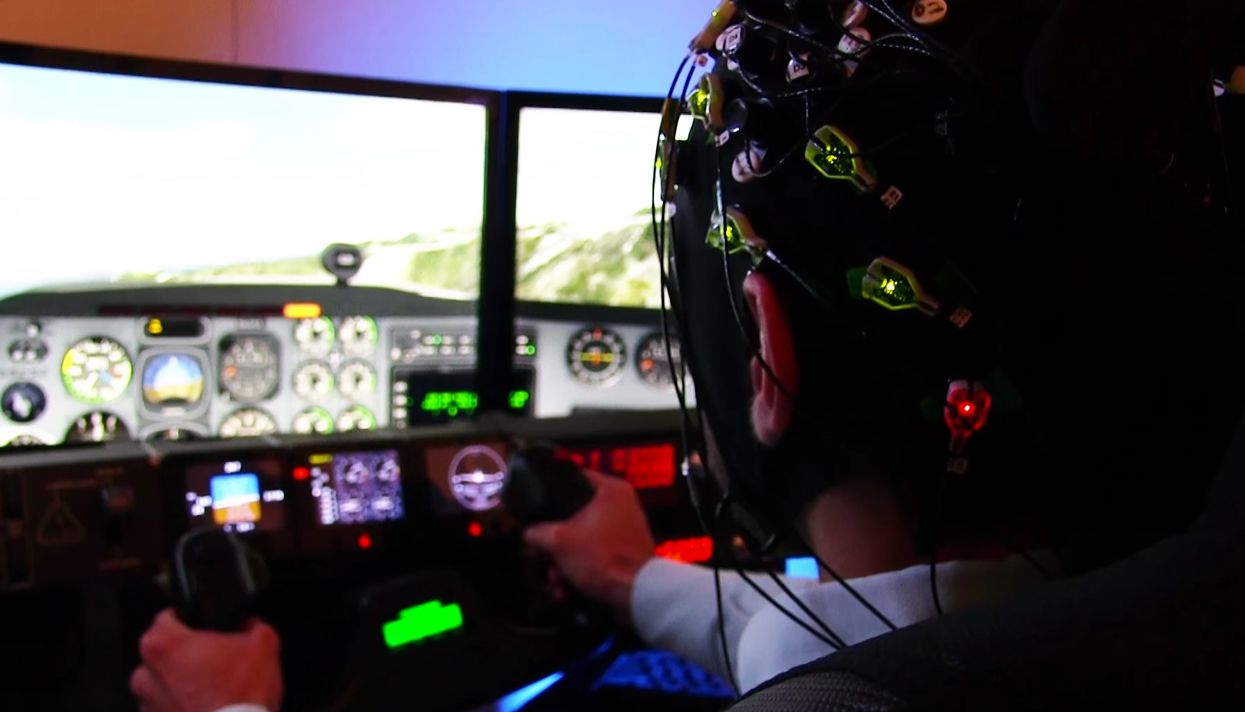
The American research center HRL Laboratories spoke about a successful experiment to “load” knowledge into the brain of people - as in the “ matrix ”, when ne in a few seconds taught all types of martial arts. In life, everything does not work so impressive, but in the future this technology can become the basis for accelerated learning programs. Medusa talks about an experiment on people who were taught to fly by plane.
HRL Laboratories is a research center located in Malibu, California. More than 50 years ago, HRL built the world's first working laser. Later, scientists from the center worked on the atomic clock and the ion engine, and in 2011 they released the lightest metal in the world .
HRL Laboratories spoke about his new achievement on February 10, but at first it remained almost unnoticed. At the end of the month, large media outlets paid attention - The Daily Telegraph and Techcrunch.
Scientists conducted their research on a specific task - teaching aircraft management. First, they considered data on the brain activity of six professional pilots while they “flew” on a realistic aircraft system.
Then, on the subjects who do not know how to control airplanes, put on hats with electrodes. Through them, they stimulated the brain of each participant in the experiment, trying to ensure that he worked in the same way as in a professional pilot.
After that, the subjects learned to plant a plane on the simulator. For control, the second group of participants was used, who also thought that their brain stimulates, but in reality this did not happen.
The study showed that people whose brain gave a “professional” signal learned to plant a plane 33% better than those whose brain did not stimulate.
Matthew Philips, the leader of the group who conducted this study, believes that in the future, brain stimulation will allow to disseminate the practice of accelerated learning. According to him, this technique can be used for classes in foreign languages, preparation for exams and driving training.
Philips claims that their system is one of the first. At the same time, the scientist notes, the method of stimulating the brain with electric signals has been used for a long time - four thousand years ago, the ancient Egyptians fought pain , applying to the head of electric fish. However, scientific research in this area began only in the 2000s.
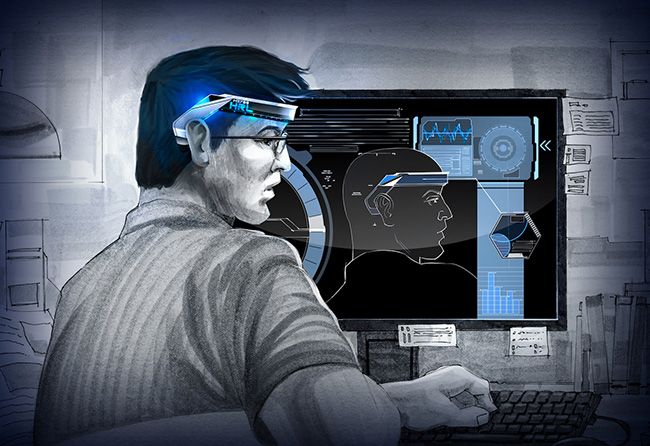
“When you study something, your brain is physically changing. During the process called neuroplasticity, connections are created and strengthened, ”explains Philips. “Our system purposefully changes certain parts of the brain in the process of your training.”
You can’t just “load” knowledge into the brain - you still have to study. But the technique proposed by HRL Laboratories will significantly simplify this process. True, it is still far from its real application: scientists note that for this it is necessary to measure and record all the changes that occur in the human brain during the acquisition of a particular skill, as well as find out which areas of the brain, as well as for what time it is necessary to stimulate in order to achieve the maximum effect.