
Translated material
Sparta against Athens
How geography defines the foreign policy strategy of Russia: Forbes
To understand the foreign policy strategy of Russia, just look at its map. In an article for American Forbes, political scientist George Friedman, the founder of the private intelligence and analytical organization Stratfor, shows how the geography of Russia allows us to judge its political, military and economic structure. As Friedman explains, geography for centuries forced Moscow to choose a very specific strategy - which was reduced to the creation of zones of influence in Eastern Europe.
George Friedman gives ten cards representing the modern and historical boundaries of Russia and the USSR; population density; Geography of railways and agricultural development. Based on these cards, he makes several observations.
Friedman notes that Russia is actually an intra -material country: its exits to the seas are either limited by climatic conditions, or can easily be controlled by other countries - Turkey, Denmark, and UK. This imposes significant restrictions on participating in international trade and the creation of a strong army (modern ground operations, along with air support, should also be supported from the sea). The geography of Russia, on the one hand, makes it difficult to communicate on its territory (a large length, a relatively small number of shipping rivers), on the other hand, makes it vulnerable to attack from the west (long land border and plain relief).
Cards cited by Friedman also allow you to see the importance of its Western and southwestern borders for Russia: it is in these areas that the bulk of the country's population is concentrated; Here are also suitable for cultivation of land. Transport infrastructure is also concentrated in the west of Russia: with the Far East, the European part is associated with only two railway branches, and most of Siberia is almost completely devoid of railway communication with the center.
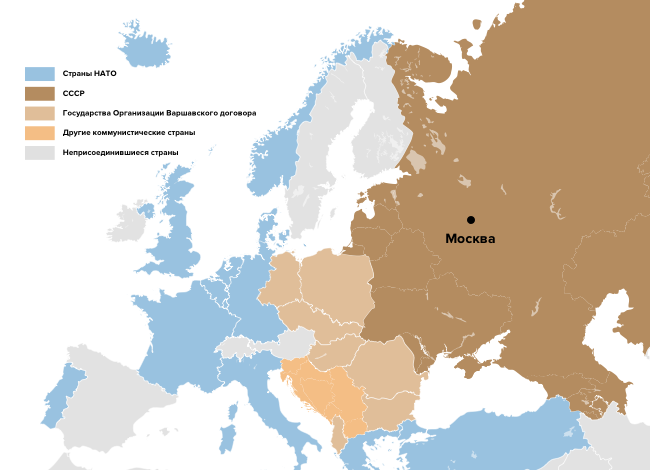
These factors are due to the foreign policy strategy of Russia: the protection of the Western and southwestern territories is vital for it. Over the centuries, Russia's strategy was reduced to holding the Caucasus and creating the most deep buffer zone on the western border. In a different period, adjacent states were included in this zone - the Baltic countries, Ukraine, Belarus, Poland and others. It was the presence of a buffer zone, writes Friedman, that allowed Russia to stop the invasion of Germany twice during the 20th century.
After the collapse of the Soviet Union, Russia lost its buffer zone, which made it less vulnerable to attack from the West. Now the border of Russia has been taking place as close to Moscow as it has never passed since the 18th century. Therefore, after 1991, Russia focused on maintaining influence in Georgia, Armenia and especially in Ukraine.
Friedman describes the modern confrontation between Russia and Western Europe with the help of rivalry between ancient Greek Athens and Sparta described by Fukidide. Athens is a rich trading city with access to the sea, but wealth is associated with corruption and a certain moral “flexibility”. Sparta was a much less rich policy, and her wealth was not acquired by trade, but with hard work. According to George Friedman, Russia is more like Sparta. She will never catch up with Europe in terms of living standards (for objective reasons), and for survival she needs fundamentally different things: first of all, a strong army and stable production. If European countries unite wealth, then Russia is the ideal of a strong country for which its population is ready to overcome economic difficulties.
“Russia is constantly in a vulnerable position. That is why the Russians will never let Ukraine go. Therefore, Russia cannot afford to believe that the West in this region is guided by exceptionally good intentions. On the other hand, the West cannot be sure that, having restored influence in Ukraine, Russia will not move on. As a result, both sides think the worst about each other ”(English.).