
Translated material
"Then, however, there was no sticks for a selfie"
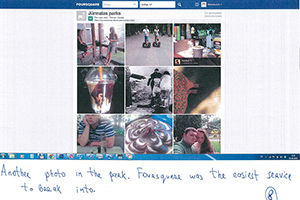
Once you can do it: go to Foursquare , to dial, for example, “Liepayah, Beach”, to begin to lamenting the celluloid pictures lazily, hidden like one pattern of vulgar carelessness and tinsel, and suddenly, neatly between the pellets of the unknown young lady and a lonely cyclist, to stumble upon a completely different Black and white reality. Six photographs of fear, horror and human shame do not fit in any way with the coast of the Baltic Sea, or with the beach, or with the tanned bodies of swimwear. In the first picture there are four women in the same way, one is trying to screw the curl on the finger, or just lay the hair better, posing on the photographer. Behind women are the military in long overcoats and caps and someone's lying clothes. On the other-several children in white angelic shirts, someone drives them along the seashore, but who exactly drives is unclear. In the third photo, a bunch of people stands, compressing, on the edge of the moat, and something is whitening in the moat, and so I don’t want to believe in a terrible hunch, but the last picture leaves no doubt: the same moat is on it, only the bottom is covered with the dead, and a man with a hook goes along the moat to pull the bodies that fallen into a common pile.
These are pictures of people from a Jewish ghetto, shot on the same beach many years ago.
About how these photos got into the glamorous tourist search engine, Victoria Ivleva talked with the Belarusian photographer Alexander Mikhalkovich, the author of the project “Make the Internet Remember the Holocaust”.
- Sasha, where did this project begin and why exactly Latvia?
- One of the shocks was my own gaps in education: well, for example, ignorance that Latvia was occupied in 1940 by the Soviet Union.
- And what, did you think with her?
- And I did not think anything about it at all.
- Isn't the history of war taught in Belarus?
- Of course, taught. But in the head of the student, she, as it were, breaks up into two different wars-ours from 1941 to 1945 and some second world there.
“But you were told about Molotov -Ribbentrop Pact?”
- They told, but in such a deft form that it was especially not clear what happened. Well, the troops came in - and went in. This is also the influence of our patriarchal education system, when the teacher and his opinion dominate.
- That is, when they seem to be formed, but do not teach to think?
- That's right. Later, when I took up a photograph, an interest in history arose from the photo, and I began to read, and everything began to fall into place ...
Namely, Latvia arose from the beautiful summer ISSP photo school in Pelchi's village. I was there a participant in a 10-day seminar, which was called "photographing the past." Simon Norfolk, a well -known photographer and our teacher, forced to prepare for classes two months before they began, the topic was the Second World War. And I began to fill in the very educational gaps that we talked about. Questions began to arise that, I couldn’t face it, would hardly have arisen at all.
- Related to the war?
- No, rather, with the mass psychology of collective madness and collective subordination. For the first time I clearly felt it when I got into the army: we were 60 people and 4 sergeants-and sergeants cannot control the situation for the first or second day, on the third in general, one of the recruits escaped, and for the fourth suddenly all subordinate and accepted these new rules of the game. Everyone became slaves. There was no resistance. This is my Army story contacted in my head with different stories of the Second World War - the main example of the collective insanity of the 20th century - and, of course, with the destruction of Jews. I learned the striking story of the Slonim Ghetto in Belarus: when they began to destroy it, eight thousand Jews were shot, and about a thousand fled to the forest, and the Nazis announced that the action had ended and could be returned, and they believed, returned. They were shot too.
- And in the Slonim ghetto, probably there were people from Latvia?
- Yes, I found out about this ghetto when, as part of a summer school with Norfolk, I began to study where the Latvian Jews ran: it turned out, including to the territory of Belarus. And there they often fell into a situation when they did not accept them in local partisan detachments and they organized their own.
- Why didn't they accept them?
-Because they were not local, and, I think, there was some kind of household anti-Semitism. There are terrible evidence: if five Belarusians and one Jew went on a task, then the Jew often did not return - they were destroyed and destroyed. Of course, this was not always, but it was. The Jews found themselves in the ring of double anti -Semitism, such a Holocaust in a square.
-And then you stumbled upon the pictures of the executions of the Jews from the ghetto in December 1941 on the beach in Liepae, made by a German named Karl-Emil Shortt?
-Yes, and these were the most terrible evidence of the everyday life of the insanity that I met, because Shrot clearly possessed some photographic abilities. He was the commander of the Liepaisian execution team, the Germans at that time only began to gain momentum. There was even such shot tourism, when the Germans from among the commanders went from place to place with cameras, tried to capture as many of these evidence as possible and then, maybe they sold photos, shared them, sent them as postcards.
-Almost like now, when on the Internet they fall out of themselves against the background of something ...
-Well, then, however, there were no sticks for a selfie ... All other evidence of the Holocaust that I saw were somehow far for me, as if I were looking at the photo of the museum of wax figures. I did not have any internal connection with them, there was no horror from them. It was precisely the Shortt series worked for me, when I sequentially laid out all the pictures when I connected every photo with the descriptions that left the witnesses of these executions, saying that the Jews from Liepaia (there was a female ghetto) were brought to the beach with groups of 50 people, they forced to go to the ground, then 10 people were ordered to undress to the underwear or completely, only Human Germans allowed the children to die in their clothes, then led to the moat ... And to all this there are neat explanatory signatures, capsins. This has become alive, nightmare and very representable for me. The moat was 100 meters long, in my opinion, six meters and at a distance of about 10 meters from the sea, from the coastline.
There is such a frame where they are striking - not yet near the moat. They were forced to just get up to photograph. And there the girl in one of the photographs as if she straightens her hair, poses. Why does she suddenly do it? Doesn't he understand that she has a second to live, or is it a complete paralysis of the will? There will be no answer.
According to eyewitnesses, Karl Emil had a whip, with which he drove those who did not want to go to the place of execution. For each person there were two members of the shooting team, that is, two aimed at one. And it was considered special skill that if people fell immediately in the moat and did not need to be discarded. There was a special person who then pulled off, pulled off, rolled people into a moat. In this series there is some kind of emotional linearity, you see everything and feel everything as if you are standing there yourself, as if it were happening today, now. I began to consider every photograph, peer into every person, think what role he played there and how this collective subordination became possible.
- Yes, but how can this be conveyed by modern photographs? It is impossible.
- The same question was asked by Simon. And I knew that I did not want, and I could not make a classic photo report or portraits of eyewitnesses. We went at night to shoot at the places of executions of Jews. Simon, like a landscape photographer, had a great influence on the entire group, and everyone photographed landscapes. There were no bird singing in these places. There was an absolute, all -consuming silence. We came there in three or four in the morning and left for seven to eight hours. And neither forest nor nature woke up with the arrival of the sun. There was silence, just the silence that we invaded, our wild group with photographs and flashes. And I remember one moment: fog, I try to plunge into this fog just at the place where people were shot, and he leaves me, runs away. I return, and the fog is returning. It's hard to convey. At that moment, in that situation, these outbreaks of cameras, this silence charged with some very strange energy of the past. And here everything turned out: I realized that I just had to somehow invade the photos of Shortt into today's carefree, doll life of the beach and seaside.
- Was it technically difficult?
- Not very simple. I had to deceive Google Earth , and I failed, I will say right away. Succeeded with Foursquare .
- What exactly did you do?
-To begin with, I suggested that the Google Image service compares whether there is the same photo somewhere on the Internet. I began to make minor visual changes in the photograph, for example, changing their heads or moving a person. And for Google Image, the pictures have become unrecognizable.
- Why didn't they get to Google Earth ?
- They stayed for several days in the status of not yet Reviewed for Google Earth - “not yet selected for Google”, and then the manual moderator sent me a notification that these pictures were not suitable; Apparently, he considered that this should not be on the Liepais beach. And I turned to Foursquare , because it was on it that the most photos from this location were uploaded to it. In addition, I changed the geodata of each photo using the FAKE program Location .
- And so that the moderators believe that you are in Liepae?
- Well, yes. Rather, I didn’t change, but entered, because the photographs did not have such data, and I was afraid that if it was not clear where it was removed, then the card could be rejected.
- That is, you tried to portray that everything is shot now and you are uploading fresh pictures to the service. This is like such an attempt to deceive the robot, and it was a success.
- With Google Image - no, with Foursquare - yes. In addition, I found pictures from the ghetto to Daugavpils and Salaspils and loaded them to Foursquare in places in these cities, where people took pictures of themselves most.
-And something has changed in you after this work?
- Probably, I began to better understand how people massively lost their will, how they stopped resisting and simply accepted what was happening to them. I stopped considering that this is impossible.
“Have you achieved what you wanted, this project?”
- Well, yes. One way or another, I made the Internet remember the Holocaust. I wanted to make a photographic intervention in the modern media space so that photographs from the past earned in the current visual-informational field, I wanted to draw attention to the topic of the Holocaust. Well, also - to raise the question of the genocide of a separate nation in the information field of the post -Soviet countries.
The project of Alexander Mikhalkovich “Make the Internet Remember the Holocaust” was exhibited in the classic photo gallery until March 20.