
Translated material
How interplanetary Internet will be arranged
Can I watch the series on Mars? Popular Mechanics answers

Someday, people will go to Mars. And these will be ordinary people who watch the series and want to communicate with their loved ones in the video. Now this is impossible, since the data transfer speed is too small. To improve the situation, a protocol has been created, which is theoretically-someday will allow you to watch Netflix on Mars. The publication Popular Mechanics talks about the prospects and problems of the interplanetary Internet.
Now the connection with devices in distant space (more than two million kilometers from the ground) is carried out using giant antennas on Earth. NASA communications centers are located at three points: in Kanberra, in Madrid and in the California desert.
Space devices interact with the centers on Earth directly. Rovers usually transmit data first to the space apparatus in the orbit of the space object, and it delivers data packages to Earth. Again directly. When there were few probes and rovers in space, the connection was easy to keep. Now that there are about a hundred of them, it has become more difficult: you have to come up with a schedule of communication sessions.
In order to solve this problem, a new protocol was invented for data exchange: with its help, spacecraft did not have to transmit information directly to the Earth, you can first send it to another of the nearest probe, and he will save it and transmit it further. One of the creators of the protocol was Pienton Serf, who is often called the “Father of the Internet,” since he developed the glass of TCP/IP protocols - they rest on the whole modern web. Now the surf is working as a Google vice president.

He reasoned that the same approach as in TCP/IP was not suitable for space. For the ground Internet, the lack of communication is more likely an exception than the rule. In space, the opposite is true: there are giant distances, and often there may not be a connection between the two devices. In the ground Internet, a data package in the absence of a connection is simply lost; For space, this is unacceptable.
The new protocol is called Bundle Protocol. Suppose data must be transferred from Pluto to Earth. To do this, it is not necessary to contact the ground directly, you can first transfer them to the probe flying around Mars, then to the probe in the orbit of the moon and then to the ground. Moreover, if the data is transferred to the Martian probe, and at this time there will be no connection with the lunar apparatus, they will not be lost, but will be preserved. As soon as the connection is getting better, the information will go away. Thus, theoretically, the entire solar system can be covered with a fairly fast Internet. Now the signal to the apparatus near Pluto goes about four and a half hours, to Mars - from three to 20 minutes.
To begin with, it would be possible to fill the software for communication via Bundle Protocol into already neglected spacecraft. But even better, in addition, launch special devices that will be needed only to transmit data using this technology. So the “spine” of the interplanetary Internet will be created - in the earth's Internet, this role is played by fiber -optic cables, which pass along the bottom of the ocean and on land. The “spine” devices could be connected not by the radio signal, but to transmit information using lasers at higher speed.
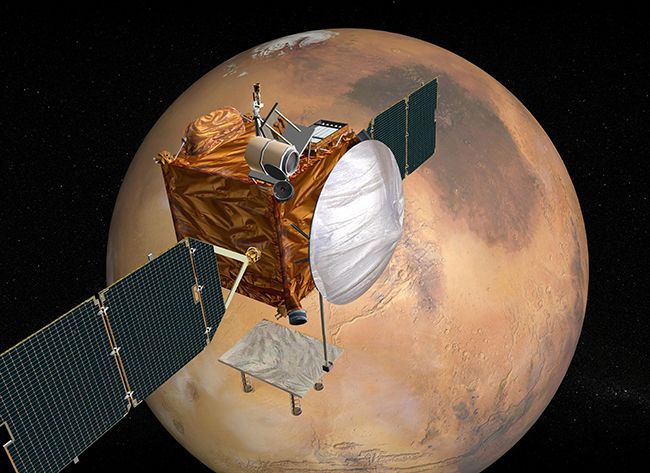
NASA planned to launch one such probe - the Martian telecommunications orbital apparatus - just to start building an interplanetary Internet, but the mission was canceled. The main problem is the lack of funding. In NASA, they are afraid to spend money on promising, but irreparable technologies.
True, in fact, the technology has already been used. In 2008, NASA transmitted data through the DEEP IMPACT device back to the ground, where there were transmitters pretending to be Marseine roves and probes. Bundle Protocol technology was also tested for the connection of the International Space Station with Earth. Astronauts with the ISS controlled the roves on the ground - and both toy, made from Lego, and the present.
Ultimately, interplanetary Internet will be needed. Scientists urge it to build it as soon as possible, since this can greatly simplify the study of the cosmos: researchers will no longer need to think about how to tie the spacecraft directly with the ground. Well, then, the first Martian visitors will probably want to download the fresh series of their favorite series. (English Yaz.)