
Translated material
Falf - do not get tired
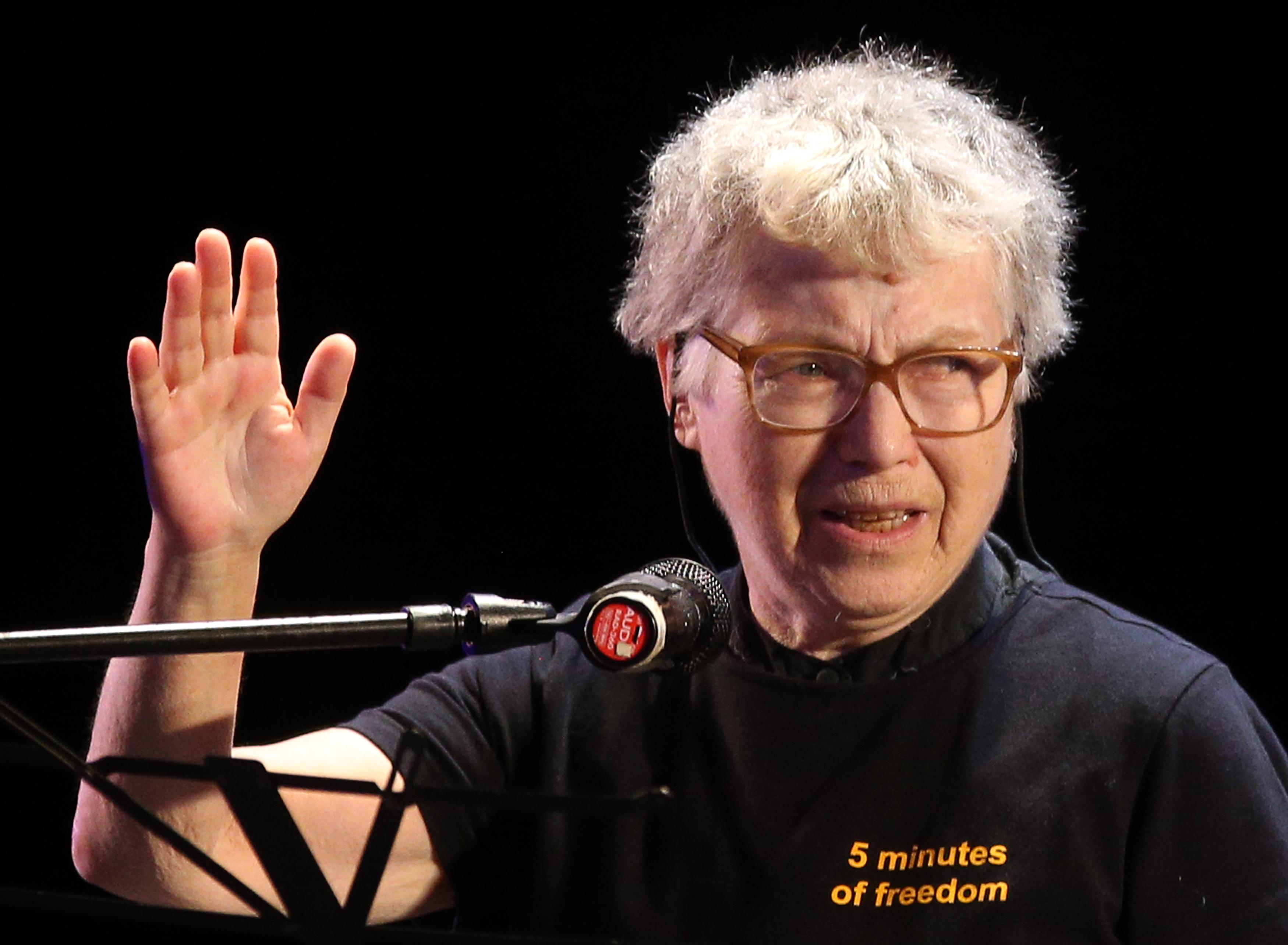
Poetry of Natalia Gorbanevskaya
Natalia Gorbanevskaya. Selected poems of 1962–2012. - St. Petersburg: Publishing House of Ivan Limbakha, 2015. - 296 p.
Even if we-suppose-did not hear anything about the exit to Red Square in August 1968, or about the years of imprisonment in prison and psychiatric hospital for "the spread of obviously false fabrications that defeat the Soviet state and social systems, nor about the" chronicle of current events ", or at all about the role of the author in the dissident movement, but would only know poetry (let's say only this The book, although the author has about one and a half dozen poetic books in general) - Natalya Gorbanevskaya would still deserve an important place in the history of Russian freedom, her patient, stubborn and sensitive education.
The two main affairs of her life - poetry and human rights movement - a general root
The point is not even that these verses - almost everything in the first person, are completely personal statement, even personal notes in the fields of being - are quite capable of without biographical commentary. Of course, they are capable, especially since they are already told (and shows their very form) everything is the main thing.
Now, since we still know what the life of the poet, translator and human rights activist Natalia Gorbanevskaya was devoted to, it is impossible not to think that the two main affairs of her life-poetry and human rights movement-a general root. Only he is very deep. They have common incentives and common ethos.
Once Allan Reed found it possible to say "about the conflict of civil and lyrical in the early poetry of Natalia Gorbanevskaya." It seems that there are many reasons to think not about the rivalry and mutual assumption of these two principles, but about their cooperation.
At the presentation of the collection in the “Cottage on the Pokrovka” Danil Fayzov, in response to the book reproach for the fact that the dates were not set under the poems, it was absolutely correctly said: so it was conceived so that the verses are not attached to the context of their time, read regardless of it. It was actually conceived or not - these verses in any case withstand reading outside the circumstances in which they were written. Yes, everything that is needed is said about the circumstances:
Where in the halo of black Salonets,
Through the verb, overwhelming
They joked like a Gascon,
In Russian galloping snow,
There, a chervonets were waiting for them for the yamba,
And the chervonets were waiting for chorei,
And for Verlibra waited a chervonets
Without correspondence - nine grams.
(This is a poem of the memory of the Oberiuts.)
But the poems of Gorbanevskaya are not only a comment on the time. They - as is characteristic of great poetry - work with being. And from his, being, closest to us, with a language. No, with the language-not work, with him, in it-life, selfless-fingered: music, wet clicks, juicy sequence, flexible whistle.
What lilies lilovo
And the gum cherishes
Pre -Slava ... Prarodno
- chop the pine pine.
And what is sows and blows
Cutting and pouring
From the Cyrillic fan,
From the Glagolitsa honey.
It seems that, no matter how Gorbanevskaya was doing, she always did, in a sense, the same thing. It, of course, is essentially ethical. But Gorbanevskaya knew how to perform ethical work with purely aesthetic means and to achieve aesthetically significant results. That is, experienced by the reader at the level of feelings and, ultimately, his own internal form.
This is the very upbringing of freedom, even its impudent implementation, which at the most superficial - but absolutely necessary - level is occupied by a political action and at a deeper level, structural - poetic action.
The political action, being correctly carried out, puts an external, social posture (it is clear that it is always not without internal results). The poetic sculpts him from the inside.
Everything works here for this freedom, from the visible negligence of intonations (“something, something / everything will end”-this is about death) to the fundamental mixing of stylistic registers, even vocabulary of different eras (“cast iron” and “Stolypin car”, archaic vernacular of “Arzhanana”-and then through the line-“The song onley”). Words that have almost no chance to converge in one speech stream, but here - please! -The very texture of the sound reduces them together, and they form a living mobile whole, what Danila Davydov called the book “inner polyphony” in the preface: “poor chamber-junker, / cast-iron-arg, / exhibited in the Kunstkamer / with a beauty-junk. // Rusty cast iron, / Stolypin car. Does he write a song?
Poems - by (fundamental) visibility are lungs. Gorbanevskaya herself simply declares this: "I just write poems, / and not for the sake of work. / I will not bring it to the end / This easy work." She does not make any pathos at all, in particular, that which inevitably accompanies the ideas about the purpose of the poet, about his high mission, although it was this mission of Gorbanevskaya that he fulfilled, and to tell her about it would surely laugh in the face. Irony, and first of the other other self -irony, for her is the issue of honesty and, yes, freedom, which pathos with his conventions and heavyweights is opposite: "I walk the streets, / like a crocodile. / I will certainly please / also bite the flap." She is defiantly frivolous (challenge? - Of course!), Even when it is about bitter, anxious, tragic. Yes, Gorbanevskaya is always ready to shut up all that she thinks about him right in her forehead, to be fundamentally called for her with her names: “In a madhouse / break your palms, / into the wall of a white forehead, / like a face in a snowdrift / there in the darkness of the violence, / the face is cheerful, / it falls in the mirrors. / For its son / dose of Stlavin. For her herself - / Potem convoy. " In general, almost counters, almost songs, siblical brothers, full of rhythmic and intonational likening to him, direct quotes from him (“something, something / spins, spins”), a vernacular (“there is no complain ...”, “non-shato”, “crap”, “opening”), obeying the parish of rhythm-invented words: invented words: invented words: invented words: invented words: "Supply and Mayata. / Pendulum and vanity"). Poems playing with sound, with its rhythm and plastic (and at the same time playing exactly! There is an accurate game? - It certainly happens in poetry), trusting the whole language, going where he will lead:
Nobody, I was not afraid of anything
where the honeysuckle squeezed into the si
where is the lilac above the silah
I spread its legs and paws,
where in bast shoes and slippers
Dilidon and shadow-tint.
This apparent naivety, sometimes almost childhood should not mislead. Before us is poetry, very saturated with cultural memory, moreover, carefully reflected. In these verses, he is buzzing, speaks on many recognizable voices, a poetic twentieth century (“Sadder, she is a merry, / O darling, O Dudochka, about the spirit / container ...”), sometimes echoing with the clarity of the distant gold of the nineteenth (“The year when autumn weather / stood for a long time ...”) - for supports, maybe. Reminiscences, half -cytons, the source of which there is even no need to indicate, so they make up the fabric of the consciousness of Gorbanevskaya’s brothers on the cultural layer and tongue, are read and now read instantly, together with the fate of those whose poems here are cited. This immediately sets the internal volume of the poem:
In the find, in crowded,
Where did my friend crush a friend
On the bunks I remembered whether I remembered
About vowel longness
and anxies in the forests
- About the highest extent
what died out in Homer,
In Achaean sails ...
( I'm a list of ships ... )
And this is not even about Mandelstam - it is not named named not only because it is already recognized by its own . This is about all his brothers in fate and era.
In these lungs, apparently verses with the "short", as she herself used to say, with her breath (a favorite form - eight -to -eight) Gorbanevskaya lord and easily with the being itself, with its primary basis. A brevity is the nearest path to them. She, who seems to play with a colored husk surface ("colorful fragments / - garbage, trash and children"), actually talks with the primary basis at equal terms, without ceremonies - and immediately about the main thing.
This clay bird -
This is me.
Angels have a habit -
The song is hung.
In the rhythm of rain and snow
Tighten the song
And then I am running out
Throw on the wall.
This is also human rights, yes, as important as the "big", social (and what more?). The stubborn defending of the rights of human being: the only, personal, as if small (in fact - boundless: in a daring, fragile existence, everything turns) in the face of the world indifferent to man. The statement of the spirit.
But colorful fragments
- garbage, trash and children -
do not silent, and did not stop,
And do not shut up.
Angels have a habit -
To sing and stop.
But, fragile, like hook,
breathes spirit in cold clay,
Falf - do not get tired.