
Translated material
"I'm sure Madrid killed him"
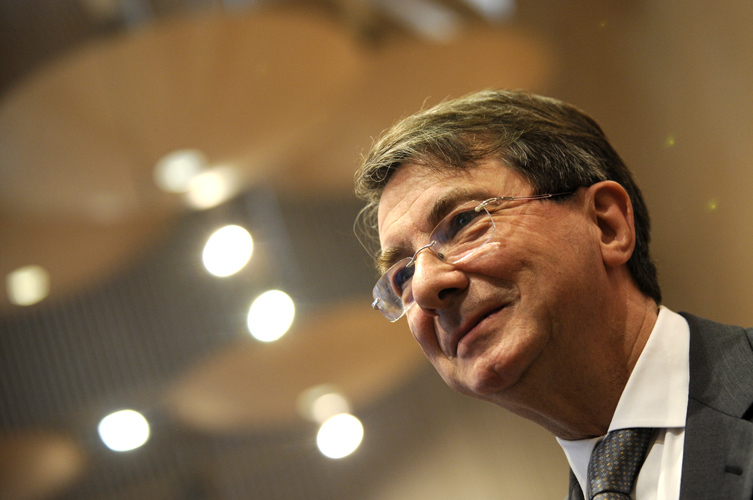
Two years ago, Gerara Mordier, the legendary opera director and reformer of the theater, in the last years of his life became an important character for Russian culture, was gone. In an interview with the Belgian radio, Musiq'3, released on March 8, on the day of death, the remaries of Mordier are shared by the conductor Silvan Camblean, his life partner and a long -term ally who conducted dozens of productions in Brussels, Salzburg, Paris, Rura and Madrid. With the courteous resolution, Musiq'3 Colta.ru publishes a translation.
- In his theoretical reasoning about the theater, Gerard Mortier always referred to his journey to the epidavator and to the fact that in ancient Greek times this theater was a mirror of society. Is there a certain explosive force in this reasoning?
- There is not explosive power, but questions. Indeed, this thesis has always been at the heart of its reasoning. Over time, he subjected this thesis less and less doubts and more and more applied in practice. This work (although he spoke about the theater as “passion”, but still the theater is work) was constant improvement, understanding, reorganization, depending on the place where he worked, and the public with which he met. To ask questions to the public - yes ... and rather - ask questions to yourself, every time to ask yourself why the theater, art and music are needed. And over time, these issues became increasingly practical and less and less theoretical.
- Gerard Mortier for the first time became the director of the opera theater in the eighties, in the era of economic growth. And he ends his career in Spain, a country that suffered from a crisis of more than others. Did he see his work differently depending on such various economic realities?
- It seems to me that his distinguishing feature has always been the ability to convince politicians responsible for the economy of the need to finance culture, even when society was in a state of crisis. As soon as he took a post in Spain, the situation turned sharply. The crisis was aggravated, and the political landscape of the country has changed a lot. Of course, all the politicians responsible for culture are faced with such problems. There are no safe and stable times in the field of culture, and this is a big risk: even if politicians admit in words that we need culture and need to finance it at all costs, they make every effort to stay away from the resolution of issues. Culture is the area that they know little about and in which it became almost impossible to plan anything for a long time.
Gerard saw his mission in this, no, rather, the obligation is to reflect on the future, about long -term and continuous work, and was not afraid to ask painful questions. Now it is more and more difficult to find sponsors, especially for the opera. In a conversational theater, you can still work with smaller budgets, while opera - nothing can be done! - This is a form of art that is expensive and will never become cheaper. I don’t know, frankly, how Gerard would have seen his profession in the current economic situation and how long he could still continue his work. In a world where everything “democrates”, music is increasingly reproduced with the help of technology, and not live. But see the DVD or listen to the disk - is it compared with a living experience at a concert or in the theater?
Gerard had many more projects in order to convince different people, artists and artists to gather and reflect on the current role of the opera in society. He did not have ready answers, and the questions became more acute and, so to speak, more fundamental. In our profession, we still feel isolated, we feel the danger that we will consider some monsters that devour the budget of culture. Gerard was convinced that it was necessary to chase people, meet and speak with them, practically pursue them in order to move at least something. To convince the sponsors, of course, politicians of all stripes, poets, dreamers. But I do not know what decisions he would suggest today.
- The power of belief. Indeed, he knew how to interest the opera of artists and artists of various disciplines. He initiated the first steps in the opera for many theater directors. Is there at least one of the prominent today's directors, who was not supported by Gerard Mortier at one time?
- Yes. And this lasted over the past forty years. When he was still very young, that is, when he worked as an assistant to Christophe von Donanya, he “launched” the generation of Gruber, Peter Stein. And right up to Madrid in his head continued to “ripen” new names. In the last months of his life, he mentioned different directors, even the most famous, wondering if they can bring something new into the opera genre. He searched among the new creators of those who would feel the perception of modern people. What always delighted him is his tireless curiosity. Even if he treated some modern technologies with skepticism, he always wanted to try them. He was always interested in whatever the aesthetic views of his counterpart is to communicate with a person who is asking new questions or comes with new proposals. In 2012, the problems that occupied his problems were not at all that in 2007 or in 1981. He would never have turned into a routine.
He chose the date for himself. He said that he would like to reach the "fairy tales of Hoffmann", the production in May 2014.
He loved the subtle game of human connections. Arrange a meeting of the conductor and director or singer; Carefully monitor the sincere atmosphere or a sudden explosion - and this happened. His task was to create an ensemble, a team. And, of course, there were people - to the very end - whom he could not tolerate to the spirit and with whom it would never have occurred to him to work.
- Is it true that he wanted the singer, whom he takes for a certain role, would not have an ideal voice for this role, justifying this by the fact that the distance between the capabilities of the real voice and the guerrilla gives the singer a call - and the more interesting to watch this artistic fight?
- I would not say that he did not want to take for the role of those who were born for these parties. Still not so. But he would never have taken a person only for his voice, as he would not have taken and only for his external data. Of the actors and singers, the most interesting are those who need to fight a little bit with the characters that they play, both vocally and in theatrical terms, psychologically or physically. He did not look for performers whose characteristics from the very beginning would have implied an internal conflict, it was not a strategy, but he was ready for any difficulties. In any case, he always made the composition with the directors and conductors, he was not interested to just collect the names and say: “Here, please, your composition.” For “all women do this,” in the production of Michael Haneke, we conducted listening for two and a half years to find perfect characters.
- The time of his directorship in Paris was very stormy. Nevertheless, today many Parisians remember Mortier times with nostalgia.
- It was just the same in Salzburg. Ten years in Salzburg were very difficult. In Paris, the main difficulty was the arrogance of the French public, who believes that he understands the opera better than anyone else. And besides, it was not easy with a large part of critics. But there were wonderful achievements. “Tristan and Isolde” with Bill Viola - no one has ever created such a thing; This production remained a milestone in history. All Varlikovsky and Chernyakov appeared in Paris for the first time during his mandate. And, of course, this is exactly what causes certain nostalgia today. Is the Parisian audience spoiled today today?
By the way, he had a clear desire to work with the "old guard", with such directors as Herrmann, Bondi or Sherro, who already became part of the story for him. Gerard was very sensitive to this, realizing that the story must be created, that every new season does not make sense if it simply consists of a series of high -profile events, but does not bring anything new in history. They said about him that he was not interested in the public - this is not true. All that he did, he did for the public. He worked for the public; His goal was to convince, but the main thing always remained the main thing - and for this he wanted to gather people around him who would think about this work with him.
In France-more than somewhere else-most of the audience comes with the finished idea of what the performance should be. In fact, surprise from surprise is good, but in France, if the audience is not shown what they expected, they perceive the performance as a direct aggression. Sometimes Gerard himself conducted an introduction to the performance, he loved direct contact with the public, he would like to be an actor, that's for sure.
If, say, he put Verdi’s opera in the program, he always plunged into context and tried to introduce the work in resonance with modern realities. And for this he was looking for information, read, tried to find connections with other forms of art and - very often - found analogies with a current political context. And in this he never moved away from the public. Of course, not everyone understood this, but that is why today in Paris and in Salzburg they recall the times of Mortier as very saturated years.
- In his image there is a kind of bullying enthusiasm. At the Paris “Figaro Wedding”, we heard his dispute with those who shouted “boo”, at the general rehearsal of “King Roger”, he forced the rebels to leave the hall.
- What happened on the general “King Roger” in Paris also happened in Salzburg. It so happened that the people whom he invited to a general rehearsal began to scream “BU” - and he asked them to leave the hall. The general is a rehearsal, no one pays for a ticket for the general. You come like a guest, and not as the owner of the right to work. He did this not in order to stand out, but because he defended what he needed, in his opinion, in defense. Sometimes he did not restrain himself and told people in the face that they were idiots, if they lack sensitivity, tact or curiosity. And this did not add friends to him.
I recall the production of “Figaro's Wedding” - we had problems at every performance. In recitatives, the harpsichord was replaced by glass harmonica, and at some moments the musicians blew into the neck of beer bottles. I heard people in the first tier said: "This is disgusting." And it seems to me that Mozart would certainly not find it disgusting. As a gesture, it is very much even in Mozart. What do they want when they come to the opera? Do they want the work to touch them? We did nothing against Mozart, everyone knows that he adored jokes, sometimes dubious taste, and evidence of this in all his letters. Humor is a very important part of all his works.
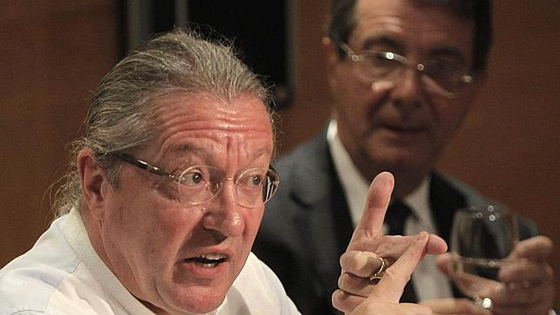 © EFE Silvan Kambubryen and Gerard Mortier
It seems to me that we must be consistent: on the one hand, we want modern productions, on the other hand, we do not need to violate the harmony of sound. But still, recitables with harpsichord-of course, they can sound wonderful, but such a sound provokes a discrepancy between what is happening on the stage, and what we hear. To make experience, to have fun in your own way and showing recitables in a new light means to offer the viewer the pleasure of hearing the play in a new way. It was not at all a “drunk trick”, as we were reproached. We thought about recitatives for a long time. And when Gerard was sure of something, he defended the idea with all his might.
Sometimes in discussions about the future production he did not agree with some ideas and nevertheless missed them, saying: “Okay, I don’t understand, but it sounds logical.” On the contrary, if something was illogical, then he defended the work. He did not like provocations for the sake of provocations. With the exception of once, when he made a “bat”.
- Let's talk about an unexpected feeling that such an intellectual as Gerard Mortier experienced the opera to the genre. The paradoxicality of this genre is that, on the one hand, it is conservative, on the other, it encourages us to listen and re -read.
- I do not think that the opera is a conservative genre.
- Well, maybe this definition refers only to some part of the repertoire, which is part of the story, but I don’t really want to re -read these libretto?
- This is true, but still I insist: the opera is not a conservative genre because it only uses conservative means of expression. Of course, there is a load of what the opera became in the 19th century, when it was cleaned and sold to a certain class of society, rich, often conservative people. But even in the 19th -century repertoire, including Belcanto, innovative things are found. And in operas such as Somnambul or Puritan, you can find modern reasons to put them on stage - regardless of how interesting they are musical. In order to put any work today, you need to have good arguments for this, and not just be guided by the pleasant exposure to digestion.
“But even if you agree that Bellinyevskaya Kantilena is something incredible, the libretto is always a prosecutor: it is difficult to force him to break away from his time and talk about today.”
- I do not agree. I will give one example: the setting of “somnambula” Yossi Wiler. All - music lovers, and critics, and colleagues - re -discovered a work, and not only thanks to his cantilens, but also a libretto. In any case, if you put the work, then you need to have a reason for this. “Somnambula” is not my repertoire, but when someone puts a similar opera, I ask myself that he wants to tell me this. And if he does not tell anything if this is done only for the pleasure of listening to a beautiful voice, for the sake of physical education, for the sake of purity of sound - why not? I admit that this can interest someone, it can move some of the public. But in this case, I have enough CDs or concert performance.
- As you, for example, acted with Rossini.
- Yes, I conducted very little Rossini. I made Semiramida with Montserrat Kabalier at a time when she could no longer sing the title party so completely. This gave me a certain pleasure, but I rarely addressed this repertoire and I will never return. And how to put Fausta Guno today?
- Which you seem to know by heart ...
- This is true. But I do not put Faust, I only ask a question. Absolutely, that it would be a critical production, antimilitarian, anticleric, anti -bourgeois. I do not see what this opera can still tell. And if someone decides to put it like that, he risks gathering all the curses of the traditional public, but at least he has reasons to set “Faust”. And if someone takes a similar play in order to simply fill the cashier, then this can be justified only if it uses the funds received to finance the play, which is much more difficult to sell.
This, by the way, was another method of Gerara Mortier. He was not at all a fan of Puccini, but from time to time he put “Bohemia” or “Tosc” at the poster, because he knew that the hall would be filled to capacity and provide him with a budget necessary to finance more difficult plays. Finances and economics - you can not pull away from them when you are led by the opera theater. But you need to have a clear idea of what and what are you doing for. And Gerard said this openly.
If only the museum form of the opera is pleased, it can survive, but in this case it should become free, as in museums, so that any person can always come - but it will not.
If I now continue to conduct in the opera, then because I love this form of expression. I choose the plays that I want to fulfill ... and even more so I choose that I do not want to conduct. If, for one reason or another, I had to leave opera conducting, then I would have been missing something in my life-special sensuality, special emotionality, which in symphonic music, for example, are completely different.
- In the eighties, you witnessed the moment when the composers began to write operas that touch the audience.
- Yes, in general, all young composers at the very beginning of the journey immediately want to compose operas. It seems to me that there are several reasons for this: the first of them is a voice. A singing voice is one of the most exciting, erotic mediums in music. On the other hand, an interest in telling history again appeared - and not just the desire to connect sounds with theoretical ideas. Maybe this is due to the influence of the movie. And also-this is curious-despite the fact that opera theaters experience difficulties, after all, a huge number of spectators go to the theater for emotions that can only be obtained in the opera.
Young musicians, composers in the last ten to twenty years listened to the opera a lot-both baroque and experimental works. The only thing that is no longer going to any is the experimental works of the early 60s. This is not so interesting. Two years ago, I conducted the world premiere of “ Wunderzaichen ” by Mark Andre - a difficult work with an extremely mystical libretto, which was not easy to understand, but the music was simply captured. И единственное, что может укрепить жанр оперы в современной жизни, — это именно интерес: сначала интерес музыкантов, молодых композиторов, дирижеров и потом публики к этому искусству. Эта форма еще не умерла, и она будет жить, если создаются новые произведения. Если удовольствоваться только музейной формой оперы, она может выжить, но в этом случае она должна стать бесплатной, как в музеях, чтобы любой человек всегда мог прийти, — но так не будет.
— Жерар Мортье мог сомневаться. Мы видели, как он извинялся перед публикой в фойе театра Ла Монне после «Макбета» или как он отменил «Пеллеаса» после генеральной репетиции.
— Да, он был очень строг. «Пеллеас» — это было возобновление, он был не совсем доволен, особенно костюмами, второй вариант костюмов оказался еще хуже первого, ничего не работало, и у нас были большие проблемы. Может быть, в расписании было заложено недостаточно репетиций. Состав певцов был очень неровный. И лишь добравшись до генеральной репетиции, мы поняли, что не можем показать это публике.
— Сегодня такую ситуацию представить невозможно.
— Да, Жерар не боялся подставиться, особенно в финансовом плане. Он не хотел разочаровывать свою публику. Этот «Пеллеас» в постановке Андре Дельво на премьере был принят неоднозначно, но у некоторой части публики он вызвал интерес. И раз уж мы решили возобновить спектакль, то надо было его делать лучше, а не хуже. Иногда ты понимаешь слишком поздно, что что-то не получится, что воплощение не дотягивает до уровня идеи или твоя прекрасная идея была ошибочной. И в этот момент главное — принять верное решение. Тогда, в Брюсселе, он не пошел на сделку ни с самим собой, ни с публикой.
Позднее Жерар стал более гибким в том, за что он отвечал. В Зальцбурге был спектакль, о котором он говорил, что это была одна из худших постановок в его жизни. Это был «Махагони» в постановке Цадека. Все прошло и вправду очень плохо, результат оказался совсем не тот, что он желал вначале, — и он это просто признал. Другие постановки, в которых он был разочарован, все равно пользовались огромным успехом. И тогда он бесился: «Да они ни черта не понимают!» По крайней мере, в этом он не передергивал и не хитрил. Он пытался понять. Когда он верил в постановку, не пользовавшуюся успехом, он снова ставил ее в афишу — чтобы удостовериться. Как в случае со «Свадьбой Фигаро» из Парижа, которую мы потом поставили в Нантере, в пригороде, с оркестром Парижской консерватории. И, обратившись к другой публике, спектакль имел колоссальный успех.
— Когда ты руководишь оперным театром, надо признать, что твоя профессия — искать? А еще признать, что будни того, кто ищет, — это не находить?
- Partly yes. Никогда не думать, что все уже найдено и достигнуто, постоянно подвергать все сомнению, признавать, что совершил ошибку или поменял точку зрения, что вкусы меняются и развиваются, потому что сама жизнь меняется. Публика театра Ла Монне в конце восьмидесятых совсем не была публикой начала восьмидесятых. Между ними лежали десять лет работы. И повсюду, куда бы Жерар ни переезжал, он прилагал все усилия, чтобы понять свою публику.
Чтобы ставить сегодня какое бы то ни было произведение, нужно для этого иметь веские аргументы, а не только руководствоваться приятным воздействием музыки на пищеварение.
Что он сделал на Рурской триеннале: он с нуля создал этот фестиваль, пригласил туда артистов и художников, чтобы создавать спектакли, — такое не получается само по себе. Сегодня это уже стало общим местом — в любом заброшенном цеху создают спектакли. А тогда это было совсем не очевидно — поставить «Святого Франциска Ассизского» в индустриальном резервуаре. Или «Атласный башмачок», или «Беренику» с Патрисом Шеро, или «Андромаху». Когда он взял на себя руководство Парижской оперой, он знал, что это будет битва. Потом ему хотелось перейти в Нью-Йорк, чтобы оказаться лицом к лицу с совсем другой публикой, попробовать что-то новое. Этот план не удался, и он оказался в Мадриде. Все могло получиться очень-очень хорошо в Мадриде, но в конце концов все случилось совсем не так прекрасно.
— Кристоф фон Донаньи мне сказал на следующий день после его смерти: «Я надеюсь, что ответственные люди в Мадриде знают, что они его убили».
— Нет, они этого совершенно не осознают. Они защищаются от этой мысли, они отказываются видеть, что люди, подобные Жерару, настолько выкладываются в том, что делают, что когда на них нападают — и зачастую очень коварным образом, — то провоцируют болезнь. Рак — мы сами его производим, он приходит не снаружи. И я уверен, что Мадрид его убил. Там были и замечательные события, у него было время заказать новые оперы, насладиться чуть-чуть результатами своего труда, когда он уже был болен, но мадридские руководители отказываются это понимать, они ни за что не в ответе.
— Что же случилось такого подлого, если здоровье Жерара Мортье, одного из самых опытных директоров, оказалось так подорвано?
— К Жерару обратились, потому что президент попечительского совета хотел окрасить золотом герб Teatro Real , который тогда был не более чем небольшим провинциальным театром. Жерар не скрывал, что ему это может быть интересно, но это повлечет за собой финансовые вложения, изменение структуры, состава сотрудников, серьезные кадровые изменения в хоре и оркестре — чтобы можно было выйти на новый уровень. Все сказали: «Отлично! Let's!" И он начал. Он сделал несколько спектаклей, которые оказались очень удачными и важными, но в какой-то момент, учитывая развитие в театре, учитывая финансовые трудности, ему пришлось еще раз договариваться об условиях: «Вы меня позвали с четкой миссией — вернуть Teatro Real место среди важных европейских театров. Если теперь вы меня просите урезать бюджет на 30%, то я с этим согласиться не смогу». Конечно, он мог хлопнуть дверью, но он не хотел. Он хотел бороться. И эта борьба становилась все труднее, атаки на него становились все изощреннее и коварнее — и поскольку эго у местных руководителей было огромным, то они поступили так, как поступили. Когда Жерар заболел, то они избавились от него самым постыдным способом.
— Мне бы хотелось поговорить о книгах, которые он читал во время болезни.
— Он узнал официально о своей болезни 10 июля 2013 года. Он приехал в Штутгарт на концерт, где я дирижировал Реквием Верди. Мы провели прекрасный день с Йосси Вилером, интендантом Штутгартского театра. Концерт был утром, а обедать мы поехали на пленэр. После обеда он сказал мне, что должен вернуться в Брюссель, чтобы узнать результаты анализа крови. Он делал такой анализ просто так, раз в год. Через два дня он мне позвонил и сказал: «Я возвращаюсь. Надо поговорить». Он приехал в пятницу: «Там точно что-то есть на поджелудочной. Ты знаешь, что такое рак поджелудочной, с ним трудно справиться, но я буду бороться». Я ему ответил, что, конечно, надо бороться и что надо попробовать сделать все что можно. Надо было оперировать, но в августе операцию признали бесполезной: врачи его зашили, сказав, что вырезать не имеет смысла. И это был момент, когда он упал духом. Чего он точно не хотел — это терзать себя терапией, он даже раздумывал о том, чтобы ускорить свой уход. Но в нем была такая любовь к жизни, такая воля к борьбе, что он стал бороться с болезнью, как боролся всю жизнь. Он начал терапию, которая поначалу дала очень хорошие результаты. Он уже не мог работать в офисе, но сохранял чистоту мысли и духа, любопытство, жадность познавать и передавать свои знания. Он себе выбрал дату. Он сказал, что хотел бы дотянуть до «Сказок Гофмана», постановки в мае 2014-го. Я это увидел только потом в его рабочем календаре: начиная с апреля все свои встречи он пометил знаком вопроса. А после «Сказок Гофмана» не было уже ничего. Было ясно: он не думал, что дотянет, но он был смел, в конце он страдал. Мы столько разговаривали вдвоем…
Иногда он не сдерживался и говорил людям в лицо, что они идиоты, если им не хватает чуткости, такта или любопытства.
Он точно знал, как обстоят дела. Его здоровье значительно пошатнулось в середине декабря, он похудел на 25 килограмм. Он отправился в Москву, чтобы попробовать новую терапию, — я, честно говоря, в это не верил, но он хотел попробовать. Он уже почти не говорил, не было сил, он не мог сам питаться. Он приехал в Москву практически в критическом состоянии в сопровождении медсестры и Бориса Игнатова, своего самого близкого сотрудника. И первое, что он сказал: «Я хочу пойти в Большой». На балет! Это не было его страстью, но он хотел быть в театре. И это был последний раз, когда он побывал на спектакле. Через несколько дней он умер. Voil à .
Он читал книгу, которую я дал ему теперь уже тридцать шесть лет назад, мы были вместе тридцать четыре года. Я открыл ему Рудольфа Штайнера. И он перенял философию свободы от Штайнера. Я очень удивился, потому что уже давно ни антропософия, ни сам Штайнер не были в центре его интересов. Когда он уже не мог читать, я ему дал аудиокниги, он хотел слушать Томаса Манна, Достоевского. До отъезда в Москву он еще мог поддерживать беседу — не слишком долго, это его утомляло, но он всегда задавал хорошие вопросы. Он до самого конца остался верен своим идеям и друзьям, спрашивал о тех, кто был с ним в течение всей жизни. Это было удивительно.
— Щегольство перед лицом смерти. Лавуазье должны отвести на гильотину, он читает, когда его зовет палач. И он говорит: «Одну минутку, я только заложу страницу». И Жерар Мортье в Мадриде, очень слабый, но ведущий пресс-конференцию с неописуемым блеском.
— Да, практически до конца он сохранил то, что всегда в нем удивляло, — блеск в глазах, взгляд. Он мог очень-очень интенсивно смотреть на людей. В зависимости от настроения или обстановки его глаза были серо-голубые или темно-серые. На той пресс-конференции, хотя лицо уже было практически без плоти, у него были его глаза, взгляд, жизнь, радость и ирония. Он умел быть хлестким, ироничным, иронизировать — и в конце над собственной судьбой. Это было поразительно. Пока он мог еще выходить, одеваться, он хранил этот огонь, этот интенсивный взгляд, которым он всегда мог охмурить кого угодно.
— За несколько дней до его ухода Варликовский поставил в Мадриде «Альцесту». Последняя картина спектакля показывает безжизненное тело Ангелы Деноке. Но на следующий день после смерти Мортье Варликовский меняет спектакль: он не хочет показывать тело. Он заменяет его лучом света. «Жерар — это свет».
— Кшиштоф Варликовский не всегда ясен в своей работе, он очень хрупкое, гиперчувствительное создание, он иногда защищается, прячется за картинами, которые сам создает. Смерть Жерара поразила многих, хотя все были к ней готовы. Ален Платель случайно зашел в спальню, где я был с Жераром за две минуты до того, как он угас. И он это наблюдал вместе со мной. И он видел его уход. Для Алена это осталось сильнейшим переживанием. Я знаю, что сейчас он работает для Рурской триеннале над спектаклем об уходе. Могу себе представить, что с той поры это для него — источник вдохновения.
Это было что-то очень личное и прекрасное: где-то за час до его ухода мы все были вокруг его постели с его сестрой, деверем и близкими друзьями. Я должен был возвращаться в Штутгарт. Он сказал: «Я сейчас умру». Он практически наблюдал за тем, как умирает. А потом он попытался заговорить. В какой-то момент он сказал «свет». Он хотел больше света, свечей, ламп — мы это поняли только потом, но мне кажется, что он хотел превратить свой уход в ритуал. Люди вокруг него и свечи. Я думаю, что это на него похоже: он наблюдал за собой, видел, как умирает, уходит. И в конце концов это произошло в узком кругу… и без света. Жерар ушел в 21 час 17 минут 8 марта. Он сам решил, что от его тела не должно остаться ничего. Мы его одели, омыли, помазали миром, а затем за ним пришли. Он попросил меня приготовить бутылку лучшего вина, чтобы распить ее с друзьями. I did so. На следующее утро я дирижировал «Болеро» Равеля, которое с тех пор и навсегда стало для меня танцем смерти.
Перевод Бориса Игнатова