
Translated material
Normal | Colta.ru
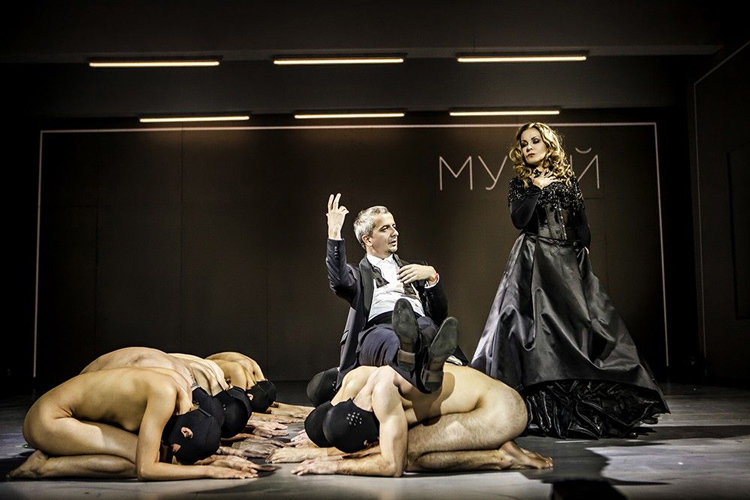
This is not a dramatic performance in the usual sense of the word: here the theater, music and modern dance are mixed in equal shares. Three dramatic artists, one singer and several dozens of completely naked driver, are occupied in the “Müller car”. The literary foundation is several texts of Heiner Müller , the leader of the European drama of the second half of the last century: “Quartet” based on the “dangerous ties” of Shorelo de Laclo, rethinking the Shakespearean tragedy “Hamlet-Machine” plus fragments from prose. Inextricably connected with each other through topics - sexuality and dying. Other objects of reflection of the playwright-such as the latest history, society, the state-are constantly looming somewhere in the field of lateral vision: either the ruins of the post-war Berlin, then modern telechronics arise on the screen.
“Mueller Machine” - Gesamtkunstwerk , a synthetic work of art in which choreography, music and video exist on equal terms with a sign for the history of the European scene by drama. The integration of performing arts-theater, dance, music, performance-under one roof from the very beginning was the most important component of the concept of Gogol Center. The financial problems of the site forced Kirill Serebrennikov to abandon the residents system, but not from the very idea of the synthesis of art. The format has changed - now artists of different disciplines do not just share one scene, but work on common projects. A great example is the first premiere of the season, a large -scale performance by Nekrasov’s poem “To whom to live well in Russia” . Serebrennikov attracted composers Ilya Demutsky and Denis Khorov to this work, and in the second, “plastic”, the act divided the duties of the director with Anton Adasinsky, the creator of the avant-garde theater Derevo , and at the disposal of the latter, which is characteristic, were by no means a professional dancers, but dramatic artists. No less than full co -authors at Serebrennikov and in the Mugan Mueller. The dancer and director of the Kostroma Dance Dance company Yevgeny Kulagin put a choreography - and he, like Adasin, dealt with the neophytes, actors of the drama. The music was written by Alexei Sysoev (Serebrennikov, as usual, preferred the phonogram of living vocals and orchestra). The student of Serebrennikov Ilya Shagalov was responsible for the video, which actually performed the function of scenography.
 © Gogol Center
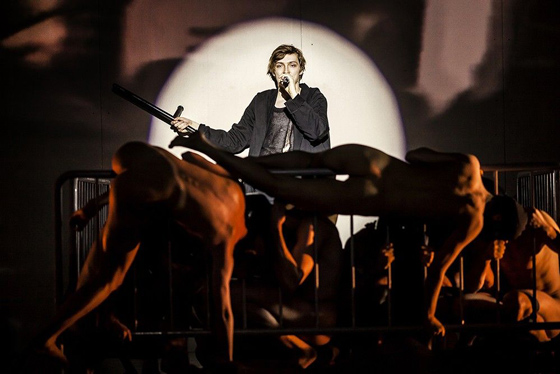
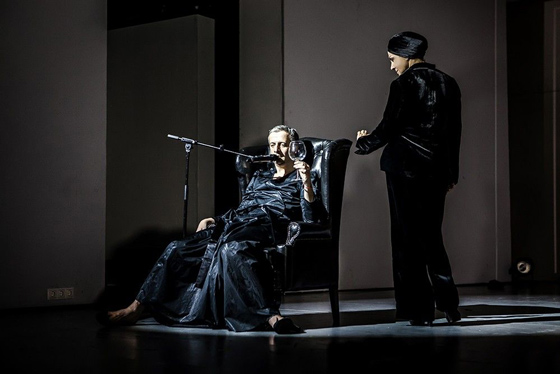
Obviously, Serebrennikov conceived this work as a co -product of large artists. This can be seen from the casting: he needed personalities, not actors. Including this applies to naked driver: as already mentioned, none of them still had experience in a dance or physical theater - these are dramatic artists who dared to a step into an unknown one. The soloists are actress and television Sati Spivakov, actor and novice director Alexander Gorchilin, as well as Konstantin Bogomolov, director with a philological background. Participation in the Muts of Müller Bogomolov remained, perhaps, the main intrigue of the premiere: the combination of two significant directorial names at the same poster was amazed. Although, in fact, the director on stage is already a trend. We remember how Yuri Butusov exploded the action of his performances - at least in the same satirikon "Seagull" - violent dance or, as recently in another "Seagull" , three directors of the same generation depicted Costore of Treplev in turn. And Serebrennikov himself invited colleagues in the workshop several times to play something: in Ommage, Stanislavsky “outside the system”, the role of contemporaries of the anniversary were distributed between leading Russian directors, artists and writers; In a recent “Ordinary History”, director Alexei Agranovich created a terribly convincing image of a businessman businessman.
The creators of the Mueller Machines defend the right to be normal in Russia.
The reception is indirectly connected with the tradition of performance, performed (often, although not always) by the artist himself: the viewer always remembers that he is not only a performer, but also an ideologist of art, and this knowledge is impressed by the impression of the moment. In this case, we have the Bogomolov - the theoretician of the profession of the actor, the author of his own acting methodology; I never saw how he replaces one of the artists in his own performances, but, they say, this is very curious (at least no other director does that). In the casting of “Muts Müller”, the logic of Serebrennikov is completely understandable: Lemovelas Valmon, one of the heroes of the play “Quartet”, is an actor by nature, a person for whom the game is a prerequisite for existence (yes, in fact, he exposes himself, improvising in the image of his passion de Turvel: “The devil has a lot of larvae. New mask, valmone?”). Bogomolov, describing the scene as the only territory of absolute freedom, the director who is eager to play himself, a comedian who annually turns the “Nail of the Season” award into the farce, is an ideal candidate for this role. He is quite confident in his own sense of taste to allow himself a little more than usually allows his concentrated-grind artists: for example, to break into a scream and at the same time not to lose irony or abruptly go from funny to serious, from a parody to drama-and vice versa.
 © Gogol Center
The Müller car will probably be called the most shocking performance of the Gogol Center-for the director’s close attention to the topics of the body, sexuality, and gender. Only in this particular case, shocking is a very unsuccessful word. Kirill Serebrennikov is not a radical, not a marginal, not an outsider. He - whoever says anything - does not engage in provocations. He is a man of norms (not to be confused with normativeness). He himself sees this work - attention! - As a production of classics, albeit not learned by the domestic theater. Yes, the attitude to the bodily in this performance differs, to put it mildly, from household Russian attitudes. The prejudices associated with the body are destroyed - there are no “wrong” or “right” bodies, as well as there are no unambiguously male or female. Men-actors wear bras and dresses; The microphone at the actress behind the belt denotes a member; The singer - an amazing contrast between Arthur Vasiliev, as if commenting on an action - looks like a man, but sounds like a woman. Refusal of shame, criticism of bodily standards, erosion of gender roles is the mainstream of world culture. The creators and artists of the Mugan Mugan are not the right to be marginals, but not less scarce in Russia, the right to be normal. For the Gogol Center, this has become a kind of mission.