
Translated material
Stay in my fur coat
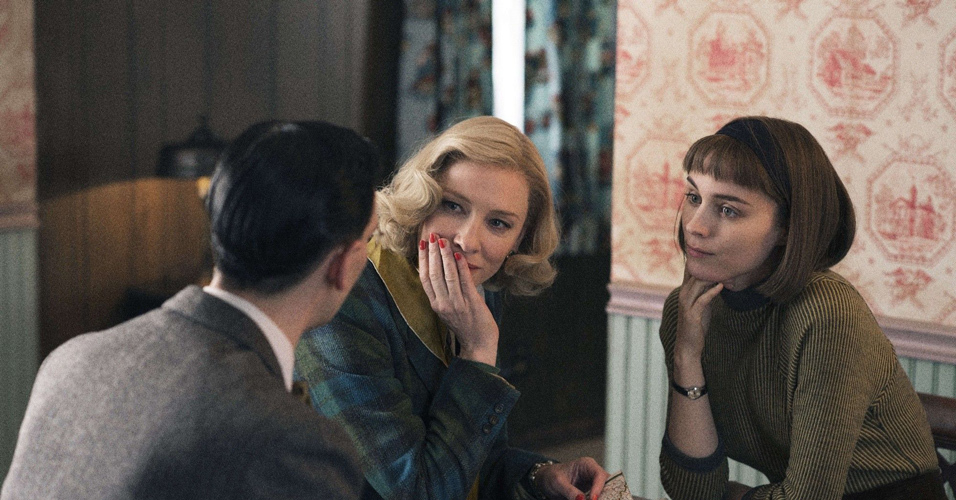
1952, Christmas. Teresa with a quiet mouse stands behind the counter of a huge New York supermarket. In the toy department before the holiday of the crowd of buyers, but when the blonde enters the hall in a mink fur coat and a coral hat, Teresa immediately notices her. The blonde is called Carol, she will buy a railway as a gift to her daughter and casually leave her gloves on the rack.
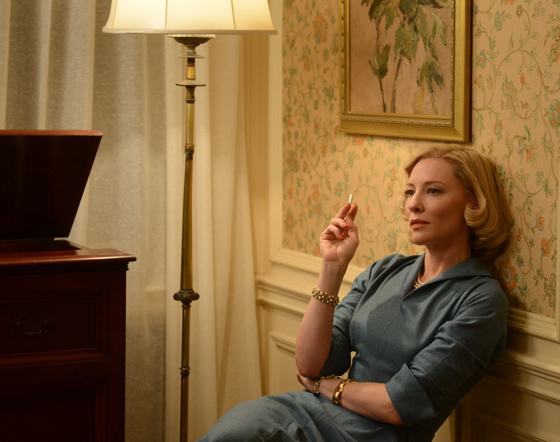
Terez dares to return them, not quite at that moment realizing that he brings her to this woman from a puppet suburbs. But the camera already knows everything: from the very first scenes, she smoothly circles around to indecent (that is, literally, to the extremely inappropriate at the Christmas bazaar of eroticism) beautiful Kate Blanchett, which does everything with the same intonation as the saleswoman is addressed - as if this appeal is a pure formality, as if it already owns the desired; Not by a railway, of course, - Teresa herself.
These expensive leather gloves on the rack, generally speaking, are a rather important gesture from the screenwriter Fillis Nagi. In the original novel by Patricia Haismit, based on which Todd Haines was shot, the title heroine did not leave any gloves in the workplace at the main one, and also did not give her, for example, a camera. And the minimum reason for the first call, and a symbolic binding gift - only a couple of numerous lines that Hines and Nagi bring, shifting the emphasis and attributing to the heroines, in the book that is not animated by almost nothing, except for the reflection of their slowly ripening feelings, more distinct functions; Clarifying who seduced whom, the authors of the film adaptation give the dreamy text of the original contours of a clear filming. Carol’s personal life, a rich housewife who divorces her husband, change the profession of indecisive Teresa - with a theater artist at the photographer, and their relationship is enclosed in a flashback frame that refers to David Lina’s “short meeting”, but filled with bitter irony: today, when this story can be told with all the details and allowed with all the details and allowed The heroines to meet again, the absurd pathos by the current standards “They are also people and have the right to happiness” regarding the forbidden novel is replaced by a dry statement - they are also people, they will also survive the revelation of first love, and then they will have everything that usually happens with people. Life, secular longing and no exciting prohibitions.
 © Number 9 Films
By the time of the release of “Carol” in Russian rental, everyone seems to be inclined to one of the options - either the film “General” or “Monstriously praised”. This, of course, is not good at all in the skillful craft of Haines: not one of the two statements in this case (as in many others) leads to an interesting conversation. “Carol” was made so carefully that this accuracy is easy to brand like soulless prudence, so tenderly that tenderness can be called lightweight, and so beautiful that it is just right to blame her for formalism. Neither the first, nor the second, nor the third will be quite accurate - if you talk about this film, it is better to do it in an undertone, sharp statements do not go to him at all.
 © Number 9 Films
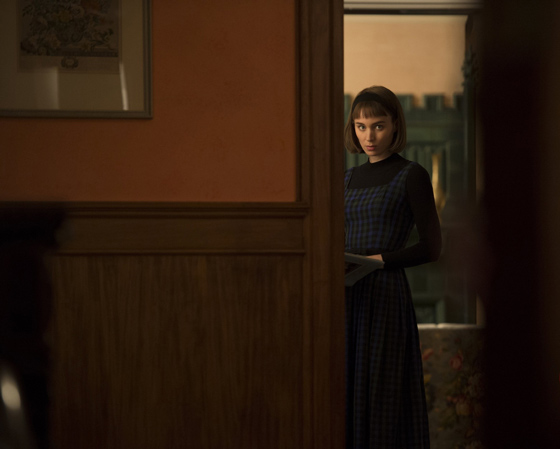
The romantic melodrama is generally conditional, its beauty is half in detail, half in the desire of the viewer to look at them from the right angle, exactly like (one of many obvious, but accurate rhymes) in the case of Carol itself, which we see through the love of Teresa through the lover. In this case, obliquely, due to the turn, through the window glass, through the lens of the camera; Any of a dozen ways that the operator Edward Lahman chooses, quoting in angles and compositions of the salt of Leiter, then Vivian Mayer, then Ruth Orkin. All this could really be considered simply a beautiful stylistic solution, if this decision was not so meaningful: on the screen - a story about a big, but indecisive love; About the incessant timid choice of a successful perspective.
 © Number 9 Films
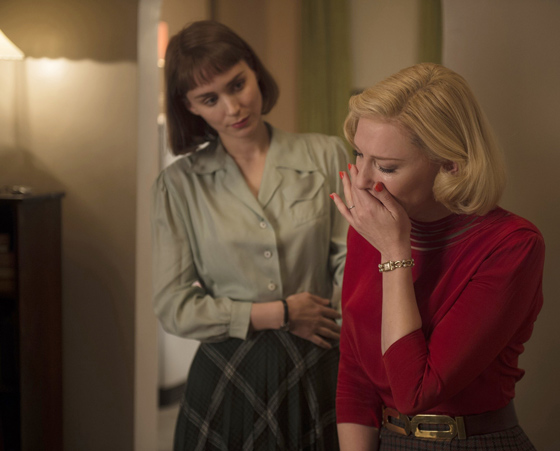
Talking the story of the girl from the universum to the power mirage, Haines, as always, uses other people's dictionaries, leaving, at first glance, there is little space for elementary empathy for a slightly suffocating game. When the director made all these techniques with the instruments of detached reflection in his Surkov film “Far from Paradise”, he was exalted. When he now muffles his own cultural comments and pretends to be seriously saying, it confuses. Because it exposes a beautiful, unreliable and most romantic property of both melodramas and love: in order for it to be “seriously”, quite often you just need to pretend.