
Translated material
Raise me with the eyelids
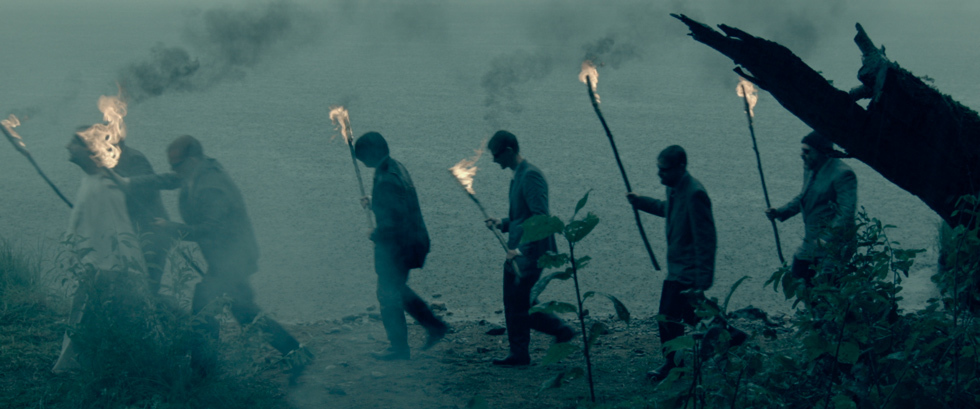
Summer, cemetery, forest, mystical strait under a lead sunset, a wet substrate of the htonic fairy tale. Partisans, fallen astronauts and postmen, who are more like awesome participants in the theatrical amateur performances, move through the forest, like connecting rods. They speak the grown language of the first Bolsheviks, crush space under themselves and chew time, believe in something vague and difficult, fight with demons in costumes of businessmen-officials, see the motherland-mother of the work of Wuchetich in dreams.
The Elixir, the first large (in the sense of timing) the work of the video artist Daniil Zinchenko, is a comment, rather, not to Russian life, but to the Russian culture of the 20th century. Despite the abundance on the screen of iconic Russian nature, the object of representation here is not so much the original elements of the grave earth, the flames of the fire, rotten wood or cheerful undergrowth, how many Petersburg necrorealism, Moscow young certificate and “parallel cinema”, prose of Platonov (it seems, it seems, slightly adapted to the need The conditional narrative, and sounds behind the scenes) and the spotlights of Nikolai Fedorov (Zinchenko himself mentions the landscapes of Ivan Shishkin as sources of influence and early cinema - not the most obvious allusion in the case of a film, almost entirely shot to the figure in classic broad -screen format).
The Elixir, although it lasts 80 minutes and is shown in the cinema, where it is not so easy to run away, is entirely on the territory of the Council, not the movie. A free, floating narrative, which consists of borrowings and carefully translated under the copy of the motives of Platonov -Pepperstein, carelessly glued to the texture of the middle lane, does not turn to the affects and not even the long -term memory of the viewer about Soviet Atlantis, but to dry formal knowledge about the history of Soviet and post -Soviet art. Socialist motifs are too dehydrated here, reduced to the signs-indocatives, the association systems are built too unsophisticated and formally, as if Zinchenko sought to expel all signs of sincerity and modernism from the film, saving the possibilities for further maneuvers towards his today's nostalgia. The “elixir” set by the public as it is, as it is, can cause anxiety and confusion of the inability to classify it in the categories of “bad/good cinema” (approximately the same effect was produced on the Soviet police and passers -by Necrorealists). The misansens here are inexpressive and naive, the texts are stolen, the faces of the actors are lubricated, all together gives the impression of a supra-cabin ... And suddenly the screen fills the magnificent and anxious landscape landscape, the same htony, the terrible elevated whose terrible Media gateways break through ... and again the obstructive, diligent-pathos reception comes in.
But the interpretation, which this video desperately requires, inevitably kills, is drowning out of his already faint fraud signal. If you disassemble the “elixir” into the components (see above), there will not be so many from it - an alarming sunset (rather a still life than a landscape), a brief catalog of cultural heroes of the Soviet era, in general, the dry mummy of necro -regionalism and “mythogenes” with a distant, almost pissing flap and a bonfire (tasteful sensations are generally very important in the world in the world “Elixir” - his heroes literally recognize the world and taste people). However, be that as it may, this is by no means timid, albeit very vulnerable, non -budgetary and hopeless (like any cinema in Russia), the experiment deserves close attention. Afasia “Elixir” speaks of the original injury of the Russian-Soviet soul much more than the vigorous and like the legible reports of a new “normal” movie like “pioneers-heroes” or “rag union” by Radutsky. In some ways, Zinchenko’s method is close to the method of Albert Serra, who, in his Ommage, decrepiting European culture of premodernism, “The history of my death” (an important part of the plot there also took place in the forest), also made a cut from a stylized text of the XVIII century, expelling formal meaning and logic from the dialogs, but thereby allowing the appearance of auras in the film, that vague and ghostly ghostly ghostly Sensations of time and memory, to which the cinema is hostile from his very birth. Turning, aura, vague, freezing into stamps of memories, a living dead of a large style - not fabulous heroes, but the ghosts of the old, almost gone into the shadow of culture, are inhabited by the coniferous forest of Elixir. Zinchenko’s refusal directly appeal to the feeling of Soviet, to resurrect this dead man in the flesh (as is happening in the films of German Sr., for example), it can be regarded as author’s weakness-but also as an act of conscious killing of this zombie, his second-and death-death.