
Translated material
The glare of the saints
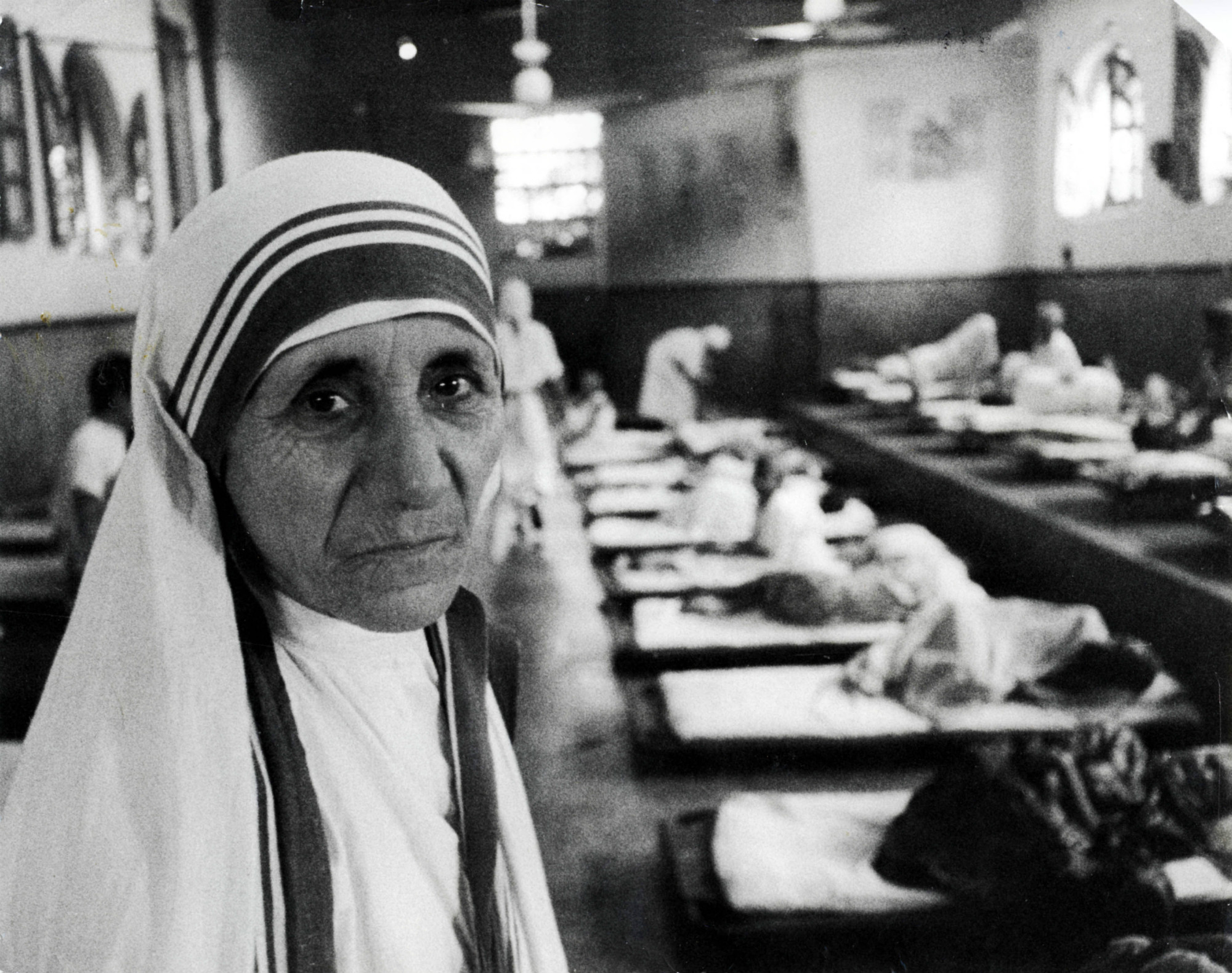
The Catholic Church is going to canonize the mother of Teresa on September 4 on the day of the anniversary of her death. But many doubt whether it is worthwhile to classify a philanthropist with opaque reporting and dubious achievements.
The future mother of Teresa, nee Anyza Gongeus Boyajiu, grew up in a very religious Macedonian family. At 18, she went to Catholic Ireland to accept monastic tonsure there. After several years of obedience in 1931, when tonsured, she took the name Teresa, under the impression of the life of the French nun Teresa from Lizier, canonized in 1927. Under him, she went to India, where she became famous as a great philanthropist.
In 1948, Teresa, who had been living in India by that time for almost twenty years, decided to create her own monastic organization “Sisters of the Missionary of Love”. The goal of the organization proclaimed service to the poor and sick. Teresa had the inclinations of a professional PR manager: for starters, she abandoned the robe of the Catholic nuns of robes in favor of white and white outfits created based on Indian folk clothing. Thanks to this, the line between the Catholic nuns and the Indians was erased.
But the sisters became famous only after twenty years. In the late 1960s, Teresa met with television journalist Malcolm Maggeridge. The former intelligence officer, Levak and Agnostic Maggeridge more and more plunged into Christianity, and therefore, with all the passion of Neopit, he wanted to tell the world about the "modern saint." The acquaintance of the nun and the journalist turned into a mutually beneficial partnership. Maggeridge found his hero, who made him a name in journalism. Teresa gained worldwide fame, and the rich and poor Catholics considered it their duty to make donations in favor of the "mission sisters".
Following Maggeriju and other conservative journalists rushed to “do a biography” of a sixty -year -old monk. In the 1970s, she became the character of mass culture, which went down in history even before the canonization. At this time, she received one after another awards and international awards, which was crowned by Nobel in 1979 "for the approval of the world in the most important field, protecting the inviolability of human dignity."
If for Christians of the whole world it has become a “living icon”, then people who are far from her religious beliefs, her statements and actions, to put it mildly, often were often confused. “There is something beautiful in contemplation of how the poor carries their burden, suffering like Christ. These suffering enrich the world, ”said Teresa's mother. The Catholic Church harshly condemns abortion, so Teresa has repeatedly performed with their criticism. She insisted that abortion could not be done, even if pregnancy became the result of rape. And, of course, condemned the use of contraception.
In India, Christianity has never been especially popular. And, perhaps, if not for Maggeridge, Teresa would have remained a private nun. But the increased attention of the press to her and her “sisters” forced the Hindus, Muslims and the Sikhs to point to the sin of Teresa before her own God: she baptized the dying. According to Christian dogmas, an adult can take baptism only after a long learning or at least after personal consent. But Teresa, trying to save pagans and Muslims from hell, baptized them on his deathbed, without waiting for consent. According to eyewitnesses, she did this, applying a cold compress to the head of a dying man. It is apparently impossible to establish how many souls she saved from the “fiery hell” in this way.
In the early 1990s, after the twenty-year triumphal procession of the image of the mother of Teresa, a reverse wave began around the world: the first studies appeared to question the image of the “modern saint” into question. The first to criticize the doctors. In 1991, the editor -in -chief of the British medical journal The Lancet Robin Fox visited the sisters shelter in Calcutta. I must say that Teresa, following her Christian logic, called the shelters “houses of dying”: after all, death saves people from new sins. Teresa herself, who had heart problems, was not going to die and was treated in Europe and the USA. However, she considered her heart disease by the machinations of the devil and asked to make a rite of expulsion of demons over her.
Fox saw that the "houses of dying" are fully consistent with their name - without metaphors. Elementary medical hygiene in these shelters was not observed. Teresa was convinced that all diseases were treated by faith, and therefore cured and incurable patients lay in the wards. There were no differences, and when the case concerned infectious and non -infectious diseases. Fox noted that many problems of the shelters of Mother Teresa could be solved if the nuns had a medical education. Due to the ignorance of elementary things, the sisters poorly sterilized syringes and were mistaken in the choice of drugs. A considerable problem was the lack of proper number of painkillers for “suffering sinners”.
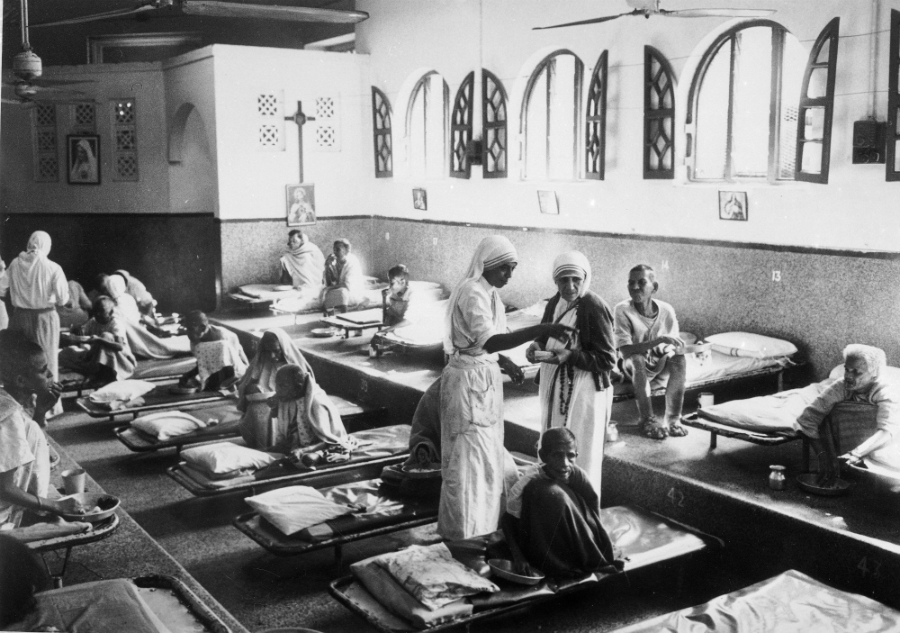 Mother Teresa in one of her missions. Photo: Eddie Adams/ Ap/ TASS
But the most burning issue for critics of Teresa was always the money that came to her from all over the world. The account went to millions with the complete opacity of their distribution between 517 missions of the "sisters" in 100 countries. Following the publication of Fox, an investigation appeared in the German magazine Stern, which stated that only 7% of the money of the “sisters” went to charity, mainly to the aid of the dying.
In 1984, the largest technogenic disaster in the history of mankind took place in the Indian city of Bhopal. At the local chemical plant, there were a release of 42 tons of toxic substances into the atmosphere, as a result of which 18 thousand people were killed. Mother Teresa called for praying for those who can be saved. This help from the "sisters" is believed to be limited. True, there is an opinion that money was transferred not directly from the mother of Teresa, but from other funds. But in any case, such rumors did not benefit the image of the Nobel laureate.
***
Having become a celebrity, her mother Teresa began to communicate a lot with politicians. They belonged to different camps. The ratings of dictators and democrats from communication with the “modern saint” only won. And the "sisters" in return received the support of their missions.
Teresa publicly announced the support of Indira Gandhi and the Indian National Congress party, which she headed. “Now people are happy because there are many jobs, and thanks to this there are no strikes,” said Gandhi's mother Teresa about the political course of Gandhi. True, she did this in 1975, when the court accused Gandhi of violations in the elections and ordered her to resign with the ban on political activity for six years. In response, she introduced a state of emergency and established a dictatorship for some time.
In 1981, Teresa started close relations with President Haiti Jean-Claude Duvalier, who was famous for large-scale corruption schemes in her poor country. However, Teresa insisted: "Duvalier loves her poor, and they reciprocate him."
In 1989, mother Teresa visited Albania, where she became close to the family of the communist dictator Enver Khoja. She personally laid a wreath on the grave of the communist leader, who, following the example of her idol, Stalin planted atheism in Albania and fought religion. Teresa preferred not to answer numerous questions about journalists about the ethics of this act.
After the death of Teresa’s mother in 1997, despite her lifetime demand to burn all her records, they were published. It turned out that a woman, who had been considered a sincere faith for several decades, doubted the existence of God until her death.
In her diary, after year, she wrote that it was difficult for her to help the dying, that because of the faith melting every day she ceases to feel compassion. “Where is my faith? Even deep inside there is nothing but emptiness and darkness. If God exists, please, forgive me. When I try to turn my thoughts to heaven, there is such an awareness of emptiness there that these same thoughts return like sharp knives and injure my soul. How painful this unknown pain is - I have no faith, ”Teresa was worried.
Naturally, such doubts played into the hands of her critics, who also added hypocrisy to all other accusations. Her supporters replied that there could be no doubt the real faith, and Teresa proved the existence of God with her activity.
But no reproaches, no matter how reasonable they were, interfered with the posthumous glory of the mother of Teresa, who in 2003 was reckoned with blessed, and will be canonized 13 years later. And now, perhaps, the name of St. Teresa will again come into fashion among Catholics, and some young woman will make tonsure, inspired by the life of a philanthropist from India.