
Translated material
Jump into the dark
Britain is split into two nations. A third of the population - authors (from the English out - “out”), ardent supporters of the country's exit from the EU. Another third - Rimeyners (from the English Remain - “Stay”), categorically against. The recently invented word "British Exit -" British exit "), meaning the potential" divorce "of the United Kingdom with the European Union, has firmly entered the English language
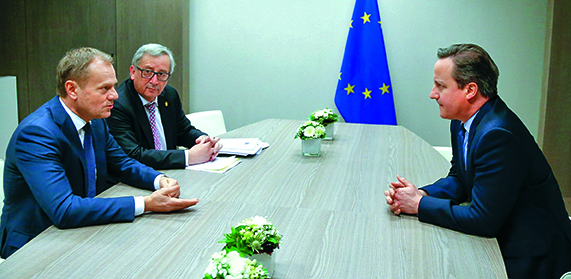
The chairmen of the European Council-Donald Tusk and the European Commission-Jean-Claude Junker discuss with David Cameron *the future of Great Britain and, possibly, the whole EU, Brussels, February 2016.* Photo: AFP/East News
Brussels, February. After the negotiations of Britain-the EU in open format, they remained the three of them-the British Prime Minister David Cameron, the Chairman of the European Commission Jean-Claude Junker and the European Council President Donald Tusk. It was about the referendum planned on June 23 in Britain about its further membership in the European Union. "Let's clarify: what is your position, yours personally?" - asked Tusk Cameron. “My position is known: Britain, when fulfilling a number of conditions, should remain in the United Europe. But I will not entrust the population. ” “And on whom do the voting results depend?” - "Both from us and from you." “Then let's talk,” Junker intervened in dialogue.
The conversation ended late at night. Cameron was quite pleased with himself. He achieved from Brussels concessions according to the most painful, as it seemed to him, for the British taxpayer questions. In the next seven years, London, as an extraordinary measure, will be able to suspend the payment of benefits to unquenchable labor migrants from the EU countries. Having agreed to pay the benefits of children working in Britain to the EU, Cameron spent the condition: the benefits themselves will now be brought into line with the level of such payments in the countries of the actual stay of migrant children. Another concession from Brussels: the slogan “increasingly dense integration of the EU countries” no longer belongs to the UK, and the pounds recognized the EU, along with the euro, along with the euro.
However, the results of the night conversation did not fundamentally change anything in the moods of outsters and rimainers. And the last part, undefined, still hesitates. And whether Cameron’s diplomatic feat has any significant influence on these fluctuations is still incomprehensible.
Cambridge vs St. Petersburg
The British position on Brexit primarily and mainly depends on the level of education and literacy. To distribute leaflets campaigning for exit from the EU, in the area of British university towns, is a hopeless business. Few people agree to take such a piece of paper in their hands, and if they grab it according to a misunderstanding, they will immediately throw the agitator with a contemptuous look in the nearest urn. But Britain is by no means of universities.
For the period from February 1 to 8, the Russian RT channel quoted five British politicians decisively advocating for parting with the EU, and only two - who are against
The Economist magazine published the results of a striking study, comparing two cities located in the same county - Cambridge and Peterborough. They are similar to many: both are growing quickly, financially successfully and are quite comparable in terms of population. There are also demographic similarities: residents of both cities younger than the national average. Both cities are located approximately at an equal (about an hour on a train) distance from the cosmolitical, pro -European London. Both Cambridge and St. Petersburg receive subsidies from the EU, helping the growth of the city economy. And even the number of citizens born in other EU countries is approximately the same - one out of ten. But this is a striking difference is in the level of education. Cambridge has a colossal concentration of people with university diplomas and students, in St. Petersburg - most barely graduated from high school. And the level of Brexit support in two cities reflects this imbalance: Peterborough - the Bastion of the outers - there are 62 %of them there. And in the scientific Cambridge only 27 %want to get rid of the European Union. By the level of Brexit's support, among the parliamentary districts of Britain Cambridge, it is in 619th place out of 632. And Peterboro at the 49th.
According to a survey of the Sociological Service of YouGov, in the whole country, among those who stopped studying after 16 years, the number of EU opponents is 57 %, and among people with university diplomas or their equivalents - only 38. Other factors play - like the level of income and age, but much less significant.
Egoists and idealists
The heads of 200 British companies, including 36, which are part of a hundred largest capitalization, signed an open letter in support of Cameron's position. However, almost two -thirds of the other companies from the Golden Hundred refused to do this. This does not mean that they are all for Brexit. No, it was simply either in the board of directors that it was not possible to develop the general position, or in companies they are afraid that those who disagree with them will begin to boycott their products.
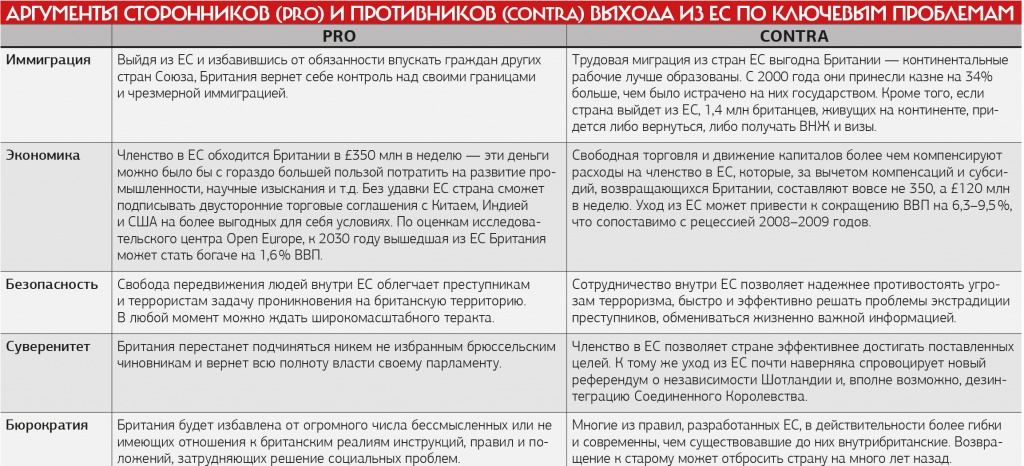

Most likely, businessmen-authors represent the interests of those industries and that part of the British economy that are not interested in the general market and, on the contrary, can benefit from prohibitory customs barriers. For example, enterprises that do not depend on supplies from the continent and the sales of which are fully oriented to the domestic market: for them, European manufacturers are only competitors. And those who are interested in creating favorable conditions for “import substitution” are not so few. However, it is impossible to talk about it frankly and out loud: after all, this would mean admitting purely selfish interests.
The political elite is also split. On the right flank of the ruling conservative party, Brexit supporters set the tone. Among them there are outstanding personalities, for example, the most popular politician of the country, a brilliant publicist, mayor of London Boris Johnson (whom, however, many suspect political ambitions, the desire to occupy the prime minister’s chair) or Cameron's old friend, Minister of Justice, Michael Gov. The main argument of Gova and his like -minded people is the need to protect British sovereignty, to get rid of Brussels. To which they answer from the opposite side: Britain played and plays one of the leading roles in the adoption of pan -European decisions. In general, they say, in the modern world, absolute sovereignty does not exist: membership in the UN, other international organizations and hundreds of contracts and agreements significantly limit the concept of state independence. And the influential observer, Columonist and blogger Hugo Dixon formulated the same thought: "Today the most sovereign country in the world is North Korea."
Putin will win?
Prime Minister Cameron calls the potential departure of Britain from the EU “jump into the darkness”, bearing in mind the unpredictability of the consequences of a step that can have the most detrimental consequences not only for Britain. The already quoted Hugo Dixon writes: if Brexit can still be argued about the economic consequences of Brexit, then "only Vladimir Putin will win from the exit of Britain from the EU." “Without any doubt, the destabilization of the European Union is the foreign policy priority of the Russian president,” the ex-Prime Minister of Belgium Guy Verkhofstadt echoes Dixon in The Guardian newspaper. 13 former commanders of the British armed forces who signed an open letter in support of the call to stay in the EU formulated a similar position.
Some authors argue that Putin's Russia not only dreams of leaving Britain from the EU and weakening the latter, but also actively contributes to the achievement of this goal. Ben Nimmo, senior researcher at the London Institute of Public Administration, analyzed the materials of the English -speaking bodies of Russian propaganda - the RT channel and Sputnik agency - and discovered undisguised unilaterality in filing information about Brexit. The vast majority of plots and materials were concentrated on criticism of the agreement reached by Cameron with other EU leaders, it was described in detail about the difficulties of its implementation. For the period from February 1 to February 8, RT quoted five British politicians decisively advocating for parting with the EU, and only two, standing in opposite positions. At the same time, authors were given incomparably more space than the Rimeyers, Nimmo writes.
British enterprises are interested in Brexit, which are not dependent on supplies from the continent and the sales of which are fully focused on the domestic market: for them European manufacturers are only competitors
Of course, the degree of influence of Moscow on the results of the referendum on June 23 should not be exaggerated, it is negligible. But…
The leaders of the outsters could never count on success, if it were not for their social support - a traditional, not too educated working class and small entrepreneurs from cities such as Peterborough. Many of them feel lost in globalization, feel the threat of a familiar lifestyle, which is carried by the third and moreover of the fourth industrial revolution, fraught with a significantly less need for labor.
Britain is both unique and not unique. It is distinguished by its island position and the imperial past, but also similar to other Western countries with the soreness of the ongoing social transformations. Movement for exit from the EU is a symptom of a general deep illness, a crisis of a change of eras, which has gripped the whole developed world. Everywhere there is a riot of archaic, taking either extreme right, then extreme left forms. But in any case, this is an uprising against modernization. And even in Russia - in completely different historical and social conditions - something related in meaning is happening: in the form of the ideology of archaic nationalist “bastards”, imposed by society seems to be from above, but with the apparent approval of the majority of the population. No wonder, by the way, Vladimir Putin became for a considerable number of people and in the West a symbol and even a potential leader in the world-historical movement. The exit of Britain from the EU may be the first step on this slippery track. “Dream in the Darkness” has a chance to end at the bottom of the ravine.
British enterprises are interested in Brexit, which are not dependent on supplies from the continent and the sales of which are fully focused on the domestic market: for them European manufacturers are only competitors
Difficulties in choosing:
Alternative models of Britain's trade ties with the EU
Norwegian
Norway, who refused to join the EU, has yet to access the common market. In return, it makes a significant contribution to the EU budget and obeys the rule on the free movement of people, as a result of which more than 6% of Norway residents are citizens of other EU countries (there are 2% less in Britain). In general, Norway agreed to fulfill 75% of the EU laws and rules. Thus, having accepted this model, London would lose the opportunity to influence Brussels decisions, but at the same time it would be obliged to comply with the rules established by him, against which the EuroSceptics objects primarily.
Swiss
Switzerland access to the EU financial services market is very limited. The adoption of such a model will cause Britain significant damage, since finances are the most important sector of the national economy. Since Switzerland plans to abandon the principle of free movement of people within the European economic zone, the EU has already warned it that it would be deprived of other economic privileges in this case. The option for Britain is absolutely unsatisfactory.
WTO
Before Britain, who has left the EU, concludes new agreements with Brussels, its trade with the countries of the Union will be regulated by the Rules of the WTO. This means that British exports will be taxed by customs duties: 5% for chemicals, 10% - for cars, 20% for alcohol and up to 50% for food products.