
Translated material
The role of feminism in the study of glaciers
Glaciation, that is, the study of glaciers, polar hats and other ice and snow on Earth, few are associated with especially hot spores (the maximum - with such boring jokes as this). The topic does not have: what will the editorials of newspapers shout about-that the glacier has advanced two meters in ten years? Nevertheless, even from glaciology in early March, they managed to inflate an international scandal when everyone rushed to discussthe article by the historian of science Mark Kary from the University of Oregon called “Glachers, Gender and Science: The feminist glaciological framework for the research of global environmental changes”.
The US National Scientific Fund (NSF) spent 400 thousand dollars studying the role of feminism in the study of glaciers - this is how this name was translated into human English on the Internet. And it doesn’t matter that he wasn’t in the lottery, but in preference, and did not win, but lost: that 400 thousand is a long -term grant not specifically for this article, and that the leading author is a well -known scientist who wrote more than 30 reviewed articles and three books, and not just passed by. It is important that half a million bucks were sawn into feminism; The story in the presentation “Well, dumb” reached the Russian Internet, where, for example, it was recognized as “a convincing victory of pure, uncomplicated insanity” . I think the unfortunate magazine Progress in Human Geography has never seen such traffic on its pages before.
Feministic ice is not the first scandal of this kind in American science. A living talisman for permanent attacks on scientists who allegedly spend money on taxpayers at the same time, the white shrimp Litopenaeus Vannamei on the treadmill became. David Shonik from the University of Pacific, he made the track himself, spending only $ 47 on this (and not three million, as he trumpeted from the screens) - he needed a shrimp simulator to study the immunity of crustaceans. But conservative authors still include the famous shots in the collections of very expensive (and, as it were, implied, idiotic) scientific research.
Fortunately, Feminism was not involved in the work and his shrimp - the main scarecrow of the current American conservatives, which from the words Women's Studies are even faster than from the hint of a state budget embezzlement. Otherwise, shrimp would have been very difficult.
A living talisman for permanent attacks on scientists who allegedly spend money on taxpayers at the same time, the white shrimp Litopenaeus Vannamei on the treadmill became.
It is useful to finally figure out what “feministic glaciology” is, which interested everyone. Mark Kary himself explained in the interview : the phrase was specially added to the title of the article to “provoke a discussion about who makes new knowledge about glaciers, what conclusions can be drawn from this knowledge, whose voices remain behind the scenes and what questions are asked (and accordingly are not asked).” In particular, Carey calls on to pay attention to the points of view and position of women.
Why specially listen to women? There is a long answer about women-scientists and short about everyone else. Well, for example, then, that there is always a chance to find unique knowledge in them: very often many questions, one way or another related to the participation and contribution of women to science and art, are the women and only they study. Firstly, the salvation of drowning people is known whose business is known, and secondly, critics of feminism terribly love in response to any comments on books, films, comics, computer games and say anything: “Do not like it-go yourself and better.” They go and do it.
So, for example, thanks to the writer and teacher of Oxford Anna Bell, we can read that the sister of Felix Mendelssohn (the same, with the march) Fanny Genzel wrote more than 400 musical works, most of whom did not see the light, because men - guardians of the family archive after her death said, "she was nothing , just a wife." The historian Margaret Rossiter excavated about 500 women in a multi -volume biographical directory of American Men of Science - and wrote a three -volume man about Americans in science, where about each you can finally read two sentences, as before, in traditional encyclopedias. Another science historian Donna Hereway was one of the first to pay attention that dioramas with scarecrow of wild animals in the American Museum of Natural History are actually reproducing not the life of the animals themselves, but quite dense ideas of their authors about American exclusivity and the role of men and women. Herey's essay Patriarchate of Patriearchy Patriarchy has become a classic of museum research.
The interest of women of the present in the women of the past is clear. Here is the little sister of Richard Feynman, Joan, grandmother said that she could not be a scientist, because they could not overpower female brains. Joan Placal, and then found Cecilia Payne-astronomer and absolutely exactly a woman in an astronomy textbook-and eventually learned to astrophysicist, worked in NASA and JPL laboratory in California and became the first woman in the leadership of the American geophysical union. Girls are so often faced with the statements of the type “X is not a female business”, which quite quickly learn to refute them to present women who turned out the X perfectly. The boys somehow do not have such a problem.
When the US national institutions in the selection criteria for grant indicated “aggressive risk accepting”, all nine winners of the first circle turned out to be men, and when the wording was changed to “pioneering research”, women immediately appeared.
But women-scientists, of course, are interested not only in outstanding predecessors: their share is greatly fluctuated depending on the field of science and the country in which they work ( an interesting scientific american made in 2014. But what we know about their labor everyday life, to put it mildly, is not happy. Women in science often (there are happy exceptions, as Asya Kazantseva loves to remind everyone ), they are forced to fight a tide: one of the first two graduates of Yele with the degree of bachelor of physics, Ailin Pollak, tells how “fun” she was like the only woman in the audience - to constantly solve tasks alone, when everyone else worked in the groups, to lag behind in matanalization in the first semester (because The director of the rural school, Ailin, forbade girls to choose advanced courses in mathematics and physics, and she studied everything, as she had to) and not raise her hand due to a city of ridicule. And never once, from any of the teachers, do not hear the proposal to go further at the master, despite the diploma with honors and the corresponding grades.
And yes, now Eilin Pollak is only 60 years old, while the first bachelor of male physics from Yale must think, died in the 19th century (if not earlier).
Since the 1970s, when teachers and classmates intensively hinted Eileen that she had nothing to do here, we have moved forward, but not so far. The unsuccessful jokes of the Nobel laureate Tim Hunt about women who cry in the laboratories are annoying nonsense, frankly, even somewhat disappointing that so much effort and screen square centimeters were spent on such meaningless and merciless garbage. It would be better if we all wrote once again that two women can literally recommend that two women find a male co-author , that the same theses of the report under the male name and surname are for some reason better than under female . That the Y -chromosome adds to the annual earnings of the hypothetical laboratory assistant about 4 thousand dollars , that harassment, which is widely known for narrow circles, can remain without consequences for almost ten years that Afro and Latin American women are regularly mistaken for cleaners . And that men are more likely to be skeptical of all of the above research and statements - simply because, of course.
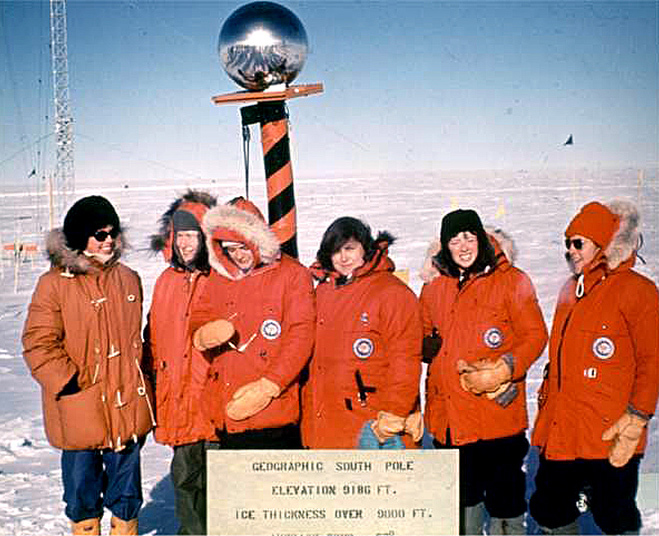
In glaciology and, in a broader sense, in geology - who would have thought - things are not very good either . Carey, for example, talks about the first Antarctic scientific expedition, consisting of some women, in 1969. The journalists of these women asked if they would be sad and lonely in the Antarctic, as well as what they would do if they are faced with a rabid seal. If this reminds you of something, then you, apparently, read about the press conferences of Sally Raid Ryd and Elena Serova : in 1983 they asked if she would cry in orbit if something does not work out, the other in 2014-how she would lay her hair in zero gravity. Truly the glacial speed of change, what can I say.
Another argument, in short, the previous ones: outside the laboratories and cabinets, women actually make up a plus or minus 50 percent of the population. Including next to the glaciers. Women in the same way store and transmit knowledge of indigenous peoples, for example, or encounter the consequences of the disappearance of glaciers due to climate change. Sociologists, anthropologists and culturologists (and it is about them, after all, work on sociology and the history of science) cannot ignore half of the respondents.
The historian of science, Donna Haarewi, was one of the first to pay attention that dioramas with stuffed animals in museums are actually reproducing not the life of the animals themselves, but the rather dense ideas of the authors about American exclusivity and the role of men and women.
Carey and his colleagues suggest that a different attitude towards women and men in science ultimately result in different attitudes towards the results and the same “patriarchy of plush bears”, when gender stereotypes are treacherously crawling where it is not necessary completely invisible to the participants in the process. “What if we still extol the heroic, risky, focused on the conquest and conquest of the elements of projects (for example, collecting data in hard -to -reach areas of Antarctic) and downplay the role of“ boring ”projects deprived of the halo of adventure?” - asks the historian. In this matter, there is more sense than it seems: when the national health institutions of the USA (NIH) in the selection criteria for the grant indicated “aggressive risk accepting”, all nine winners of the first circle turned out to be men , and when this wording was changed to “pioneer [research], women immediately appeared.
It is not without reason that criticism of feminism gives a story with ice (which is sometimes not-string) as an attack by feminism on the “normal”, that is, natural, science (humanitarian and social sciences, they simply wrote down the utilize political correctness). An attempt to see how knowledge is produced in such a science - even not, the arrogance itself to assume that this knowledge may not be born pure, objective and beautiful, like Aphrodite from sea foam, but is extracted by imperfect people - this heresy and blasphemy for those who have a blind spot in the application of the scientific method falls directly on this scientific method.
Read the interview , which in the summer of 2015 gave the BBC the deputy director of the Institute of Psychology of the Russian Academy of Sciences (then just all discussed Sir Tim Hunt and his jokes). There is no discrimination in science - if a woman is competent in her field, has serious motivation, works, then it is very difficult to interfere with her. And then, through two paragraphs, men are already more prone to the exact sciences, and women are more successful in humanitarian.
We live in patriarchal culture, gender stereotypes are tenacious, which means that and then suddenly a man more developed rational thinking, a woman has a more intuitive one. How is this wild emulsion from mutually exclusive paragraphs, stating facts and terry neurosxism (the same Asya Kazantseva, who directly allows everyone to call her “heifer” and does not particularly complain of feminism, the first to you in lectures , and in the book will say that such axioms about different thinking are not disintegrated into a separate head, resolute It is incomprehensible. Moreover, it is not clear how you can, having read such reasoning by a scientist in a leadership, not think that they are also people.
David Sholnik’s sports shrimp, ultimately, was not very affected by increased public attention, and the glaciers will certainly survive it. Historians of science, probably, will continue to be more careful to choose the names and write brief presentations of their articles. And there is some loss for society in this: now only feminists will find them again and find them, who, as we have already installed, drowning themselves. And it would be useful for us all more often to discuss precisely the non -washing of science, and not all sorts of jokes or shirts there.