
Translated material
The dialogue is above all
The museum program of the Charitable Fund Vladimir Potanin began with the invention of the format. More precisely, with chewing for the Russian audience thought that the museum can and should be perceived as a place of collective production of culture, and not as a warehouse or archive. To date, we can already say that in the minds of the Russian museum community it has settled largely thanks to the fund.
At the beginning of the zero programs of the fund, the development of the cultural methodology as an industry and the cultivation of the expert community was the development of the methodology. At the level of specific tasks, this was expressed in the sequential formulation and reproduction of “new museum standards” that came along with an updated cultural elite in the person of managers and entrepreneurs. The reinforcement of the museum in the spirit of the New Age ultimately demanded from the reloading institutions of value landmarks.
To the orientation on the media, to the openness and accessibility, transparency and publicity of the production process (with the opacity of the competitive selection of applications, the mechanisms of which remain for the public invisible) added “moderation and accuracy” that are related to them: that is, neutralization of reflection and the absence among winners of the grant competition of projects that do not fit into the format of near -domestic cultural events.
For Vladimir Potanin, who in 1998 became president and chairman of the board of directors of the Interros holding company, the fund’s museum program was not the first cultural project. “Onexim Bank” during his presidency became the first Russian bank financing the Hermitage, in fact, the “financial consultant of the museum”. The next bright episode of his philanthropist activity took place in 2002, when Potanin bought the “black square” of Kazimir Malevich from the collection of the bankrupt Inkombank for a million dollars and presented it with the Ministry of Culture. This was the first case of such a large -scale investment in the culture from a private person in post -Soviet Russia.
One of the basic conditions for institutions is the ability to self -financing.
Later, in 2013, Vladimir Potanin will join the “Oath of Gift”, becoming the first Russian businessman who supported the initiative of Warren Buffett and Bill Gates: all those who joined the “oath” are undertaken during their lifetime or posthumously transferred 50% and more of their condition for charity goals.
Today, the fund, founded in 1999, is associated primarily with two initiatives - the famous Potaninsky scholarship for students and young scientists and with the museum program, which has existed since 2003 (over the years the fund has supported 206 museum projects from 49 regions of the Russian Federation).
The professional museum community, especially in the province, at the time of the birth of the fund was a rather loose mass that had not yet moved away from the shock therapy of the 1990s. The “new standards” of the fund’s program were kept on two pillars - interactivity and social involvement of the museum into the life of the city and the professional community, within which the need to compete among themselves for the attention of both the viewer and the sponsor was artificially created. The fund, thus, worked on the replication of events. One of the main tools for their production was educational programs for participants in a grant competition, which allowed the project to support the fund to support the project - that is, to make it available to a wider audience.
In many respects, the relationship between the philanthropist and institutions at that time was based on coercion for communication in exchange for support - financial and informational. The museum, closed in research work, which cannot be presented as a show, could hardly count on support.
At the same time, the fund, according to the ideology of the museum support program, does not deal with the meaning of projects, but sets them a tough bureaucratic frame, the correspondence of which is the basis of competitiveness. The business structure, thus, intervenes in the life of the institution as constantly present and requiring the observer's reporting. The museum in this configuration loses the right to an experiment not prescribed in the original application, it remains only to comply with the contract.
Relations between the philanthropist and institutions were based on coercion of communication.
Nevertheless, the museum program of the fund has become the embodiment of an “smart” philanthropy unusual for Russia, which almost for the first time focused on the process of creating the project, and not on the result.
Today, the program is crushed into several areas, among which there is a partnership program for developing joint projects with state salaries and a grant competition “Museum Guide”, designed to revive and “increase tourist attractiveness” of not very popular local history and archaeological museums and parks. The Museum landing program offers foreign internships for museum employees and assistance in establishing intermediary cooperation in any form - from joint seminars to counseling. And the most famous grant competition of the fund, “changing the museum in a changing world”, is working to bring a number of museums that have confused the charge of relevance, from cultural anabiosis, to stir up the community in the field and create an expert base.
The last program is especially indicative. She also approves the priority of communication before representation, but also appoints the project the main unit of museum life. First of all, all its participants had to revise the concept of “exhibition”, because the “project” should be based on the process or context, and not on artifacts. This is perhaps the most pronounced innovation of the fund that makes it a kind of co -author of the projects that he supports. Outside the projects that the fund supports, it seems to be not carrying any ideology or at least does not articulate it: its representatives speak only about the tasks of the current moment. However, on following the “trends”, the new type of relationship is built - both within the museum community and in the communication of institutions with the audience - the creation of which the program is working.
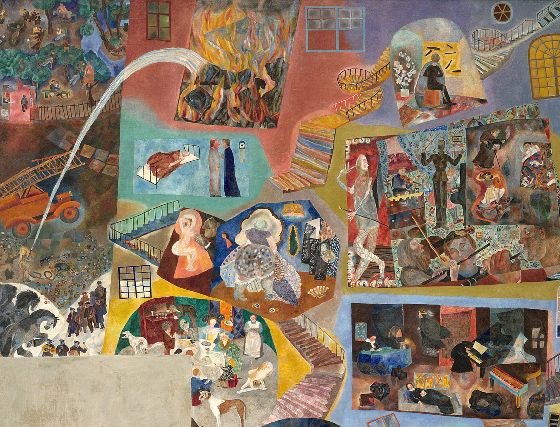 Glebova T.N., Porn A.I. House in the section (cut of our house). 1931. Yaroslavl Art Museum
Since the appearance of its winners, a variety of projects have become in the range from the reflective sociological study of the Moscow Kremlin “Who needs this museum” to the “House in context” - the educational history of the Yaroslavl Art Museum, which increased from the eponymous canvas of the Philunovsky school. The project was an attempt to make out the general in the private-through one picture to present a cut of culture of the 1920-1930s. As a result, an interactive series was obtained, which assumed lectures, work with the original, the creation of a multimedia application and the site.
Today in the competition there are four nominations - “Museum Design”, “Museum and the local community”, “Museum Start” and “Open collection”. Each can have several winners. The prize fund of the program is 25 million rubles.
Explaining financial issues, the Director General of the Foundation Oksana Oracheva said that almost all the projects that the Fund supported under museum programs are partnerships. “Already at the application stage, it is implied that the project should be co -financed,” she says. - If there is a need to expand the project, its authors are simply looking for additional funds. The fund does not help them in this process - our task is somewhat different. But the support of the fund, as a rule, is a significant help for the applicants in the search for additional resources. ” That is, one of the basic conditions for the institutions participating in the competition is the ability to self -financing.
In this case, only non -profit organizations can apply. In 2015, for example, 424 design applications were received for the competition, of which 63 most promising were first chosen, and then, by decision of the Expert Council, 20 of them were awarded. Some winning museums made tourist routes to fishing places in the Astrakhan region with a tasting of local cuisine (as a 2015 winner project, “more than a souvenir”), others seemed sufficient to launch a site or publish a book. The general leisure focus of all projects is also one of the new standards of museum activity.
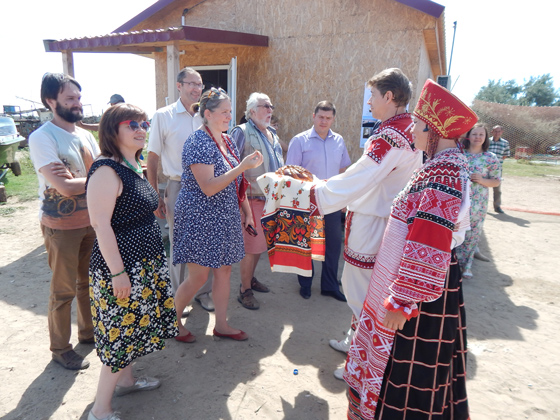 The project "More than a souvenir"
Over the 15 years of existence, the Fund really fulfilled almost all its attitudes (first of all, having created a base of loyal experts) and in 2014 formulated a new museum strategy, reformatting old programs. The organizers of the contest “Changing Museum in the Changing World”, for example, abandoned the intermediate refinement of applications and introduced a new approach to nominations. “How the museum implements its project depends exclusively on it: it can be an exhibition, an educational event, something else,” says Oksana Oracheva, telling about the “Museum and local community” of the “Changing Museum ...”.
The maximum openness and transformation of the museum into a brand became the new guidelines of the program. True, both of them over time quickly turned into information satiety. So, in the context of the “Changing Museum ...” contest, a mechanism has launched tons of secondary content - from diaries that project managers must be conducted, to publications in the press and specialized seminars. Reporting forms, which was not the end, replaced both the process and the result itself. That is, a project taken as a unit of museum production has ceased to exist outside the media history.
In the course of work, some of the previously non -obvious moves became clear. For example, what to work to update the collection often meant to find codes that are freely converted from one media or format to another. The project that won in 2009 is most indicative in this sense: the Kursk State Picture Gallery named after Alexander Deineki then implemented the project “Advertising Place is rented”. Its authors twitched on billboards in the city of videos about paintings in the gallery. In parallel, the same small films were projected in the gallery itself during exhibitions. It was not just an intervention in the city, but a search for a format available as a widest audience as possible.
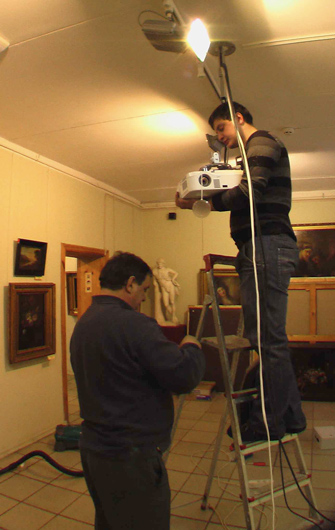 The reorganization of the exhibition hall for the project "Advertising Place is rented"
For the same purpose, the cultural functions of institutions were often replaced by social ones: museums deliberately performed situations, working at the junction of education and the intelligence. For example, in 2011, one of the winners was the project “The Brill sculpture language” Elena Gerasimova, the head of the educational programs of the Tretyakov Gallery. The exposition intended for people with vision problems (all sculptures could be touched by hands), broadcast the triumph of social inclusion. Another example: with the assistance of the Fund, the studio “The Tale of the weekend” appeared in the Literary Museum, where the children read the tales of Russian writers of the 20th century and staged performances on them, made cartoons, films and illustrations. The museum, thus, gained confidence in the audience, becoming a school from the research center. Talking about the nomination “Amazing Museums of Russia” in the Museum Guide program, Oksana Oracheva explained that “any project that supports the fund should be socially oriented.”
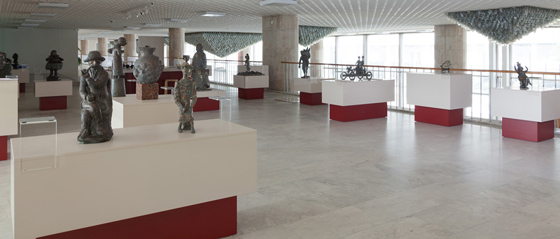 "The language of the sculpture in Brylya"
At one time, the program even had quotas in federal districts. But a few years ago, the organizers of the competition abandoned them. “To this day, a strong community of museum designers has been formed, who are able to compete on equal terms regardless of which part of the country they work,” says Oracheva. - Moscow and St. Petersburg museums, by the way, from this point of view are in a more difficult situation: they are used to resting on the laurels and sometimes do not carefully work out projects. Of course, we are interested in expanding the geography of projects, but there are no formal preferences, because experts make a decision based on the quality of the application. ”
When the museum program changed the format in 2014, the fund began to demand more independence from participants in work on projects. In particular, he abandoned special seminars for the program participants. “A seminar for semi -finals was never the goal of the program - it was a means to finalize applications,” Oracheva believes. - The museum community has changed: strong applications are received from all over the country. For their authors, seminars are excessive, because they themselves perfectly write applications, act as experts and win at international competitions. ” Now, within the framework of the Museum Troops program, there are internships for museum employees, as well as the educational history of the “Museum Guide Laboratory” at the Intermuseum festival.
Over time, it is no longer the socialization of the museum and the multiplication of “new standards” became the main priority of the program, but the transformation of each project into the brand - as happened with the project “Kolomenskaya Pastil”. In this case, the whole museum cluster grew out of a grant received from the fund. The Kolomenskaya Pastil Museum was opened in 2009 to revive the lost tastes of the local pastille and tell the history of the place through them.
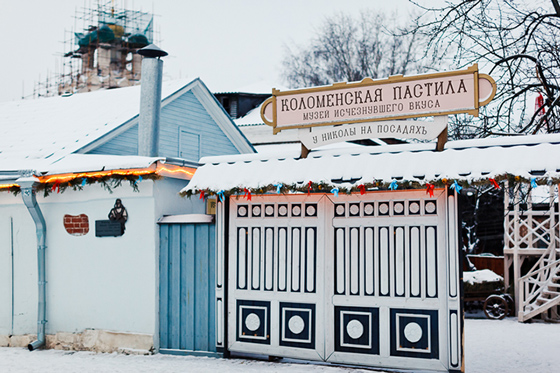 Museum "Kolomenskaya Pastil"
The rate of the program to expand horizontal connections, of course, is primarily focused on traditional state museums, one part of which is still an archive that is not capable of mobile activity, and the other part reproduces the consciousness of Soviet interests in interests. Having produced primarily the experience of creating a new type of projects, the fund really initiated a living creative process in those institutions where life has almost freezed.
But at the same time, another consequence of such an orientation towards communication was the loss of communication with museums that exist for themselves - for the sake of symbolic values that cannot be measured by reports about attendance and work done. After all, a project is always a response to what is happening. Hence the increased sensitivity of the fund to “trends”, and the installation of the production of a formally “new”, which is opposed, violating the usual system of antonyms, not “old” and “traditional”, but “boring”.
To this day, we can already say that the system of work of the Museum Program of the Fund has learned to reproduce itself. On the one hand, the result of the work became more predictable, and the process was somewhat reduced to the ritual. But, on the other hand, a common language has been formed that simplify the dialogue between museums and the fund - a consensus regarding how a modern museum project can and should look.
Download the entire issue of the magazine "Disagreements" (No. 2) "Museums. Between censorship and efficiency ": PDF , MOBI , EPUB