
Translated material
Passing time
As part of the competitive program “Golden Mask” -2016, the Moscow premiere of the play “Beckett. Plays ”, staged by Dmitry Volkostralov in the St. Petersburg Youth Theater. About one of the central events of the festival - Zara Abdullaev.
“Time passes”-a replica from the play of Becu-Bai. Behind her should be a replica "it's time to stop." “Lullaby” (the name of the text) with the refrain of these replicas sounds in the monologue of Alice Zolotkova. It seems to be time to stop repeating that "new forms are needed." It would seem only to follow how “old forms in the new function” awaken - for example, the use of videos, monitors, the location of the public. The expectation of new forms and surveillance of whether the old forms are transformed into something else, themed in the play “Becket. Plays "Dmitry Volkostralov in an equivalent community with the artist Lesha Lobanov and composer Dmitry Vlasik.
The main sensation, it is also a concept, it is also communicative connections and breaks, cutting out various texts and directing “Beckett ...”, there is a passing time. (“Passing characters” by Lydia Ginzburg, who recorded the replicas, habits and reactions of Leningraders in blockade time, sometimes seem absurd, but they are super -real, specific. They do not cease to understand.)
The passing time is with the inevitable and intended refrain of replicas or actions, with the attenuation and revival of sounds and lighting, movement and its stops - the semantic frame of the play. He holds the rhythm of directing. It is he who determines the animation of the actors passing through the time, the texts, the spaces of the actors and - which is no less important - shows not at all the hidden feelings of loneliness, longing, distances, and intimacy. And the most strange thing is harmony from nowhere. From clean or littered air.
 © Stas Levshin
One of the plays is called "come and leave." Flo, Vi and Ru sit side by side on the bench in the frontal mise -en -scene and in the control light. The audience does not see the persons of actresses. But multi -colored coats are very distinguishable in this theater materialized from the Bekket text of the shadows. As well as from the memoirs of characters, that is, from the past time - "we are all sitting together, as before on the Miss Wade playground." The gaming theater platform heeds some kind of long-standing playground, literalizing the very passing time that you, like everyone else, try to grab, catch, feel.
Replicas (for example, “Do you like ru? - Do you see such lighting”) declare the ghost of those sitting on a bench and three girls passing through the stage. The literal correspondence of the replica and lighting plastic pushes the substance of time in all its fragile and stressful visualization. Girlfriends whisper about one or the second to each other and the third something “terrible”. And the one who opened her ear, bursts out of the interjection “Oh!”. This is "Oh!" Three actresses are pronounced by three different sounds. And then they quietly disappear. As if they were not there. Or their time has passed.
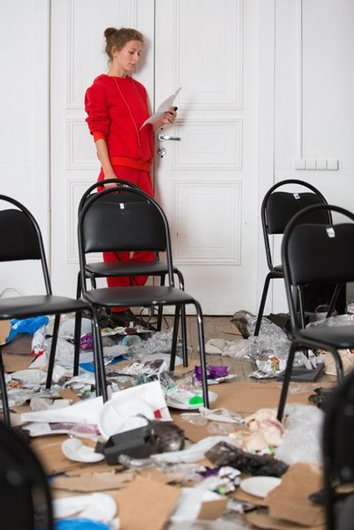
The sterile rigor of the artist and director (for example, in the play “Phantom Trio”), a combination of large, medium, distant plans on the stage on monitors (in other plays) clarify the accents in the lasting and intermittent time of the play. It materializes sensually, tangible: either with selective, then dried voices, music of Schubert, Beethoven, Vlasik percussionist anxiety and unexpected sound in the finale - in the play “Breath”. It is played in a room, the floor of which is covered with garbage - candy candy wrappers, used bags, plastic bottles. On arbitrarily arranged chairs, spectators stuck. The dim light is exploding the cry of the newborn. Its record includes one of the actresses. Then comes the "sound of silence." He is voiced by the recording of breathing. Loud. Time passes. It's time to stop. It's time to finish the performance.
Tenderness breaks into post -conceptual art, and harmony (without caring about catharsis) breaks into tragedy.
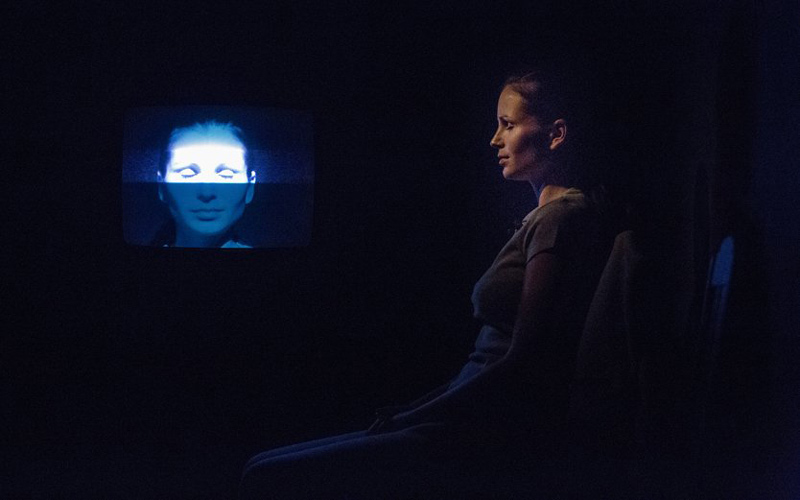
In the “Ghost Trio” - in a gray room with a topchain, window, door - an actor sits on a chair. This interior with the character is broadcast on the monitor - on the stage - in the first part of the performance. The audience passing into the hall sees the space itself before it began. The actress at the microphone conducts a tour of this interior, where there are all shades of gray.
The viewer describes what he sees, or, more precisely, what he is looking at. The scale of plans (large and medium) certifies a person’s stay in a gray room. The actress asks this or that plan to “repeat”. Music sounds, resolves, resumes. Behind the door, it should - on a replica - to be a boy. But he is not. The Ghost Trio materializes cash - the time of gray space, but also the waiting time - possibly in vain. (“Everything has become gray” - the text of Boris Mikhailov under the everyday photograph in his ingenious album “Unfinished Dissertation”; in the same strip, the artist quotes Walter Benjamin that the dream no longer opens the blue Dali, everything has become gray ...)
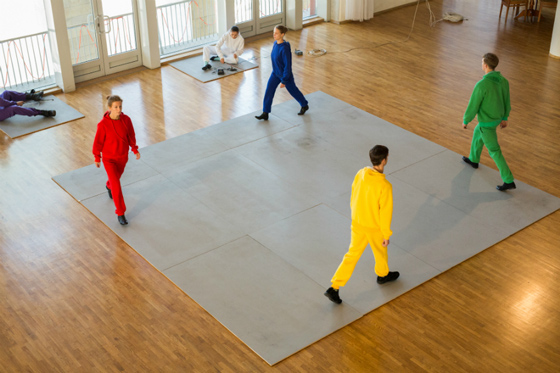
Between the first and last parts of this tript, wolf -wolfers demonstrates the “square”, where four actors in red, green, yellow and white tracksuits (percussionist - in blue) on gray square flooring are performed, striding, solo, duets and a trio. The quasi -how movements of the actors are not imitating greetings to the “mechanical ballet” of the Lege - beautiful, like modernist (picturesque) squares that measure the defendants from flesh and blood.
 © Stas Levshin
Reference in this performance is the confrontation of the belief that “time passes”, although it still has passed. But it is precisely the mode of the play, which lasts a certain period, that consolidates the present. At some points, it becomes enduring.
Repeats, their variability - not only in the "square" - is the desire of the authors and performers to violate the automatism of perception. And automatism of existence. This is the message of the director. Hearing him, including him, the viewer discovers himself in contact with those who conceived and implemented “Beckett. Plays ".
In the play “ Nacht und tr äume ” in an empty room, barely lit from the window, then darkened, you observe another melancholy (or romantic?) Quartet. The actor on the advance shop with his head lowered sees, maybe a dream. It seems that he is also sitting on the catwalk, but - in simultaneous mise -en -scenes - this is now another actor. Someone, an illusory in such lighting, brings a cup. The faces of that (that?), Who brings a cup, who puts his hand on his forehead, is not given to see. But the audience see their hands on the monitor, and large.
The third visit of the director to this theater was decisive and not the last, probably. Actors - Alisa Zolotkova, Alexander Ladygina, Adelina Lyubskaya, Andrei Slepukhin, Ivan Stryuk, Boris Chistyakov - took possession of the director’s method without compromises inherent in residents of foreign territory.
 © Stas Levshin
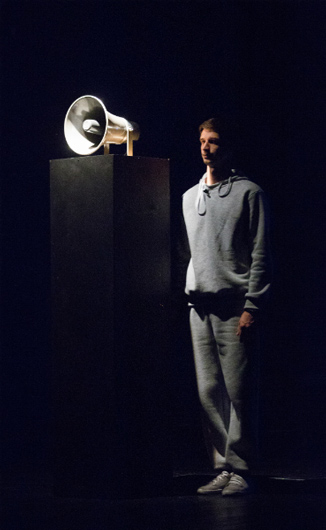
The three -part structure of the performance is produced in three spaces. Several plays are played in the traditional arrangement of the stage and the hall. However, they provoke in a twenty -minute, it seems, the darkness, in which at the beginning of the performance (the play “Sketch for Radio”), the viewer is immersed, his ability to focus or conclude an unknown contract with a future performance. The darkness is saturated with a rustle of replicas with interference and other sounds, including music.
Time passes. The space is littered. This garbage dump is reminded of both the living and the born (childish scream) life. So tenderness breaks into post -conceptual art, and harmony (without caring about catharsis) breaks into tragedy.
In this performance, the director demonstrated that his eyes have acoustics, and his ear is inner vision. Not being an adherent of the “antitheater”, partly practicing the experience of performative art, in “Becket ...” Volkostrolov still problematizes significant questions about “likeness” and “repetition” in a new way. And also insists on refrain as the possibility of falling out against the replication of their and strangers, today's and long -standing (avant -garde) breakthroughs, even if they are sometimes called “gusts”.