
Translated material
"Hold on to the end and we will kiss you"
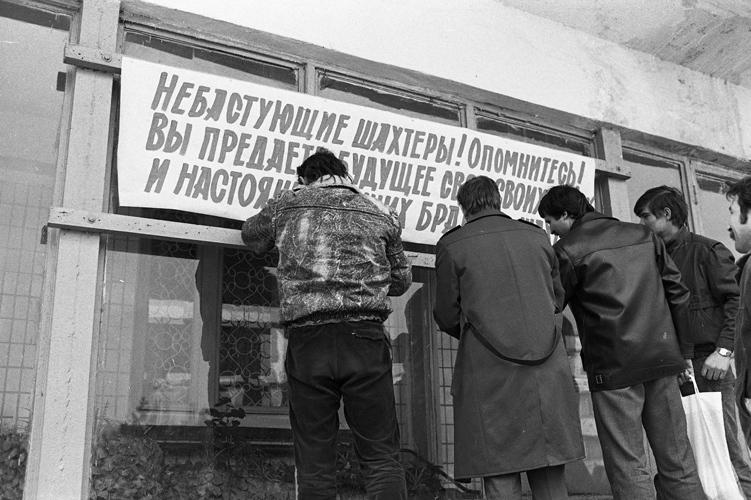
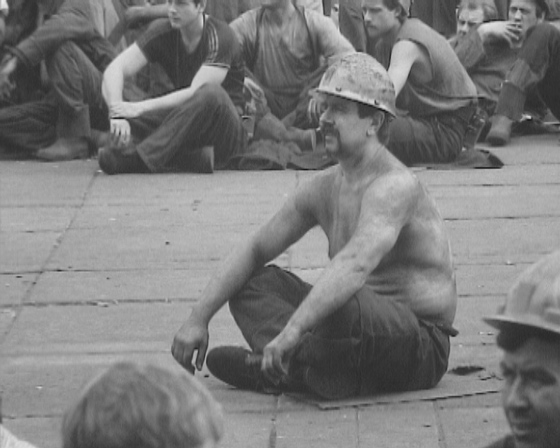
This week in Kyiv begins the Docudays UA documentary film festival. In the retrospective part of his program, one can see the Diloga thunderstorm dilogy about the strikes of the Donbass miners in the early 1990s. The films “Strike” (1989) and “Embrace” (1991) directors of the Ukrkinokhronika studio Anatoly Karasia and Viktor Shkurin - almost the only movie documents about the hundred thousandth pickets of Donetsk miners. The strike began in July 1989 before the building of the regional administration. With interruptions, this strike continued the next two years, in fact until the collapse of the USSR. The causes of protests were inhuman working conditions and the existence of miners: dilapidated housing, lack of heating and centralized water supply.
The theme of the mining movement was one of the most relevant in the late 1980s and, of course, was actively exploited in the political game. In the 90s, people who were directly related to the Coal Industry of Donbass came to the Ukrainian government (later they will enter the Party of Regions), who promised the miners reforms that did not take place. The miners, these “abandoned people” (this was the name of the “miner” project of the Ukrainian photo documentary Valery Miloserdov), again remained with nothing.
The co-author of the July Thunderstorm Anatoly Karas tells about the details of the filming of the protests of the 89-91th, the atmosphere of sunset of the USSR and the current role of the miners in the settlement of processes in the Donbass.
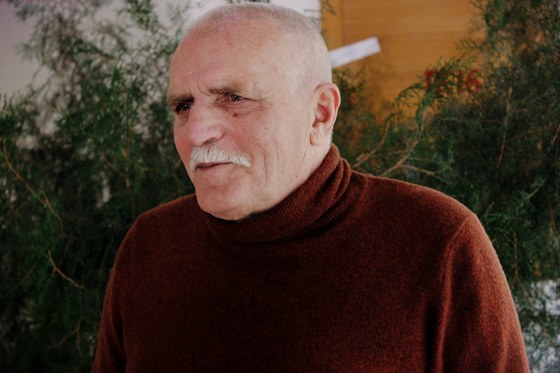 Anatoly Karas
- How did you end up in Donetsk in the summer of 1989?
- You know, in 1989 people were very intimidated. Therefore, the word "strike" was so atypical that no one could simply assume that this could happen in the Soviet Union. All our upbringing, all our experience told us that in the USSR such a phenomenon as a rally or strike, there simply cannot arise a priori.
And then suddenly in the Donetsk region the miners begin to strike. And we thought: “Ukrkinochronika” should respond, we must respond. But the heads of the studio wanted peace and did not want us to climb where we did not need. It was also when we shot the Chernobyl epic - at first Ukrkinokhronika did not want to intervene and only then began to shoot.
They decided to shoot a striking miner as a small black and white plot for the Soviet Ukraine film magazine, they thought that the strike would end soon. So we, some enthusiasts, went to the shooting - I, director Viktor Shkurin, film operator Viktor Kripchenko. We also hoped for our building in Donetsk and the local movie operator Sergei Timofeev.
When we arrived in Donetsk, no one was waiting for us: what kind of group it is, who gave permission to shoot? In Donetsk, already at the station, they only heard conversations about the strike. And we immediately went to the scene, to the square near the building of the former Donetsk regional administration. There we saw a lot of people - the miners took up defense, spent the night in the open air, right on the asphalt. Kripchenko immediately began to shoot.
- Do you remember what day the strike was?
- Second. Moreover, we never reached our hotel, spent the night with the striking miners.
-In the 90s, in the preface to the film, you and Shkurin described the protesters of the same words that characterized people on the Maidan in 2014: free, decisive, beautiful. Was it really so?
- Yes, the people who gathered there were organized and configured to win. They then really felt their strength and their voice. I remember when we started shooting, one of the miners drew attention to us, they say, it means that we were allowed, but the police lieutenant colonel, who was at that time in the square, loudly denied this: “There are no Soviet correspondents here. I repeat once again: there are no Soviet correspondents here. ” But we shot and searched for episodes that could reveal the essence of mining labor.
The miners did not receive the laid for their convict work. This is illustrated by various episodes of the film. For example, the mother of one miner talked about the head of the district party committee who lived in the neighborhood. The car took him to work each time, he ate well and did not refuse to himself anything (one of the requirements of the miners was to increase the norm of issuing soap to 800 gr. Per month per person. - Approx. Auth. ).
Mother says: “Are we not people? Do we have no right to eat normally? " Indeed, the miners did not go against someone, they went beyond their elementary rights.
-But these protests continued further, in the 90s ...
- Then we still could not understand that this mining strike would become the beginning of the collapse of the Soviet Union - the Evil Empire. This is evident in the second series of the film. After all, then the miners were actually deceived. They signed a resolution with the Prime Minister of the USSR to fulfill all the requirements of the striking.
But in fact, nothing has changed. Although soap, of course, was given to them (smiles) , in a word - handouts. And the miners continued the struggle until the dissolution and closure of the Donetsk regional party committee.
In early 1990, we began to make a sequel - the film “Embrace”. There is an episode in this picture when one miner remarks: “What is Shakhtar? Nobody talks about us, neither television, nor the central press. But when the action of foreign miners takes place, everyone talks about it. ”
We finished shooting in 1991. I remember one morning I had to interview the first secretary of the Donetsk regional party committee, but at about six o'clock I heard the familiar music of the Swan Lake. I did not understand why this is happening. He jumped up, and it turned out that the coup occurred. They postponed the meeting in the regional committee, come, they say, later. But I waited for the head of the regional committee, and he said: “What I will tell you: Gorbachev did not manage to carry out the reforms that the country scattered, the party was removed, but they did not find a replacement.”
The miners rejoiced. Donbass was against the GKChP.
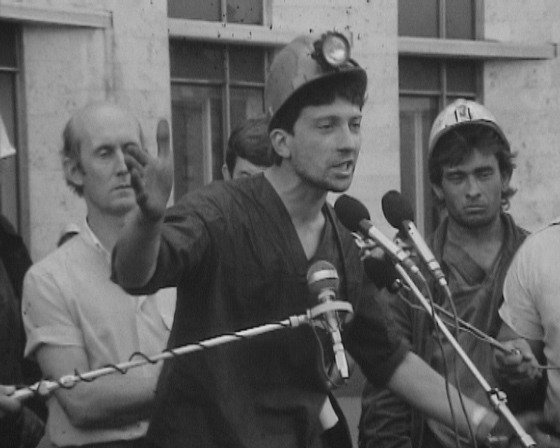 Frame from the "July Thunderstorm"
- How strong was the support of the strike in the Donbass in the rest of the territory of Ukraine, how much were aware of the situation there?
- In the Donetsk region, more than 90 mines (out of 121. - approx. Auth. ), About 100 thousand miners. Then all the mines of the Lviv association, the mines of Pavlograd, stopped - the support was from all over Ukraine, the miner's solidarity was greatly manifested.
There is an episode in the film where, after the delegation of miners from Moscow, the chairman of the Stachkom Boldyrev (in the future, deputy of the Party of Regions. - Approx. Aut. ) Offer July 29 to be considered the day of Shakhtar, and the area where the strike was, to be renamed to the Square Solidarity Square. But this did not happen either.
Strike was also supported by metallurgical plants, they actually stopped along with the strike of the miners. And there was such a thought: let everything fall, but the strike will not be over until all the requirements are fulfilled.
- The film has a number of episodes with famous politicians, as well as discussing the mining issue at a meeting of the Council of Ministers in Moscow. As far as I understand, it was quite difficult to get there ...
- This meeting was held by Ryzhkov. Of course, no one invited us, we came to Moscow of our own free will. They persuaded miners from Karaganda to take us to the meeting. And they said: "The newsreel is ours." So we went without passes for a closed meeting.
There was another scandalous episode with our main Kyiv communist Peter Simonenko. At the meeting, representatives of the Stachkom demanded that he send the party’s secretariat to resign. Of course, then they did not agree to anything, and the miners began a hunger strike right at the regional committee.
-There is a sensation (possibly erroneous) from the film, that at that time the miners did not have a single leader, as it was not at the beginning of the Maidan in 2014.
- This is true, and this is the minus of the mining strike. Because the leaders appeared later, and there were a lot of them, but one strong and smart leader was never found.
-Did Shahtera participated in those strikes?
- Women at that time no longer worked in the mines themselves, but they worked on the surface: they served baths, canteens, and other sites. Despite this, they still had a mining experience.
During the strike, women, like men, spent the night on the street near the building of the regional party committee and insisted on fulfilling all the requirements. There was such an episode when we were brought a letter in which the miners supposedly asked the miners to return to work. However, this was an absolute provocation, because the wives, on the contrary, said: "Hold on to the end, and we will kiss you for this."
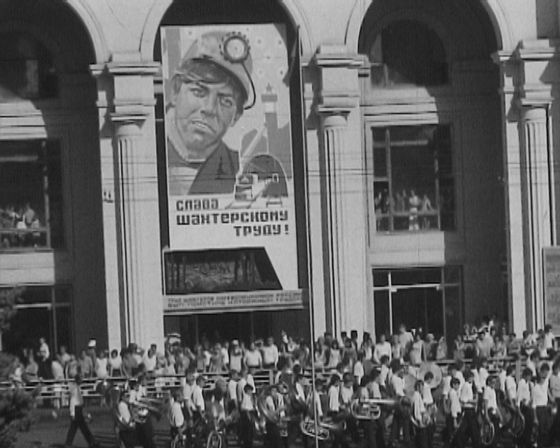 Frame from the "July Thunderstorm"
- In the film, miners emphasize that in their actions there was initially no policy, only the economy.
- This is at the beginning, and then they began to say: Down with the regional committee, resigned. None of the miners managed to rise to the political leader. In a political sense, they were clumsy. I think this was primarily due to a lack of education and experience. Those leaders who were then engaged in the stachkom moved away from work at the mine and began to do public affairs.
Nikolai Volynko, for example, became the chairman of the independent trade union of the miners. Alexey Boldyrev, one of the leaders of the Stachkom, became a deputy in Donetsk, and then became a people's deputy and took a pro -Russian position.
- In fact, in parallel with you, the film about the minerial strike of the Donbass “Perestroika from below” was shot by American researchers Daniel Valkovitz and Barbara Arbash. Have you seen this film crew, talked with them? What was the attention of foreign filmmakers and journalists in general?
- No, I'm unfamiliar with this group. At that time, a group of CNN TV channel was filmed in Donetsk. They were the only witnesses of this miner's strike. Their final gear was on the air from the scene. There was no one else, obviously, they were not allowed to shoot, or maybe they themselves did not want to go to the Donbass.
- Were there any attempts to censor the film or interfere with the shooting?
- There were, let's say so. Viktor Shkurin recalls how the head of the Internal Affairs Directorate of the Donetsk Region, Major General Nedrygaylo, called him and asked how much the film costs. He said that a full -length film costs 100 thousand rubles at those prices. And he suggested buying all the films to close the question of the film. Of course, we did not agree to this. There were attempts to follow us, and to Kyiv itself, but did not come into contact with us.
And the studio leadership at first reacted very negatively, but then, when our personnel saw, when Gorbachev spoke about Donetsk, the vector changed dramatically.
- How did you work with your co -author, a native of Donbass Viktor Shkurin? Indeed, at that time it rarely happened that the film has two directors at once.
- Our team was spontaneously, but we worked together. Kripchenko and I were the initiators of the film, and then Viktor Grigoryevich Shkurin joined us.
The help of the Donetsk operator Sergei Timofeev was very strong. We still regret that we have not included him in the list for receiving the Shevchenkovsky Prize (the Higher Gosprem in Ukraine in the field of art, Karas, Shkurin and Kripchenko received it for the “July thunderstorms” in 1993. - Approx. Aut. ). He helped us a lot, in particular, with a film. He also made shooting at the emergency mine.
I remember one of the brightest episodes when we spent the whole day from morning to night on all fours in the mine. We shot everything. I remember that, unable to withstand all this, I threw off my lifeguard on the way back and left him in the mine. But the master scattered me on the surface - he is worth money! (Smiles.)
We had great difficulties with installation, because there were a lot of material. There was a question about the invitation of the announcer to the film, but in the end they decided not to do this. But recently he watched the movie and realized that, apparently, they refused in vain, in the second part of the film it was possible to read the text.
-In the film, you use the songs “Marsh of Mineers” and “Sleeping the Dark Mounds”, once written for the film “Big Life” (1939), as well as archival shots. Where are they from?
-These are shots of different years, starting from the emergence of the Stakhanov movement, that is, in fact from the 30s.
- And the shots from the "Symphony of Donbass" of Dzigi Vertov did not fundamentally take it?
- Principly. I don't really like this film.
- Too modernist?
- Yes.
- But you have an episode in the film with the same mine with a star that was shot by helicopter in "enthusiasm."
- (Smiles.) But it was removed by accident.
Chronicles we wanted to illustrate the songs that always created this happy miner image: after all, the miners were always good and rich in the cinema. But no one said what kind of labor they acquired this good.
Those frames do not reflect how many girls from the Ukrainian villages were recruited to the Donbass. And they were recruited. They did not want to go neither of their own free will nor with a good heart. For each village, then the order came to how many girls should go to the Donbass, and they went to restore mines. They worked in mines, underground.
 Frame from the "July Thunderstorm"
- Do you remember the premiere of the film when it was, how the audience reacted?
- The premiere of the film took place in the Kino House in Moscow. It was a big event, because usually in Moscow the premieres of the films "Ukrkinochronics" did not take place. We arrived with the whole group. The head of the Stachkom Boldyrev was with us, he represented the film. When the film ended, the hall exploded with applause. Conscious cultural figures came to the film. It was 1990, there were still the USSR and the “specific party situation”.
We no longer showed the second part in Moscow. The premiere was in the Kiev House of Cinema, as well as on central television.
- You have no feeling that the chance that was given to society - and especially Donbass - was lost during Ukraine? Indeed, in fact, then, in the 90s, a lot of people from Donbass itself came to power. For example, Efim Zvyagilsky, who before this headed the mine, and later ended up in a ministerial chair.
- Zvyagilsky was the director of the Zosyadko mine. He was constantly on the square next to the striking miners and promised the miners in a piece of soap, if only this strike was stopped, but he was a balabol and a stratebrich.
-You returned to Donetsk in the 90s, but after these events?
- Yes, returned. But everything died down, only our personnel remained. We took off how the USSR scattered. And he crumbled because he completely forgot that a person is the greatest good.
-Once you said that this 189 Sterk was underestimated. And now, from today's perspective, what can you say?
- This strik is underestimated both as a political phenomenon and as a film. After all, he became the beginning of the end of the Soviet Union. I will tell you that everything is known in comparison, and if we talk about today's Donbass, I feel sorry for looking at what is happening. Russian aggression brought so much grief to this region. And I do not understand one thing: the miners, who were then the main driving force, were now in the shade. They did not show themselves as then, in 1989. And they could stop aggression, could stop the war ...
-As a screenwriter and director, you have been working at Ukrkinokhronika since the 1970s. What was this studio? Did you feel in the shadow of other Kyiv studios - “Kievna -Science” and the Dovzhenko film studio?
- Rather, on the contrary, we have always been at the center of political events. Then television did not have the possibilities that we possessed. We were involved in any shooting with party leaders, for example, to arrive Indira Gandhi. There was also an option for filming abroad, the planning of which was carried out through the co -consuming. But Ukraine got shooting, for example, in Laos, and Prague, Berlin - this is not us.
And we often shot the Donbass, because we had one of the nine cornets there and the director Kosinov worked, who knew this topic and how people live there.
I made a lot of films with Alexander Koval, and all our work permeated the look at man, at his life and care. We wanted to document how and what an ordinary person lives.