
Translated material
Ours or Turks?
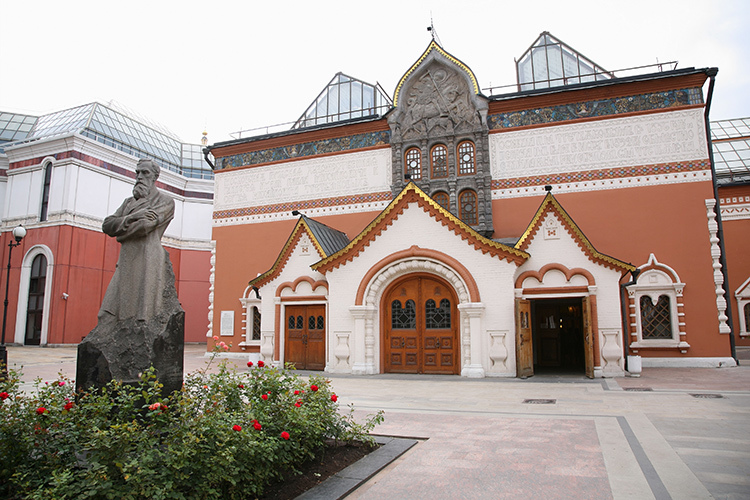
A strange quirk is to consider the State Tretyakov Gallery an art museum. GTG for Russia is, first of all, the National Historical Museum, and only then - a collection of art. From its very foundation, the Tretyakovyk fluctuates between two converging and diverging dimensions - national and democratic. Pavel Tretyakov gathered his collection in the complete realization of what he was doing “a great thing for Russia”-and this great work was carried out against the backdrop of nationalist sentiments that accompanied, for example, the Russian-Turkish war and the colonization of the Russian Empire of Central Asia.
The Russian realism, which makes up the backbone of the old Tretyakovyk, is inscribed in the still functioning ideological contradiction formulated in the 19th century for many countries - the contradiction of the national and universal. The universal, supranational, that above the civilizational disagreements and solidarity on a national basis is represented in the story of a friend of many Russian realistic painters, the writer and artistic critic of Vsevolod Garshin “Four days”. Garshin is the beloved hero of Ilya Repin, who appears in his paintings in different roles: in the role of himself, a young writer, who is excessively sensitive to the suffering of the oppressed, in the role of returning the exiled in “did not wait, in the role of the bloodied prince in“ Ivan the Terrible ”. In the story “Four Days”, Garshin talks about a young man who has gone in a fit of solidarity with the fraternal Slavic peoples as a volunteer for war with Turkey, wounded on the battlefield and spent four terrible days near the corpse of the Turk killed by him: “This is a corpse. Ours or Turks? Oh my god! It’s not all the same! ”
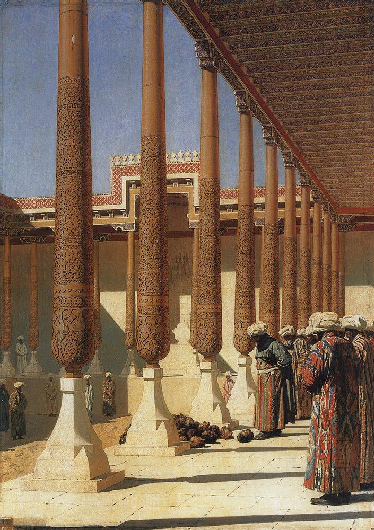 Vasily Vereshchagin. Represent trophies. 1872
Garshin’s story is the wrong side of any, even “progressive” nationalism, including Tretyakov’s nationalism, who, competing with the king, lays capital for the monumental ultraralist military series of Vasily Vereshchagin-for his masterful colonial hypersonal, satisfying the curiosity of the metropolis to the exotic horrors of the wars, which are far from somewhere far away. barbarians. Tretyakov, for whom the “war against barbarism” - the “great work of the Russian people” collects not only and not so much art as heroes, creating a still successfully functioning historic pantheon “revived” by the artistic imagination of historical personalities (often associated with the key moments of the formation of Russian statehood), such as Ivan the Terrible Antokolsky and Repin, Peter the First Gi and Surikov, and among the first Ga and Surikov, and among the first Ga and Surikov, and among the first them - the main historical personality, according to which the meaning of others is measured - Christ (Antokolsky, Ivanov, Kramsky and many others). Tretyakov’s most important curatorial project is a gallery of portraits of great figures of Russian culture, living, dead or preparing to die (at the time of writing) of bearded husbands from Mussorgsky to Tolstoy, from Nekrasov to Glinka.
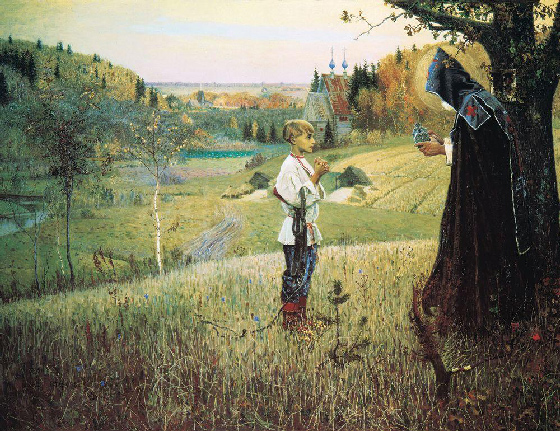 Mikhail Nesterov. Vision of the lad to Bartholomew. 1889–1890
The supranational, class democracy of critical realists speaking in the international artistic language of its time is built into the ideological frame of national art, which is constructed and supported by the Gallery collection as an integral organism. The stylistic “Russianness” of each of the emblematic artists of the Tretyakovka, if we compare them with Western counterparts, is almost elusive and therefore is still advancing as a kind of immanent, purely artistic quality, which the connoisseur is obliged to feel intuitively.
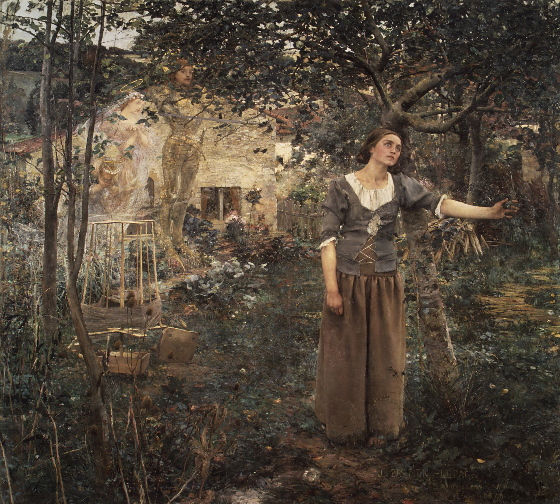 Jules Bastien-Lepage. Joan of Arc. 1879
Otherwise, it would be impossible to say why Mikhail Nesterov is more Russian than his beloved Basteen-Lapazh, and Vereshchagin is more Russian than his facherist teacher Jean-Leon Jerome, as it would be impossible to call the Retrospective of the same Nesterov “in search of his Russia” in 2013.
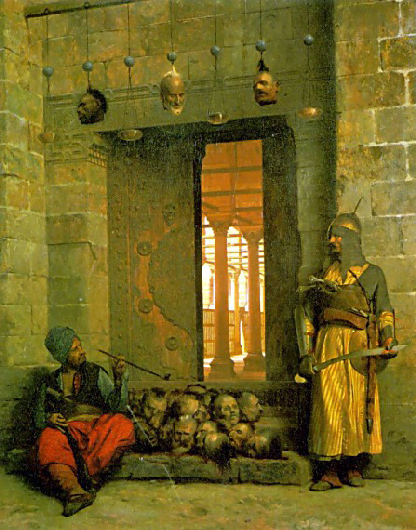 Jean-Leon Jerome. The heads of the rebellious beevs. 1866
The “national” model of the Main Art Museum was reinforced in the late 1930s and in the 1940s, the war years, when the class categories of the previous period left the stage, and the entire cultural heritage was rethought as “folk wealth”, the pride of a great nation, which was supposed to resist aggression of fascist invaders.
The way in the era of Putin’s reign of the GTG is built into public narratives is owed to the Stalinist model of the war years. In the appeal to the people in November 1941, Stalin put artists and composers on the same board with the commanders, the saviors of the nation: “These people, deprived of conscience and honor, people with the moral of animals have the arrogance to call for the destruction of the great Russian nation, the nation of Plekhanov and Lenin, Belinsky and Chernyshevsky, Pushkin and Tolstoy, Glinka and Tchaikovsky, Gorky and Chekhov, Gorky, Gorky and Chekhov, Gorky, Gorky and Chekhov, Gorky and Chekhov Sechenov and Pavlov, Repin and Surikov, Suvorov and Kutuzov! ”
Following this Stalinist attitude, the art critic and the author of the experimental Marxist exposition of the Tretyakov 1931 Alexei Fedorov-Davydov in the 1940s and 1950s was forced to move away from the class interpretation of the history of Russian art, completely switching to the nationalist narrative. In the 1920s, he wrote that the art of the era of capitalism is fundamentally international and that the same processes go in all national schools, but, say, in the 1951 book “The Great Artist Ilya Efimovich Repin”, he already reproduces the obligatory nationalist formula: “In the days of harsh trials, when the fascist horses approached the capital of our Motherland, our great leadership, our great bond Stalin named the name of Repin among those outstanding figures who make up the top of the culture of the great Russian nation. ”
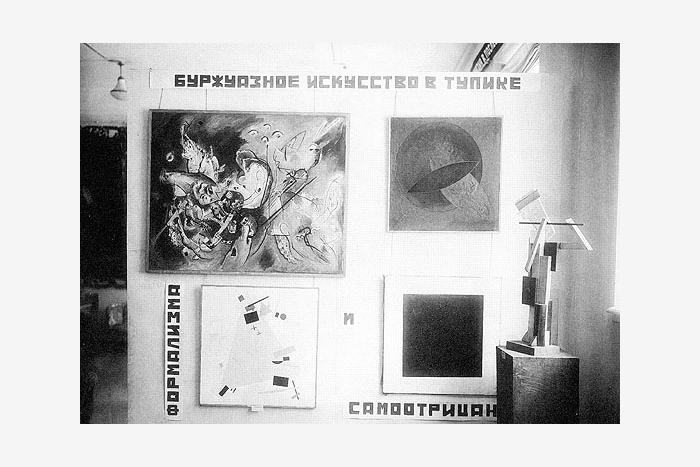 Experienced Marxist exposition in the Tretyakov Gallery, early 1930s
The nationalist attitude set by Tretyakov, combined with a democratic, liberation impulse, was rethought in the state-nationalist spirit in the 1940s, and today only one imperial is represented from a combination of democratic and imperial art. Thus, the ranging anniversary exhibition of Valentin Serov , which-no longer said the connoisseurs of the magnificent artistic skill of virtuoso, was arranged as historical-household and only second-hand art (all Serov’s modernism, and at the same time the political satire was built so that the “graphics did not fade”). This exhibition has become a brilliant gallery of portraits of kings and aristocrats recognized by explications, with which spectators of various social layers - “nobles and commoners” wanted to correlate themselves; The exhibition came not to look, but to read, but to read, enjoying his eyes, not like a dry text, but as a magnificent flower garden of revived historical images. All the conversations about the “destroyed national elite” and the “gene pool of the nation” accompanied by the exhibition were supported by Putin’s visit, which personally wished to look at the last Russian kings. Well, on “How it is written!”, Of course.
* * *
The role of the old Tretyakovka as the central historical museum of the nation, where it is especially easy to manipulate the imagination, building “artistic” images into self-evident sequences and not complicating the “reliable” historical commenting, is strengthened against the backdrop of the dying of Soviet historical, human and revolutionary museums built according to the class model. Actually, such a class museum in the 1930s died inside the Tretyakov Gallery itself-it was the same Marxist exposition of Fedorov-Davydov, which, with all its innovation, could not but annoy her didactism, distracting from the “art itself”. Each stage in the development of art in it was equipped with an obsessive class-detached commentary, connecting art objects with a certain state of production relations. In fact, the exposition was built in the same way as in the museums of atheism, where each object of the cult was accompanied by an explanation of its place in the everyday life and representations of a certain class - only not faith in God, but faith in art. In the USSR, ethnographic, anthropological, geological, and all generally non -artistic, especially natural science, museums were considered a software part of atheistic education.
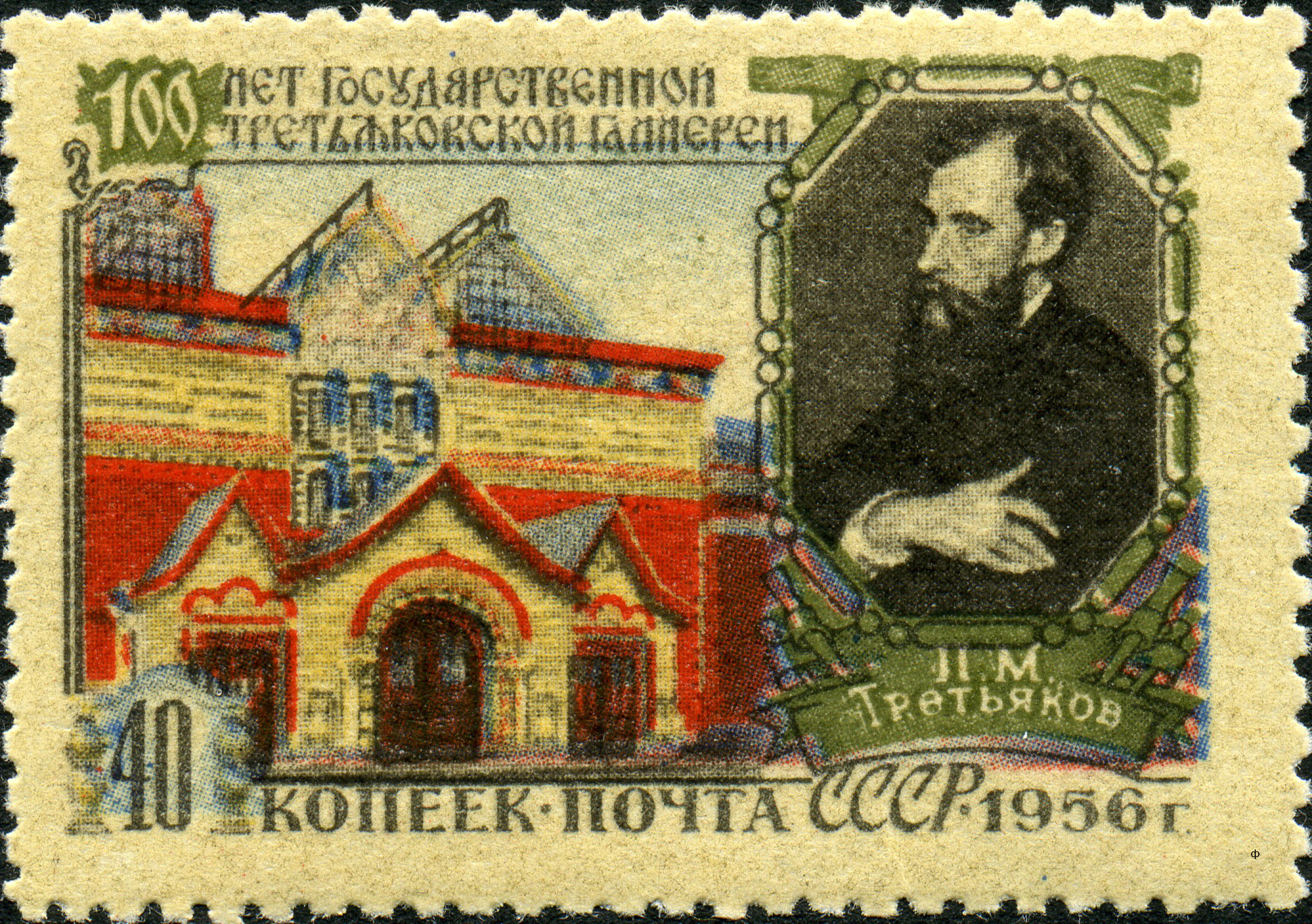 Mail brand dedicated to the anniversary of the Tretyakov Gallery
Despite the curtailing of a class approach in the USSR in the construction of the narrative of the art museum, the class approach existed in historical, historical and local history museums. In the 1920s, when the question arose of preserving the estates and mansions, the form of the museum-sya was found, which implies the preservation of not just the architectural monument, but the class museum of the noble or boyar life, which was not idealized, did not denigrate, but was reconstructed and clarified. Thus, the household museum of the 1840s opened in the 1920s and closed in the 1930s was organized, in which the life of the Democratic noble intelligentsia of this period was represented (the museum was dissolved in the funds of the State Historical Museum).
Until the end of the Soviet period, the expositions of local history museums were built not “regardless”, but based on the idea of the positions of classes that are with each other in antagonistic relations - and some of these expositions have survived to this day. For example, in the exposition of the Sitz Museum, updated in the 1980s in Ivanovo, data on the owners and organizers of the manufactories are compared with information about the workers' unrest and the revolutionary struggle for labor rights. In the same way, through class analysis, archaeological exhibits in the local history museum of Veliky Novgorod are shown. At the same time, the life of manufacturers or the realities of the Novgorod Republic are not condemned and not denigrated - through the museum reconstruction of everyday life and production a dialectical picture of relations between the owners and workers. The same class dialecticity, which, is considered today, is not for anything in the “purely art” galleries of portraits of patrons, but in combination with factory owners, for example, at the Serov exhibition in the GTG.
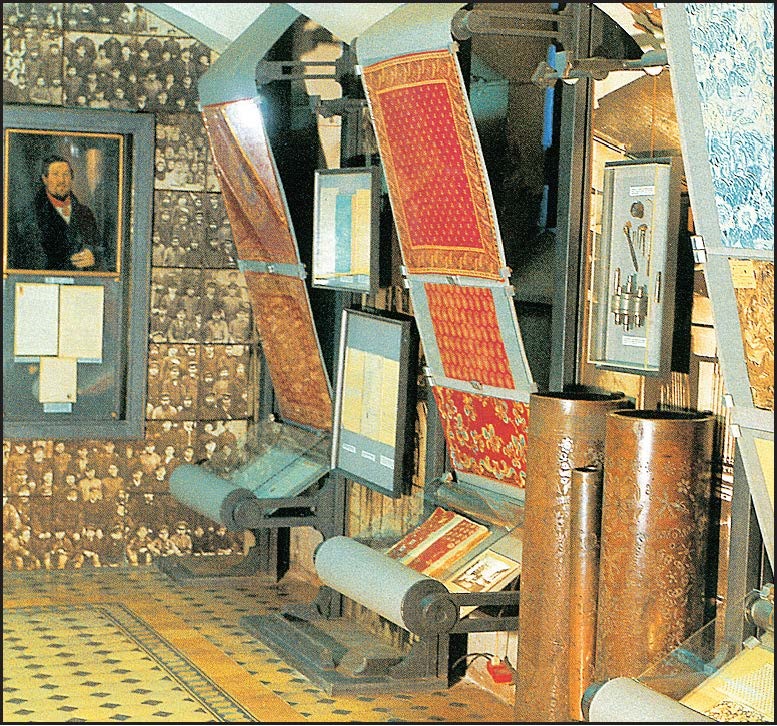 Sitz Museum Exposition in Ivanovo
The most radical of historical museum projects did not last long and basically did not survive the Stalinist conservative turn associated with the revival of nationalism. From the late 1920s to the end of the 1940s, many historical museums were closed or attached to larger museums, so that then again to be liquidated, their structures supporting their study of the Russian estate were disbanded, and their active employees were repressed. Then the “art” museums, primarily the State Museum of New Western Art, suffered. The reason was the same: they did not correspond to the national-nationalist approach that affirmed from above.
Those historical museums that survived after this “large cleaning” ended up on the periphery of the institutional system. In Soviet times, of course, they were supported, but they were not the main in the museum of the USSR at all, but art museums-giants like Pushkinsky, Tretyakovka and the Hermitage. The last two could well have been to historical museums, but were turned into their opposite-museums of fine art. The late Soviet “religion of culture”, general for both the authorities and dissidents, made it possible to transfer this museum system in the post -Soviet time, when it naturally began to degrade, falling into changed economic conditions, but was accepted almost all without question and was not subjected to critical rethinking. But here the old museums of fine art appeared a competitor.
* * *
Flying out with the "pride of the nation", in the 21st century, the authorities use proven tools (whether it is Soviet painting or Repin with Serov), but not averse to attracting modern art in its international sense - by definition the supranational. The permission of this contradiction lies on the surface: no matter how cosmopolitan in the cultural sense the exhibition, artists and audience - as the institution of the museum is a guide for the “national”. Neither his architecture nor its filling has nothing to do with it: the shell is also adjusted for world requirements as the contents. The museum as such, and not at all what is shown in it is an instrument of propaganda of the “national”.
Lobbying by the leadership of the HCSI of its museum of contemporary art was built on a game of “national achievements”; Possible manipulations with the budget were the second incentive for officials from culture. The dream of the federal museum has turned into a fix idea. “Throughout Russia, there is not a single full -fledged museum of contemporary art, comparable to the main foreign analogues, and it is advisable to build it primarily in Moscow,” said Mikhail Mindlin.
The exposition was built in the same way as in museums of atheism - only not faith in God, but faith in art, was materialistically exposed.
In a country where for 25 years of capitalism they have not built a “normal” museum of art of the twentieth century, fantasies about it are given a desire to comply with international trends in the field of national imaginary. It has long been noticed that the construction of a museum of contemporary art is a manifestation of a kind of cargo-poll of capitalist modernity. In the Middle East, the states rich in oil build their museums, not only because the sheikhs invest money in art or love to shive (although this is true). The main idea of Megamuzes - Guggenheim in the Persian Gulf or various centers of arts wearing the names of the fathers of the eastern peoples - in a monumental form to realize national pride. This is important not only for “young nations” like the UAE and Qatar, who gained independence in the 1970s, but also for the former republics of the Soviet Union, including Russia, which is proud of its millennium history. In the post -Soviet period, the search for national identity intensified, if not "again began." The duty references to the past do not work - the world context and the content of the concept of “Russia” have changed, new forms of nationalism have appeared. With the past, they work and construct it in the same way as the present.
In Russia, a lot of money is allocated to the Museum of Contemporary Art, not only because it is a successful occasion to steal them: according to the logic of Russian economy in each project, an article on the “cut” is laid down. But it is naive to assume that several billion was allocated only in order to enrich people who are not closest to the supreme power. In the project of the Museum of Contemporary Art (we repeat: the art of supranational), it was national interest.
Over the past fifteen years, various instruments of national propaganda have been tested - some of them were recognized as less effective. And the Moscow Biennale was also created as a "big project for Russia." Let the specific minister of culture on the Biennal seem like a pile of bricks, it is important that, despite the “aesthetic” disagreements, this is a platform through which Russia can be broadcast as a serious national project. So it was two years ago with a “manifesto” in St. Petersburg, which coincided with the actualization of the discourse of the “Russian world”.
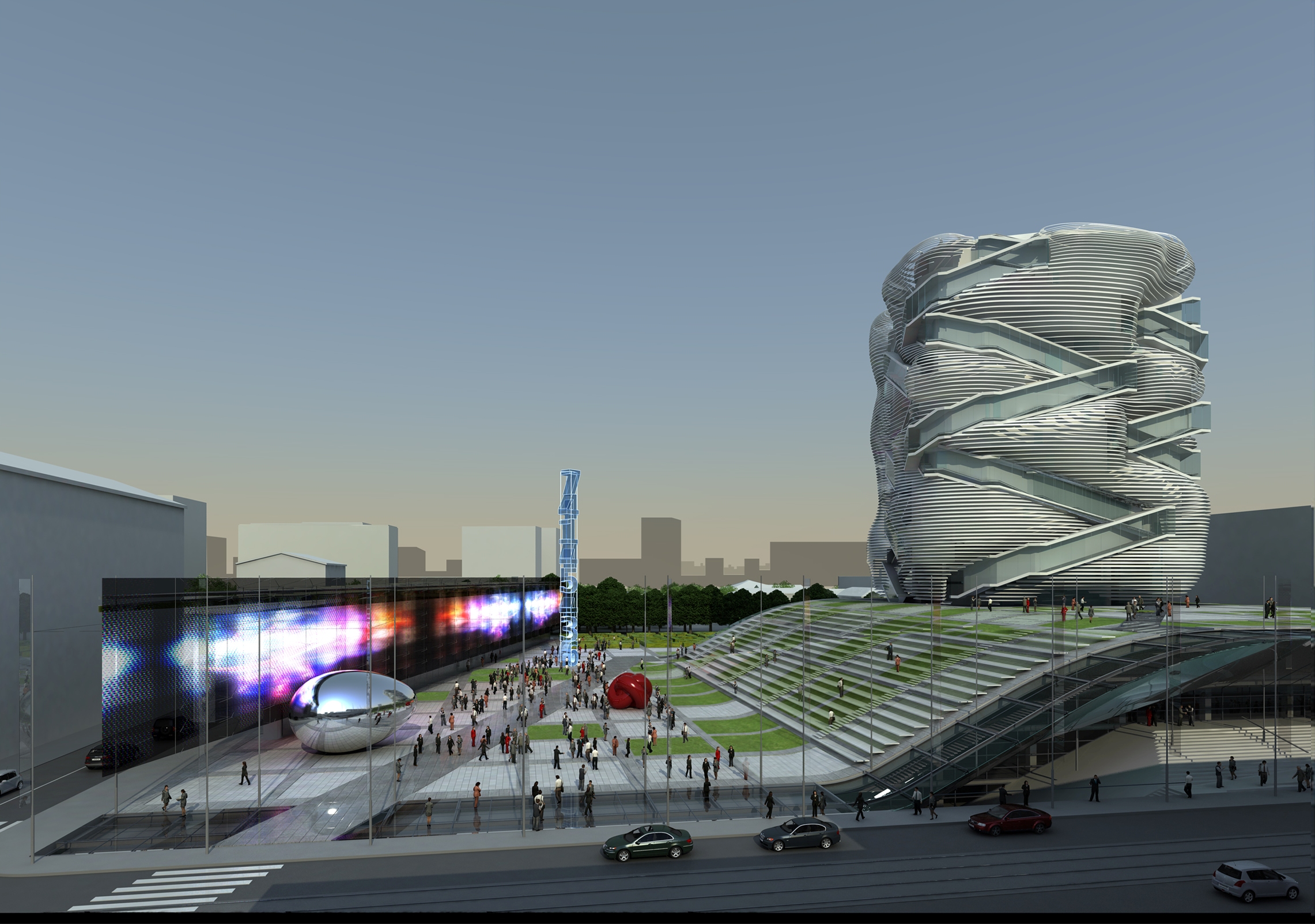 One of the projects of the new HCSI building in Moscow
And yet, for all its cost, the museum is a more reliable investment in the “national” capital. Of course, in a crisis they try to invest in something more catchy and folk-patriotic, and therefore the project of the museum, conceived by the HCCI, is frozen. But it is not worth excluding that in the future he will be defrosted or created by his analogue.
The artistic community also worked on the national logic of the Museum of Contemporary Art, even that part of it, which has strong allergies to nationalist narratives. The integration of contemporary art through the structure of megamuseum or megasia is always political technology. Thus, the authorities indirectly lure the dissatisfied to their side, and the audience, which is conventionally progressive, will react to exhibitions such as “romantic realism” with skepticism and, especially “Orthodox Rus'”, but in the case of Biennale or Museum of Modern Art, it will be favorably tuned. More "new" and "unexpected." If everything is done as it should, then the event or institution will look “like in the best houses of London and Paris”, but the person who pays will be asked the semantic frame.
The subject of national pride is the institution. This is logical and inevitable in the country where bureaucracy soldered with business and crime rules. The only important component of such a museum for the authorities is a document management that confirms its existence, and materials in the media. Architecture, exhibitions, collection and star curators are only information farms. Only the figure of the director is still important, who should be an “effective” manager and the appointment with the accumulated experience of grayness. This figure is needed again for the media, the real director of updated museums is the Russian bureaucracy - collectively. This logic is indicated by all museum rearrangements of recent times.
Предметом национальной гордости становится учреждение.
Когда содержанием музея становится его учрежденческая сущность, в него можно больше не заглядывать — проще прочитать о его административной работе, посмотреть интервью с директором, изучить список выставок и упоминания в прессе. Музею интересна теперь медийная скандальность акционизма, пример чему — шумиха вокруг очереди на Серова. Идеал, к которому он стремится, — открытие Олимпиады в Сочи. Ярко о главном в нашей большой и богатой стране.
Выставлять в таком музее можно что угодно. Коллекция превращается в конструктор, из которого собираются все новые выставки: этому способствуют укрупнение музеев и программы межмузейного сотрудничества. Привозные выставки — будь то «Манифеста» или текущая выставка Кранахов — делаются ради того, чтобы сказать: наконец это можно увидеть в России. Так же гордятся на Ближнем Востоке, когда в только выстроенный пустой музей привозят импрессионистов. Такое отношение свойственно не только чиновникам, но и художественному сообществу: о проекте музея говорили в том духе, что хоть и плохонький — но главное, чтобы построили.
* * *
Государственная бюрократия и глобальный капитализм совместными усилиями будут воспроизводить описанный паттерн настолько долго, насколько им это позволят. Если первая стремится подчинить музеи как пропагандистское орудие, то второй все время повышает ставки в сфере коммерциализации выставочных пространств. Музеи могут, конечно, существовать практически вне государственного контроля. Не надо забывать, что Третьяков и Рокфеллеры — это локомотивы капиталистического национализма, и музеи, которые они создают, могут жить без бюджетных вливаний и «в свободном мире» — они готовы стать главными игроками на музейном поле, если государственная машина ослабеет. И фактор «национального» от этого не исчезнет, просто примет другие формы. Примеры всем известны.
Альтернатива может начать прорастать и через нынешнюю ситуацию, но не сможет оформиться до конца. Музеи будут постоянно сбивать с дороги, как в 1990-е и 2000-е, когда, например, в Иванове их оккупировали в частных интересах. Пример такого остановленного движения — музей «Пресня» в Москве, который стал было реальной площадкой для разговора о постсоветском через события 1905-го и — особенно — 1993 года. И тут же полетели головы сотрудников, а еще чуть погодя под удар попали экспозиция и в целом статус музея как музея революции.
Классово-конфликтный подход к экспонированию материала неумолимо уничтожается.
Музеи революции, так же как вообще классово-конфликтный подход к экспонированию материала, неумолимо уничтожаются. Классовое экспонирование сворачивается в пользу примиряюще-патриотического нарратива о великих представителях и сокровищах нации. В революционном Иванове — когда-то третьей промышленной столице России, где сегодня почти ничего не осталось от былого производства, — в 2000-е годы не только ставят памятники «фабрикантам и меценатам», но и музеям дают имена промышленников, чьи особняки были когда-то отданы под музеи.
В центральном для ивановской истории Музее ситца занимавший большую часть второго этажа раздел экспозиции, посвященный знаменитым агитационным тканям 1920-х годов, был демонтирован еще в 2007 году, чтобы дать место постоянной экспозиции моделей Славы Зайцева; ивановский Музей первого Совета используется как универсальный выставочный зал для коммерческих экспозиций. Панорама стачки на Талке — сердце этого музея — закрыта и разрушается: печальное отражение судьбы московского музея «Пресня» и его панорамы.
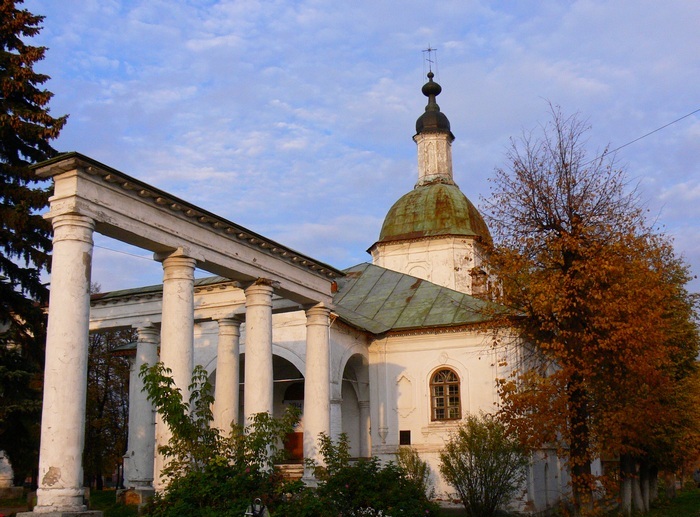 Краеведческий музей в городе Слободском, где хранится коллекция русского авангарда
Именно в провинции бросается в глаза параллель между ликвидацией проблемного классового экспонирования и гибелью музеев революции, с одной стороны, и с другой — шатким положением, в котором оказываются коллекции авангарда в местных художественных музеях, которые, как и краеведческие, борются за финансовое выживание. Как и Музей первого Совета или Музей ситца, Краеведческий музей города Слободской (Кировская область) вынужден ради заработка прятать ядро своей коллекции. Но только в данном случае это не историко-бытовая экспозиция, а несколько десятков первоклассных произведений авангарда, распределенных сюда в 1920-е годы Наркомпросом, — они убираются в запасники, чтобы, например, разместить коммерческую выставку тропических бабочек. Такая же история происходит в Петрозаводском художественном музее, где, чтобы показать заезжую выставку батика, в запасник прячутся не иконы и не второсортные «русские» пейзажи XIX века, а авангард, который в карельском Петрозаводске представлен работами филоновцев (Порет и Глебовой).
Иногда вытеснение авангарда в запасники или высылка из постоянных экспозиций на гастроли для заработка совпадает с эстетическими предпочтениями местного музейного руководства, но не это решающий фактор. Самим своим существованием эти музеи и их коллекции противоречат ситуации, в которой оказались, а потому их отдают на откуп коммерческим структурам, местным Союзам художников и, конечно, нуждам государственной пропаганды. Авангард провинциальных собраний, хоть к нему и прицепилось определение «русский», в большей степени, чем современное искусство, неудобен для националистической инструментализации. В нем могут быть национальные элементы, как, например, у Натальи Гончаровой, и крупные институции в России умеют этим пользоваться, но сам проект подобного искусства — так же как проект революционных и классово организованных историко-бытовых и краеведческих музеев — предполагает радикальное преодоление границ национального, чего не так много в сегодняшнем современном искусстве. Оно наднационально по факту своей миграции с биеннале на биеннале, из музея в кунстхалле — но внутри страны музейная система охотно принимает «национальное», не желая мыслить «классовое».
И, возможно, альтернативу националистической логике центрального художественного музея — будь то старая Третьяковка с искусством от икон до модерна, Новая Третьяковка с авангардом и соцреализмом или будущий Музей современного искусства — стоит искать именно в запасниках провинциальных краеведческих, художественных и революционных музеев, которые таят в себе вытесненное нынешней музейной системы.
Скачать весь номер журнала «Разногласия» (№2) «Музеи. Между цензурой и эффективностью»: Pdf , Mobi , Epub