
Translated material
"Not good order"
160 years ago, on March 30, 1856, the final results of the Crimean war were summed up in Paris, in which Russia suffered a painful defeat
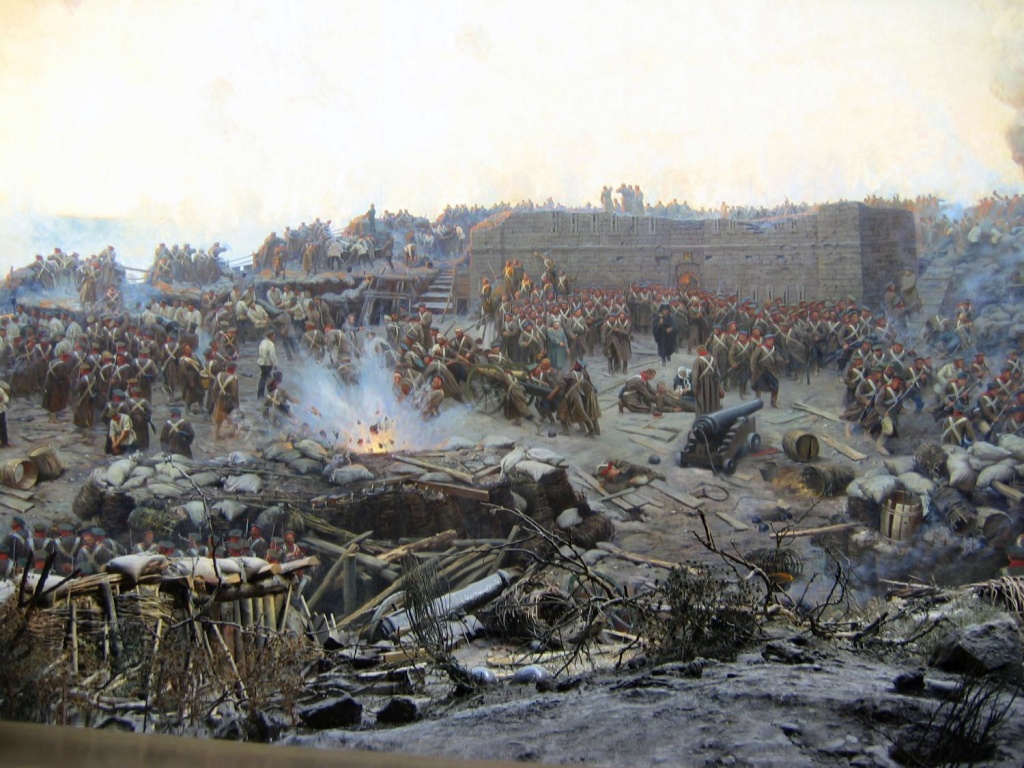
Franz Rubo. Defense of Sevastopol (1854–1855). Panorama fragment, 1905
This war in Russia is called Crimean, and in European countries - sometimes also eastern. The fighting lasted two years, from the fall of 1853 to the fall of 1855, and cost the participating countries a total of a quarter to half a million people who died and died from wounds and diseases. It is believed that the most severe consequence for Russia was the ban on having a navy on the Black Sea; Territorial losses were insignificant.
Be a gendarme
The reasons for the war are diverse and are a whole ball of European and Middle Eastern contradictions. The leading powers wanted to dispose of the fate of the “sick man in Europe” in their own way-the Ottoman Empire. They did not like the role of the "Gendarme of Europe", which Russia played - it acquired this position following the results of the Napoleonic wars. Prussia and Austria were competing for leadership in the upcoming unification of Germany, Russia and Austria - for influence in the Balkans. The personal ambitions of sovereigns played a significant role. For example, usurping power and proclaiming himself the emperor in 1851 Napoleon III in every possible way sought to return the brilliance and influence of the first empire of his great uncle II. and Nicholas I, who absorbed his mother’s milk (it would be more correct to say “with my grandmother’s milk”, but it will turn out completely obscenely) the ideas of the “Greek project”, did not want to derive his position “ and the intercessor of the Christian peoples of the Ottoman Empire. ”
The rivalry of Great Britain and Russia approved such an image for the influence in Russian society: spiritual Russia is opposed by the selfish "Englishwoman"
The Russian public met the beginning of the war by a patriotic rise. For almost forty years, a sluggish Caucasian war has been giving a thirst for high -profile military victories in society. The “Big Game”, which was going for a reason, is the rivalry of Great Britain and Russia for influence in Central Asia - approved the same image in the Russian educated (and especially half -educated) layer: spiritual Russia is opposed to the selfish “Englishwoman” (the female clan was probably formed in connection with the accession to the throne in 1837 by Queen Victoria), which forever “shits”. As for France, the paratriots did not get tired of reminding her of the events of forty years ago:
... if uncle is inglorious
He returned from Rus' back
Then the nephew is even more so
And in the distance to be not good ...
So wrote in 1854 a little -known poet Vasily Arefiev, who instantly became incredibly popular.
However, one cannot fail to notice that the sensation is "enemies around!" It was also characteristic of European opponents of Russia, not to mention Turkey. It seems that Friedrich Engels expressed a pan -European opinion when in 1853 he wrote: "... if Russia seizes Turkey, its forces will almost double, and it will be stronger than the rest of Europe, combined together."
The most mediocre
The war began for Russia quite successfully, which only spurred the intention of Great Britain, France, Austria, and later Sardinia, who claimed the role of the Italian unification center, take part in it. The destruction of the Vice Admiral Nakhimov, the Turkish squadron in the Sinop Bay in November 1853 (the battle went down in history as the last major clash of sailing fleets), forced the European powers to violate the status of the Black Sea Strait, established by the London conference of 1841, and introduce their ships to the Black Sea, as well as accelerate the transfer of their ground and marine sea contingents on the Balkans. The inaction of the Russian fleet and the enormous forces of the allies (the operation participated two and a half times more ships than it was part of the invincible armada in 1588) made it possible to freely land the sixty-thousandth Anglo-French landing near Yevpatoria.
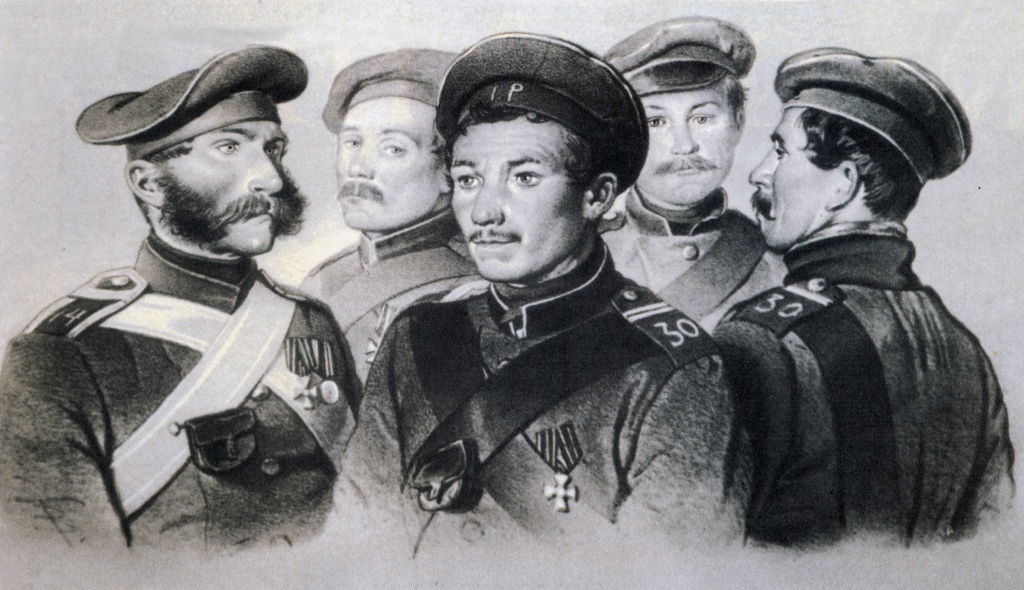
Heroes of the defense of Sevastopol. Litography according to the drawing of George Wilhelm Timm, XIX century. From the "Illustrated History of the USSR", Moscow, 1977
This was followed by the defeat of the Russian army on the Alma River and the beginning of the siege by the British and the French of Sevastopol from land. Then - flooding by the decision of the military council at the entrance to the Sevastopol Bay of a part of the Russian fleet, which still could not compete in the open sea with the larger and more advanced enemy ships. Following - the heroic defense of the city poorly prepared for it. Much has been said about the technical superiority of the allies over the Russian troops on a number of most important positions, and the mediocrity of the commander in chief of Menshikov, and the monstrous even by Russian standards of theft of the quartermaster. It is said that after the next report on this subject, Nicholas I addressed the heir with the words: “It seems to me that in all of Russia you only do not steal.” It is well known, largely thanks to the “Sevastopol stories” of the second lieutenant of Leo Tolstoy, about the heroism of soldiers and sailors, officers and admirals, ordinary residents of Sevastopol, and also about the fortifications of Colonel Totleben, who had turned the land approaches to the city into fortified positions, and medical surgeon Pirogov in a few weeks.
It is less known to our reader that in the UK and France this war is considered far from brilliant. According to modern British historians G. Hughes and J. Tigg, “this war has become an exemplary symbol of supply, medical and tactical failures and bad control. The public opinion of the United Kingdom was furious from the monstrous mistakes of the command and suppliers; Newspapers demanded radical transformations, and parliamentary investigations demonstrated numerous shortcomings of the armed forces. ” The British Encyclopedia in the 14th edition (1930s) even called the Crimean war “the most mediocre of the military campaigns of Great Britain in the 19th century”, which, taking into account two Anglo-Afghan wars and a number of others, far from the brilliance of military enterprises of this era, can be considered more than a derogatory assessment. French historians are also not enthusiastic about the actions of their command (in particular, the opportunity to pursue Russian troops retreating from the Alma River and break through to the Sevastopol’s defense), from the organization of supply and many other circumstances of this war.
After failure
The most important thing in any epoch -making historical event is the lessons that descendants learned from it. In this regard, Alexander II was on top. Not at all in his upbringing and views by Liberal, he nevertheless realized the need primarily internal changes - which is important, not towards twisting the nuts, but in the direction of decisive liberalization. The direct consequence of the Crimean war was the great peasant reform, and in turn its consequences were reforms of 1864-1874: Zemsky, judicial, financial, military and educational.
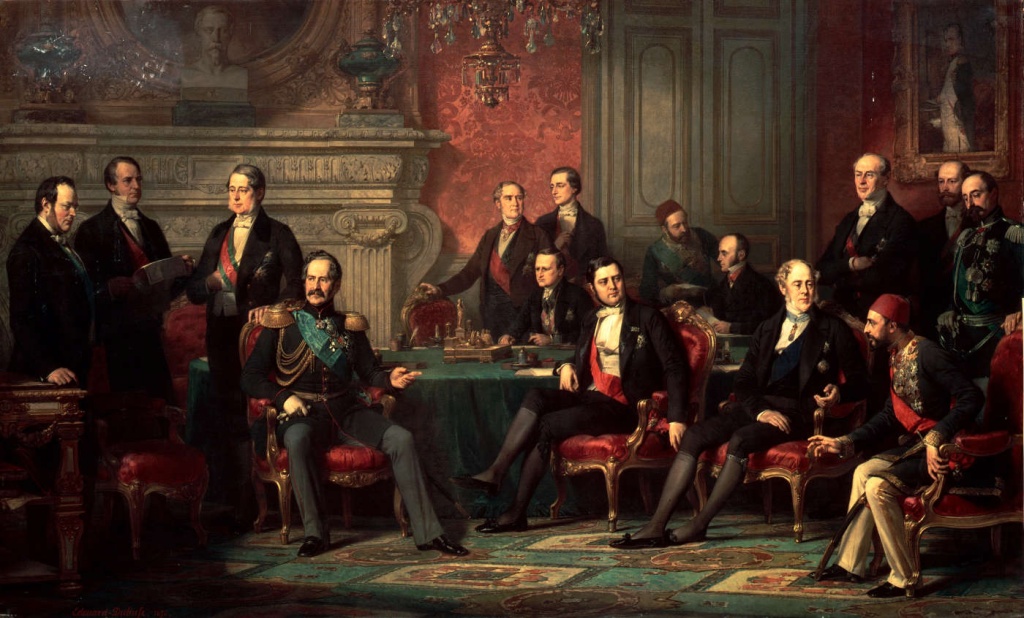
Louis-Eduard Dubuf, “Signing of the Paris Peace Treaty”, 1856
Today, on the new wave of ura-patriotic sentiments, in Russia they say a lot about the fact that that war was not at all such a defeat that it ended almost with a draw ... And even-almost a victory. Thus, in his project “Big Game”, Mikhail Leontyev claims, quoting in isolation from the context of the famous English politician Bulver-Litton: “The Russian star in the east overshadowed English. The loss of Sevastopol for Russians is not as terrible as the loss of Kars for the British. This event will forever remain a dark spot in their history. The capture of Williams (British Colonel, who led the defense of Kars. - Auth.), Naturally, will be interpreted by the peoples of Asia as a victory of Russia over England. ” If you look at territorial losses - they are really insignificant: Sevastopol was exchanged for Kars, a little squeezed on the Danube. Human losses are comparable to the losses of the coalition. It was worse, in a word.
Worse, who is arguing? But that is not the point, the case was in the state of the country. The Crimean war was not so much worsening as it opened and highlighted. In particular, with regard to economics, army and foreign policy.
The burden of backwardness
Since the late 1830s, the financial situation of the Russian Empire has been stabilized. This was achieved by various measures taken under the leadership of the Minister of Finance Count Egor Kankrin. However, tremendous expenses for war were committed to well -being in this area. Military expenses in 1854-1856 increased compared to pre -war by 2.5 times. According to the calculations of the authoritative British historian Paul Kennedy, in absolute numbers, Russia spent as much as France, and a third less than Great Britain, but for its much weaker economy, this turned out to be an excessive burden. Inflation, successfully restrained by Kankrin measures for one and a half decades, rushed up. The authorities were forced to abandon the free exchange of credit tickets for gold and silver, which led to the destabilization of the entire financial system for the next third century.
Not at all in its upbringing and views by liberal, Alexander II nevertheless realized the need for internal changes in the first place
The Crimean war has opened the numerous factors of Russia's lag in military affairs. Technical backwardness (smooth -bore weapons, sailing fleet) in comparison with the armies of advanced European powers now was now obvious to soldiers and junior officers. An even greater problem was the army acquisition system: based on the recruitment set, it did not allow to have significant trained reserves in case of war. The troops control system are also outdated. The underdevelopment of the railway network did not allow to supply troops in sufficient quantities with the necessary loads, primarily ammunition. As a result, by waging a war on its territory, Russian artillery was significantly inferior to the artillery of the allies, responding with one shot to three enemy.
The preparation of troops also differed in low quality. The best military Minister of Russia of the XIX century Dmitry Milyutin appreciated her condition: “Even in the military case, which the emperor was engaged in such a passionate enthusiasm, the same concern for the order prevailed, not for the significant improvement of the troops, not for adapting him to combat purpose, but for external only harmony, behind the parades, pedantic observance of innumerable petty. formalities dulling human mind and killing the true military spirit. ”
Finally, the war demonstrated the shortsightedness of the foreign policy of Nicholas I, which led to the diplomatic isolation of Russia. Moreover, the point was not in the eternal Russophobia of the European powers, as the then (as well as the current) cheers-patriots stated-in the end, Russia, both before and after, completely succeeded in military-diplomatic alliances! - And in the absence of foreign policy realism. Plus the Messianic idea of maintaining at all costs began the Holy Union.
It is difficult to say what exactly the dying Nicholas had in mind, telling the heir: “I give you a team in a good order,” he understood - how “not in the kind”. The main thing is that the heir was ready to accept the team and quickly took up the correction of the done and the implementation of the incompetent.
Photo: Shutterstock.com, Wikipedia.org