
Translated material
PR and propaganda
In his book “Propaganda”, our today's hero writes: “Conscious and skillful manipulation of streamlined habits and tastes of the masses is an important component of a democratic society.” With his life, deeds and ideas, Edward Bernis laid the foundations and developed the concept of modern consumption society. Steve Jobs against the backdrop of Edward Bernis seems to be a modest student, consistently executing the instructions of Professor Bernis.
Edward Bernies was born in 1891 in Vienna, but he lived in New York for most of his life. His mother Anna was the sister of Sigmund Freud, and his dad Eli was the brother of Freud Freud Marta Bernis. In 1915, Edward began his career in the field of public relations and, in total, worked in it for about eighty years, finding almost the entire 20th century. Kinship with the founder of psychoanalysis and acquaintance with Freud's theories played a key role in the career of Bereneis.
When Austria was in the economic crisis and all the savings of Uncle Sigmund evaporated against the backdrop of unbridled inflation, he turned to his American nephew Eddie and he took up the stamp and spread of Freud's work and ideas in the United States. In a fairly short time, Bernies managed to popularize the work of the Vienna psychoanalyst, focusing the public attention on sex, which the psychoanalysis was saturated. After Freud became popular, Bereneis began at every opportunity to recall that Freud's nephew had to.
Many researchers note that Bernis has become a modern embodiment of Niccolo Machiavelli, who said that the one who deceives will always find those who will allow themselves to deceive. According to the only daughter of the PR guru, one of Bernis’s favorite characteristics for subordinates, children, acquaintances, and even more so for the masses, was the word “stupid”. If someone did something wrong as Eddie Bernis would do, he immediately fell into the category of fools and received an appropriate attitude. Colleagues said that he did not pay attention to specific people and rather treated them as functions. The main interest of Bernis was the masses of people that he tried to understand as best as possible, then to affect them as effectively as possible.

Bernis began as a journalist, but quickly turned into a man who, through the media, defended the interests of the business. One of the main clients of the novice specialist in public relations was Enrico Caruso. Bereneis managed to make a superstar out of the opera singer and contributed to the popularization of theatrical art in America. Together with the opera, he took up the ballet and at twenty -four organized the first tour of the troupe of Serge Diaghilev in the United States.
One of the first major employers of Bernis was Media Magnat William Hurst, who hired him to promote women's magazines. Bereneis began to decorate magazines with advertising wrappers involving movie stars, which were also his clients. He was one of the first to use the production playing in the cinema. In order to increase the attractiveness of President Kalvin Kulidge, who was popularly considered gray and boring, Bernis invited several dozen movie stars to the White House reception, all the newspapers of America wrote about this event and the president in the eyes of the public turned from hopelessly boring in almost cheerful and Ugotny. This case is considered the first official use of PR in modern politics.
The President of the American Tobacco Company turned to Bereneis with a request to help turn women into active smokers. In America, XX for wearing a short skirt in a public place, police could send a woman straight to jail. Smoking was also considered dangerously obscene, and women were forbidden to smoke even at home. The dangers of smoking for health at that time officially knew nothing, so it was about pure sexism, as feminists would now say. Having received an order, Bernis first turned to the student of his uncle Freud, Abraham Brill, who at that time was considered a leading psychoanalyst in New York, with the question that cigarettes mean for women? Brill explained that cigarettes are the symbols of the penis, and every woman, according to Freud's theory, from childhood envies the presence of a penis in men and feels deprived of something. So the cigarette in a sense was a “torch of freedom” for women, a penis that they never had. Then Bernis hoisted the cigarette to the banner of the liberation of women from male oppression and used for this a symbol familiar to every American from the diaper, - a torch from the hands of a statue of freedom. During the popular holiday, Bernis sent to a parade in New York trained secular lionesses, who took out cigarettes and lit up in front of dozens of cameras, and there was a slogan nearby-the “torch of freedom”. Bernis did not have to pay the press, the next morning this story was on the first page of every newspaper in America, a terrible scandal and noise rose, against which a public discussion began to liberate women from oppressing men. Each free -thinking woman began to smoke from the principle and in public places, sales of cigarettes began to grow every day. By the way, Bernis's wife was a feminist and was in the junks club, who did not change the girl’s surname after the wedding.
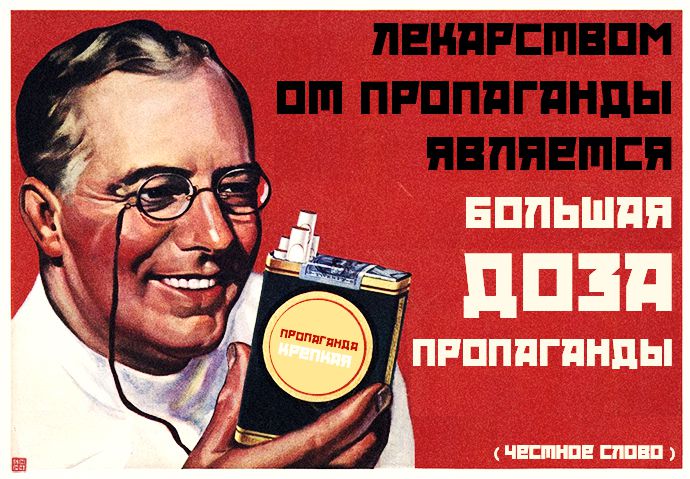
To prepare the Americans for the First World War, the Committee on Public Information was created. Bereneis and journalist Walter Litman explained to the Americans why the United States entered the First World War. They claimed that America was involved in the war not for political reasons, but in order to bring democracy to all Europe. “Build the world - save democracy,” with such slogans Bernis and the company sent American soldiers to Europe and made a real hero from the President Woodlon Wilson.
In the First World War, one hundred sixteen thousand seven hundred eight American soldiers and another two hundred and four thousand people were officially injured. To smooth out such losses in the eyes of the public, the media focused on the dramatic and heroic stories of individuals. The image of the war in the minds of the Americans was formed not on the basis of facts, but on the basis of carefully directed stories from the media. Four million seven hundred and thirty -four thousand nine hundred and ninety -one American was called to serve in the army, but Bernis and Litman were convinced by the majority of the absolute need for a power struggle for democracy. Walter Litman claimed that the basis of democracy is not a rational choice of people, but their animal instincts and irrational. He believed that the masses of people were controlled not by the mind, but by the spinal cord. Together with Bereneis, they replaced statistics on those who died with the emotional perception of individual stories, creating precisely the emotional, rather than the intellectual idea of what war is.
The war ended, and Bernis was sure that the tricks that worked during the conviction of the masses of the need for war should work in peacetime. He managed to convince ordinary Americans that they need to take loans in banks, which Bernis also represented in order to buy shares on them and communion with the universal spirit of entrepreneurship. Such propaganda led to the influx of a huge number of investments in the securities market, the largest economic bubble in history began to form. This played into the hands of American magnates, like Henry Ford, whose income grew due to manipulations with shares of their companies on Wall Street. However, on Thursday October 24, 1929, the bubble burst, everyone rushed to sell the shares, and Wall Street plunged into chaos. After the Black Thursday, Black Friday came, followed by Black Monday and Tuesday, and then the great depression began, extending ten years. Millions of people went bankrupt, lost their jobs and lost faith in a big business. The services of such dealers as Eddie Bernis ceased to be in demand, people stopped buying unnecessary things and again concentrated on survival. Democracy and the free market became questioned.
In 1933, Franklin Roosevelt became the president of America and lasted in this position unprecedented for the States for three terms. Roosevelt declared war on the influence of large business on the White House and headed for the centralization of the economy. In this, he converged with his European colleagues Stalin and Hitler, who also considered the market economy uncontrolled evil. Hitler’s popularity in Germany of the 30s is largely owed that he contrasted democracy with a single and centralized system. Instead of a free market - a planned economy, instead of orientation on an individual - orientation to the state: "Service, not selfishness." Roosevelt’s struggle for the centralization of the economy was publicly approved by Goebbels, who at the same time read the works of Bernis in a bip. The Minister of Nazi propaganda also told his colleague von Weigand that Bernis’s “crystallization of public opinion” formed the basis of the Nazis campaign against German Jews. The purebred Jew Bernies was extremely embarrassed and put in an awkward position.
Roosevelt pushed a large business from managing the economy on the basis that it was because of the business and the securities market that the unemployment wave covered America and the difficult economic crisis came. After Roosevelt was elected for a second term, the business elites decided to seriously get down to business and confront the president and his new course. Eddie Bernis again entered the stage. He proved to the public that money was at the head of everything, and, unlike an “active citizen” according to the concept of Roosevelt, proposed a model of a “man-consumer”. With the help of his technology, a big business began to rapidly conquer the sympathies of ordinary Americans, appealing, as always, not to reason, but to feelings and experiences.
Before the arrival of Bereneis, advertising in the United States appealed to the practicality of goods. Everything, up to the car, seemed to customers in the light of benefits and reliability. Large American business, which dispersed the mass of mass production of goods, after the First World War, was faced with the threat of market overestimation and bankruptcy. When all the Americans will have all the necessary goods, they will simply stop buying new ones, and the established production machine will stop. To avoid this, citizens had to be convinced that purchases and consumption are a way of life, not a practical necessity. One of the advanced bankers of that time wrote: “We must transfer America from the culture of needs to a culture of desires. It is necessary to teach people to want new things even when the old ones have not yet been used to the end ... A person’s desire should overshadow his needs. ” Nowadays, this is the granted truth, and, say, Apple with its endless phones makes millions of people around the world give the last money and buy a new phone simply because it is now the newest, and not because the old one is already unsuitable.
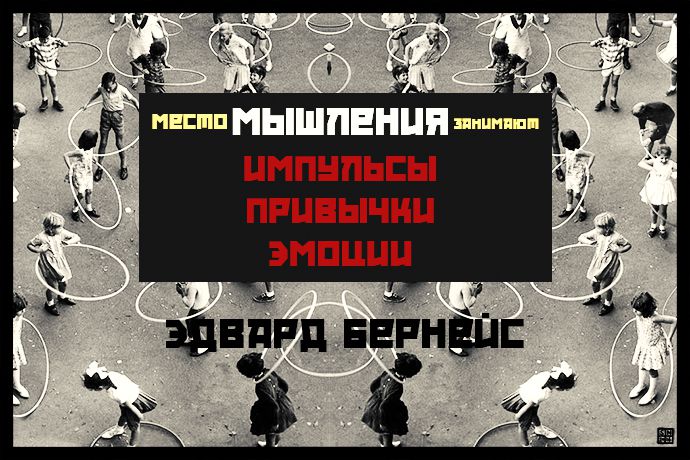
Under the influence of Freudian theories and under the sensitive control of Bernis, the Americans began to buy things not because of the need, but in order to "demonstrate their inner world to others." Women were convinced that it was possible to express themselves and should be expressed with the help of new -fangled clothes and jewelry, and the masculinity and energy of a man directly began to depend on the brand of the car he drives, and the cigarettes that he smokes.
A large business tried to prove that America owes progress and power to industrialists, businessmen move the world for the better. The Roosevelt government, on the contrary, tried to prove that a large business, and first of all, specialists in PR, constantly deceive and systematically bred ordinary citizens.
In 1939, the World Exhibition was held in New York, the topic of which was the unification of democracy and American business, the main consultant was Edward Bernis. The exhibition was presented with a giant white dome called Democracy (built by General Motors). The model of democracy, in which the government and business go hand in hand, ultimately won. Nowadays, American politicians are indistinguishable from large businessmen who often go to Washington just in order to lobby their business from the inside of the government, having served one senatorial term. And vice versa, leaving the government, many ex-politicians go into business.
“Modern propaganda is a consistent, quite long activity aimed at creating or informational design of various events in order to influence the attitude of the masses to the enterprise, idea or group.”
In 1662, Pope Gregory XV created the congregation of the propaganda of faith, which was carried out and maintained by the Catholic faith in Europe, Africa and America. The word “propaganda” completely arranged Bereneis, the so -called his first book, but over time, this word was more and more closely associated with militant Germany, so Bernis decided to continue to be called “an adviser to public relations”. So propaganda turned into PR.
In his book “Propaganda”, Bernis writes that the mass consciousness does not think, but instead submits to impulses, habits and emotions. One of the basic principles of the psychology of the masses is that when making decisions, people primarily follow the example of the leaders they trust. Such a leader can become a parent, a character from a cartoon, a politician or a movie star. But even when the situation is completely new and it is impossible to refer to the leader’s opinion, people turn to universally recognized cliches, pre -prepared words and images approved by their society. Propagandists are working to provide the public with “correct” opinions that will easily push the voter and the buyer to make the “right” choice. In the Bereneisian definition of propaganda, its duration is emphasized.
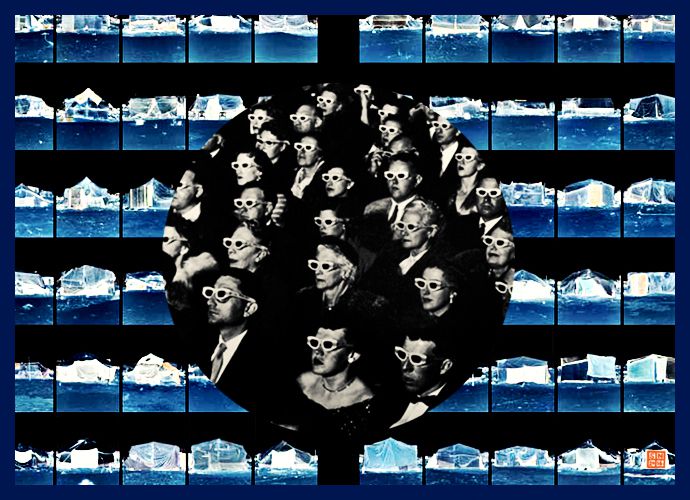
Propaganda sees in a person a set of stamps formed under the influence of the media. Nowadays, this is Internet, television, radio, printing press, public organizations, religious institutions and so on. All these sources supply a person with opinions and attitudes about everything in the world, comment and evaluate each aspect of life, leaving no space for the originality of thinking. “Millions of people have this set of stamps, and if you influence these millions with the same incentive, the response will also turn out the same.”
Propaganda works at two levels: tactical and strategic. A tactical level is an assessment of current events. Commenting on events, propaganda appeals to the established stamps of the crowd and, using proven incentives, causes people the desired reaction and evaluation of events. At the strategic level, propaganda forms stamps inside people, sets them a general direction. At this level, the values and priorities of the people are formed. The prolonged exposure to propaganda causes the “generation effect” when a person who is accustomed to a certain type of ideas and goods remains their faithful follower until the end of his days.
In the Banana Republic of Guatemala, a politician comes to power, who promises his fellow citizens independence and independence from American monopolists. The fruit company begins to endure losses and turns to Bernis for help. Bereneis inflates phobias in American society, and he translates a private question about business into a communist threat. He declares enemies of his business interests the enemies of the state. He poses a threat to the private profits of United Fruit Company as a threat and a challenge to the entire democratic system at once. Bereneis sent a group of journalists to Guatemala, who talked there with specially prepared local politicians who stated that the president of the country is a communist and poses a threat to the United States. At the same time, as if by order for journalists, a large -scale anti -American protest rally was organized in the center of the capital, many believe that this also happened according to Bereneis's instructions. In parallel with this, in America, through the front -line news agency, Bernis extended rumors about communist plans to Guatemala, processing and convincing ordinary citizens that jokes are bad with the Communists and in no case allow them to the doorstep of the free American land. In 1952, Eisenhower approves the PBFORTUNE operation - a special operation to displacement of the current leader of Guatemala, who was replaced by a general general. When Gvatemala began to bomb, Bernis convinced the Americans that this was by no means an invasion, this was a liberation war for the same sacred democracy, against the same worst communist enemies. The Arbenets government eventually lost the power to the regime of the regime, and Eddie Bernis once again demonstrated the ability to convince people that black is white and vice versa.
Eddie Bernis lived in a wide leg and from his youth nostalgic at the time of Louis XIV, who said "the state is me!" Сто четыре года и почти весь XX век он принадлежал к меньшинству, управлявшему массами, президенты менялись, а Бернейс оставался и остаётся до сих пор. Напоследок давайте ещё раз поразмыслим над словами Никколо Макиавелли: «Чтобы узнать, что должно случиться, достаточно проследить, что было. Это происходит от того, что все человеческие дела делаются людьми, которые имели и всегда будут иметь одни и те же страсти и поэтому неизбежно будут должны давать одни и те же результаты».