
Translated material
"Computer simulation of reality: fashion or the beginning of the revolution?"
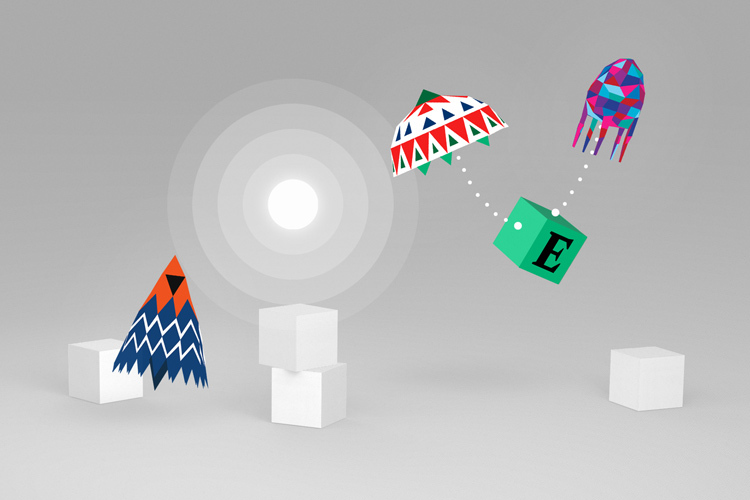
Perhaps you or your friends played Drei - a simple, at first glance, puzzle for the iPad and iPhone, where you need to build a turret, controlling a creature, similar to a jellyfish and an air snake. The game becomes more complicated when you switch to levels with the multiplayer mode: you have a partner - a random user from anywhere in the world with whom you need to “work out” without using words. This application tells better about the cooperation and conventionality of geographical and cultural boundaries than political slogans.
Drei was developing a small Swiss studio Etter. Like many other Swiss video games, the application was created with the support of the Swiss Culture Culture “About Helvetia”. The development program in Switzerland of "Digital Creativity" - Digital Creation - is called Mobile ; The sphere of interests of this project includes not only games, but also any artistic initiatives related to the interactive and IT technologies. The leader of the program, curator and art manager Michelle Vyust told Anton Khitrov why cultural institutions should support games and how technologies change art.
 Michelle Vyust
- In Russia, the idea of video games as art is not generally accepted - they are usually considered entertainment (even worse - purely entertainment for children and adolescents). And in Switzerland?
- Whether games can be art in theory whether existing games can be considered art - in fact, it is not very interesting to us. If we begin to understand, then inevitably we will come to the more global question “What is art?”, Which still has no generally accepted answer and often causes discussions. I do not know if the games of art need to be attributed, but I am sure that this is one of the most important phenomena of modern culture. This is quite enough for institutes like the Swiss Culture Culture “About Helvetia” to be engaged in games.
- In Switzerland, art is still divided into “high” and “low”, “elitist” and “mass”, status and less status?
- Looking about who we are talking about. Of course, in academic circles and in the traditional areas of culture, these ideas still have power-but they are constantly disputed, at least from the 60s. In any case, we want to support and promote original ideas and promising projects not only in the field of theater or contemporary art, but also in the field of pop music and computer games.
- Are the boundaries between video games and other types of art are eroded? Does it often happen that people come to the playing industry from animation or contemporary art?
- Games adopt the experience of other types of creative activity: this is the construction of a narrative, and the principles of fine art, and music. And yes, people from music, cinema and literature always went to the game industry. But at the same time, this experience should be adapted to the specifics of the video game, which consists primarily in interactivity, in the presence of an interface. The development of the gaming industry is highly dependent on the development of technology and the market - perhaps more than other spheres of culture. She needs not only professionals-artists, but also experts in technology and business.
Today's blockbuster games often lack creative risk, they are standardized, and yet it is a history of innovation.
-Is the difference between indie games and expensive studio projects fundamental for you? Is there a place for an experiment, a creative search in high-budget games, where business and business are present on a par with art?
-In the zero indie games arose by themselves and brought diversity to the industry. There is an economic, social and cultural difference between this kind of projects and studio works-but this does not mean that all the most valuable is born in the field of indie games. Today's blockbuster games often lack creative risk, they are standardized, and nevertheless, the history of high-budget games is the history of experiments and innovations. There are many examples-take at least the Grand Theft Auto series: yes, this is a successful commercial project, and at the same time there were real breakthroughs in terms of narrative and game design.
- Why did the need arose in the Mobile project? How were things with the Swiss DJITA-Art before your program?
- The cultural institution should adapt to the needs and needs of creative people. If artists are experimenting with digital technologies, we must support them. Our role is to promote their career in the direction that they themselves chose. So the task was that the Swiss Culture Council learned to deal with projects that are not related to the agenda of our other departments (we are engaged in music, dance, theater, literature, visual arts). We wanted to support and encourage artists who use the capabilities of modern IT technologies. Other initiatives appeared before Mobile in Switzerland, but they were mainly connected with Mediaart as a section of Contemporary Art , and we try to cover all interactive - games, interactive graphic novels, augmented reality, transmedia projects.
- Can you give several examples? Any interesting, important works of Swiss artists?
- Recently, a lot of innovative interactive projects have appeared in Switzerland. These are games and not only, these are interactive films and simulations of reality. Among them are Drei from Etter Studios , Feist Florian Faller and Adrian Stepets, Late Shift from Ctrl Movie , Birdly studio, Somniacs , Sequence from Apelab and First Strike , created on Blindflug Studios . These works received good reviews of critics, collected international awards, and some of them were commercial success, which infrequently succeeded in Swiss artists. These are ambitious, innovative and at the same time available projects understandable to a wide audience.
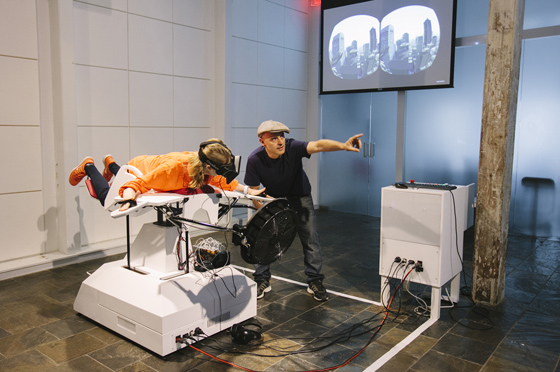 Birdly from Somniacs
- What are the main trends in digital interactive art?
- One of the main trends of 2015-2016 is a computer simulation of reality. Moreover, in this area, several of our Swiss studios are leading, which are engaged in both the scientific, technical and creative research of the topic. The main question is how stable this trend will be: maybe it is just a bizarre fashion, or maybe the beginning of the revolution.
- How will the fate of the old forms of art in changing reality develop? Maybe new forms are replaced by them?
- This question arises every time a new media or a form of art appears. Did the movie have a cinema to kill the theater? Did television kill the movie? No, but young forms of culture, of course, changed the older ones. Media coexists with each other and adapt to the environment. With the advent of the Internet and the revolution in the field of communications, traditional types of art received new opportunities, but also faced new problems.
- What do you see the main difference between digital creativity and traditional types of art?
-Starting from the 60s, but especially in the last 20 years, digital technologies have greatly changed the processes of production, distribution and consumption of cultural resources. First of all, it affected cinema, photographs, music and design, but also affected literature and performing arts. Today, artists work on computers, sell their works over the Internet. The audience gets acquainted with their work online and reads criticism there. Today, a chain of computing operations is extended between the design of the artist and the response of the audience. In this sense, many traditional forms of art became digital, but in fact they have changed little. The film is still a story with the beginning, middle and end. So the most significant difference is interactiveness and the presence of such a role as a user, a user. We see this specificity in digital art, network art, but the most significant product in the cultural and social sense is, of course, video games.