
Translated material
Evil is others
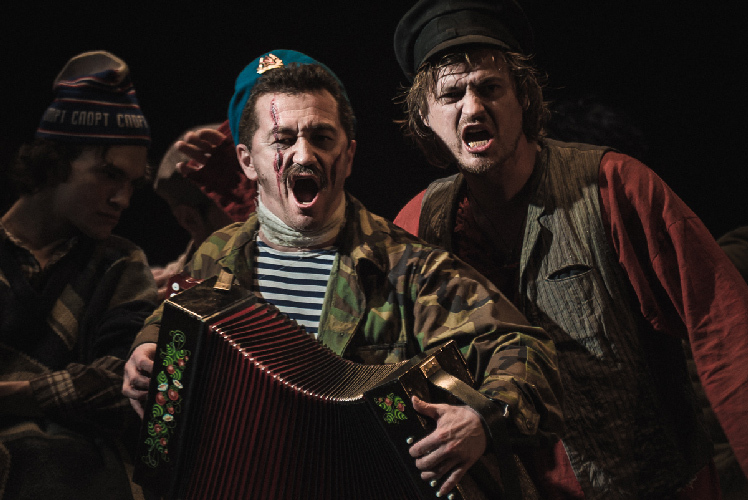
When the author begins with a story about the history of the creation of a work, he clearly has nothing to say. But the musical “Crime and Punishment” was preparing for so long-the idea was born in 1979, but was realized (except for the concert version in 2007) literally the other day-that the very duration of the creation has become an important factor in the work.
According to Andron Konchalovsky, the idea of putting a musical performance on the work of Dostoevsky was born to him more than 30 years ago. “I drove to the director Mark Rozovsky and poet Yuri Ryashentsev, we wrote a libretto, and then composer Eduard Artemyev appeared in our company.”
Composer Artemyev : “A lot of sketches were written, material for three or four operas in volume. But all this did not suit me. I started endlessly all over again, and if it weren’t for Konchalovsky, I probably would have pulled it until the end of my life. But in the fall of 1998, he called and said hard: if you do not leave everything outsid and do not concentrate on the opera, you will never write it and then you will not forgive yourself. These words acted strongly on me: to execute all my life! And I threw everything and finished in two years. ”
So. Although the plan arose in the 1980s and something was written all this time Ryashentsev and Artemyev, the main work on the rock opera took place in 1998-2000.
 © Musical Theater
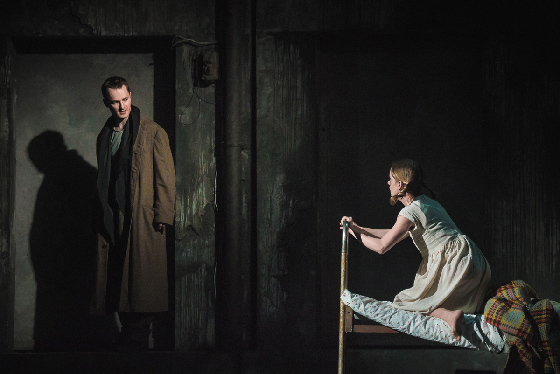
And this is not difficult, in general, guess when you see a musical. The work, as the hermeneutics teaches us, primarily expresses the meaning of the era in which it was written. And here, of course, not the “TV series on Dostoevsky”, as is now accepted, but the solid independent work of four self-respecting authors about good, evil and justice, completed in the 1990s and carrying the ideas of the 1990s. Along the way, this is an interesting experience - because we have the opportunity to see what excited the creators then and compare with what scares them today.
Here we need to make another digression. This is a kind of curse that pursues Russian culture. For political reasons, some important things become available to the mass reader or viewer after 20, 30, or even 50 years. You can convince each other forever that art is eternally and endlessly-but still for the work of art it is important to be seen and read on time.
If the novel “Life and Fate” by Grossman was released in the 1960s, and not in the 1990s, his effect would be comparable to “One Day of Ivan Denisovich”. In the 1990s, Grossman’s book was also important, of course; But a massive acquaintance with the work took place in essence only a few years ago, when the series of the same name by Sergey Ursulyak (2012) was released, devoid of the “C concentration camp”, but seen by love lines. That is, this acquaintance took place 50 years later and in a very truncated form - too late for the country and society, and the novel did not produce the tenth share of the effect that was designed for.
 © Musical Theater
About the same story with the musical “Crime and Punishment”.
If the rock opera came out in the 1990s even in the form as it is now, it would be the most important thing for the self-identification of society.
Our hero Raskolnikov is modernized, like the plot, and is placed on "our days." This is not new by itself; But it is important that the authors turned it into the hero of the nineties, the young man of the Yegorlet type, from which a poster with a sickle and a hammer hangs over the bed, and the works of Marx and Lenin are lying under the bed. Then the authors guessed it right. The left idea in the 1990s acquired an exciting, nostalgic aroma, the aesthetics was gradually transformed into the ethics of “restoration of social justice” and at the same time “restoration of the empire”.
Go out this rock opera in the 1990s, she would have addressed directly to this fierce, encountered by the new world, a teenager who decided that sickle and hammer are “beautiful” that it was non-conformism and at the same time solving the problem of “injustice”. Because of such “left”, the left idea in Russia did not become a sparring partner, a constructive critic of capitalism (in the spirit of the Frankfurt School), but turned into an irrational denial of the very idea of the “market”, communication and at the same time modern as such. Actually, the current television and radio hosts, now howling about the “Red Empire” are the same schismatics from the musical, young lovers of sickle and hammer, who were left to their own devices all these 25 years, were in their metaphysical underground, and some kind of porridge made of white and red were cooked in their heads.
Evil, generated by Raskolnikov, for some reason comes in a completely different place, in another country, with some others.
If this conversation-about good, evil and capitalism-with the young Leninians of the nineties took place at the same time, in the 1990s, they might be deprived of current illusions and delusions. It would be a very correct conversation - on equal terms, without stuttering, but also without notations. There is injustice, was and will be, says the musical: but it cannot be defeated by violence. Simple and understandable, the pathos of the play is also appropriate: Raskolnikov crossed the line of humanity “to the dispute” - while others allowed themselves violence without any purpose and without any principles, just like that. Violence gives rise to violence.
And then follows the scene of mass violence. Observing it, Raskolnikov seeks. He understands everything. And goes to admit.
This scene is the key to the current musical.
Probably, it was she who was subjected to the greatest editing over all these years.
Initially, she apparently depicted some social shocks of the past-for example, a 1917 revolution. In the 1990s, this first came to mind. Further, the scene was probably redone many times, the authors during this time also reviewed their views on “social evil”. Yuri Ryashentsev : “Last winter I went to Konchalovsky to the country, we were engaged in the correction of the script. In connection with the events taking place in the country, something in the images of the heroes, in the relations of Rodion and Sonya, cannot but specify. ” He says this in September 2012, after Bolotnaya, Sakharov and May 6, and the “Events taking place in the country” - this means winter 2011-2012.
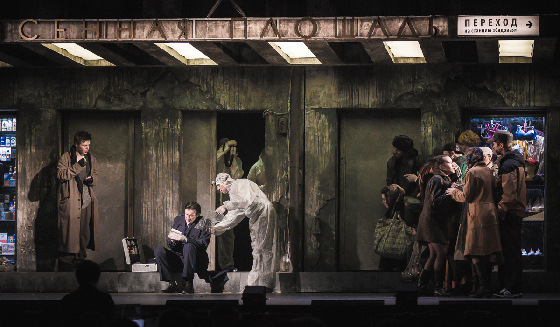
Now this scene looks (who would doubt) this way: flaming windows, masked people, people with shields, auto -zaki - this is a Maidan and generally any “color revolutions”.
 © Musical Theater
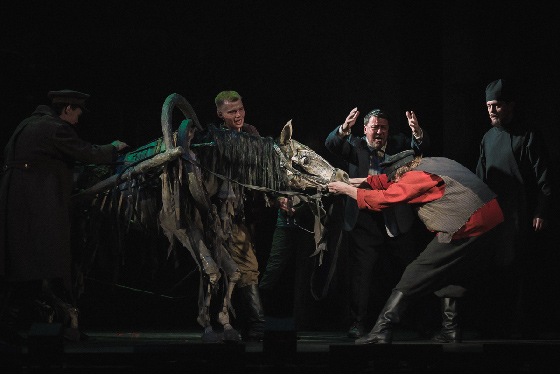
The scene is still very important. Only now in a different way. She carefully leads the current viewer, a teenager of the 2010s, away from the problem of evil in you and away from internal problems-somewhere outside the country and the described history. This is such a Freudian “transfer”. At the same time, the previous logic of the performance has not undergone changes. For example, the scene with the beating of a horse remained a refrain (it is repeated three times, like an obsessive dream). Probably, in accordance with the early concept of the authors, it was supposed to introduce us into the problems of violence, and all the further also brought the viewer to talk about cruelty in ourselves. To the way the people themselves crossed the line after Raskolnikov. But now it turns out that the evil generated by Raskolnikov, for some reason, is in a completely different place, in another country, with some others.
And what about their own, who beat the horse? ..
They are in short fur coats and scarves, with lamps stand in the final stage and quietly sing something. The two sinners, schismatics and Sonya, rush into the arms of each other - "Together forever!" They repented and will be forgiven.
As a result, the evil has not been worked out, not spoken, not thought out-but moved somewhere “there”. Accordingly, cynic Mr. S., prostitutes, raspberry jackets-all this is also left in the “past” in the 1990s.
Moreover, we note that Ryashentsev's zongs themselves are good and original. Artemyev’s music itself is also good - however, this division is striking: evil is always rhythmic here, and good is entirely melodically and elegant. But still. The main problem is that too late it all appeared. And a shivet with multiple ideological threads. And as a result, no one understands what this is about. All dead, everything ends well. Raskolnikov is different. Evil is different. Not you.