
Translated material
Antonen Arto. Explosions and bombs
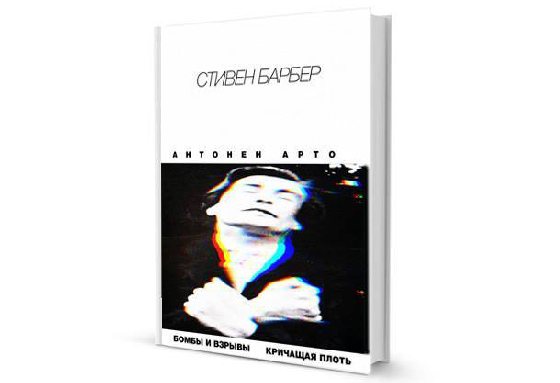
The team of the independent bookstore "Tsiolkovsky" decided to engage in not only trade, but also the publication of books. For this, a small crowdfunding project was launched. The first book, which is planned for the publication, was the biography of the great and crazy Antonen Arto. The book of Stephen Barber “Antonen Arto. Explosions and bombs ”was released in London in 1993 and has since been repeatedly reprinted, including in other languages.
The name of Antonen Arto, a French writer, poet, actor, director, scriptwriter - a person, without whom it is impossible to imagine the history of the theater of the 20th century - is still little known in Russia. The Russian translation of his most famous book - “Theater and his double” - was published in 1993 and had long become a bibliographic rarity. Other small publications are mainly also related to the beginning-invention of the 1990s, however, small texts about him and tiny translations of his work are coming out today. There is no doubt that the biography of Arto, this great revolutionary in the field of the theater, will today be extremely in demand.
The collection of money for the publication of the book takes place at BoomStarter , there is also all the main information about the book and remuneration for donations. Everyone who transfer the money will receive from 1 to 10 copies of the book (in a regular or collection publication), as well as other pleasant gifts. If it is possible to collect the necessary amount, then the book will be released by a circulation of 500 copies., And if you manage to collect more, then the circulation will be larger, and the retail cost of the book is lower.
In addition, the VKontakte and Facebook groups were created to collect money, where the texts of Arto and the art and other interesting materials on the topic are laid out every day.
Below is an excerpt from the biography of Antonen Arto, which was preparing for the publication, dedicated to his “theater of cruelty”.
 © "Tsiolkovsky"
The theater of cruelty was born from long conversations about the theater with itself; At the next stage, Arto splashed these internal monologues in a series of polemic declarations addressed to an indefinite audience - half to the literary community, half to possible sponsors. Only one person constantly supported Arto during these years of searching for a new cultural path - Jean Plan, successor to Jacques Rivier as the editor of the “new French review”. Contrary to the open murmur of other authors published in the magazine, Plan took Arto under his wing, supported him and took care of him. Almost all this time, Arto lived in poverty and despondency - excluding brief periods when he received fees for shooting in films or inflated his spirit, again gaining hope to realize his ideas on stage.
For forty years of loud and ambiguous glory, the theater of cruelty was often called the impossible theater - beautiful in its original idea, but hopelessly vague and metaphorical, it is worth moving from theory to practice. One of the most influential followers of Arto in the 1960s Theater, the Polish director of Jerzy Grotovsky, believed that changing the theatrical principles of artho means neglect them and desecrating them, but their literal embodiment would lead to a catastrophe, when actions on the stage would lose all meaning. Arts for the theater of cruelty implies that the director harshly imposes his vision to both actors and the public: chaos, creative, but inconspicuous, should be the result. The theater of cruelty for Arto is a thoughtful, precisely designed action, eventually triumphant over the meaning. This is a dangerous theater: it threatens personalities and bodies and participants and spectators. It requires improvisation - one performance cannot be played twice here; He does not trust the words, for the words are inevitably repeated. However, these principles, in the lips of their author, are strictly opposing any compromise, over time distorted beyond recognition. Arto promised that his theater of gestures and screams would embody a miracle, magic - and saw the transformation of his work into a cheap booth, played by tired artisans on Boulevard stage.
... The whole concept of the theater of this time is determined by the fact that he wrote texts and manifestos for famous literary magazines. His ideas are packed in a wrapper of eloquence and vivid images. To some extent, this affects the content: for his scriptures about the theater, Arto developed an open, very attractive style, which helped express complex, difficult to perceive the idea. However, in the context of literary magazines, he never managed to explain what kind of madness and riot should be done on the stage of his new theater, in all details. This was a serious obstacle to his plans: readers could not imagine how Arto intends to turn their verbal formulas into a living theater action.
In the spring of 1932, a short -term theater strike was held in Paris. This gave Arto an occasion to announce: he dreams of the death of the current theater to make a place for a new one - his theater:
During the month, just completed, Parisian theaters, cinemas, dance halls and brothels ... No, they didn’t really goals, but rather played out a strike. But even this helped us understand how the true theater would benefit from the disappearance of all these booths, vying to call us to their ideas. All them-theaters, musical Halls, Kabaret, brothels-a place in one garbage heap .
... He got the place of the assistant director with Louis Zhuva, in the production of a play called "Rural Confectioner". This everyday work gave the art to bombard Juve with her ideas and offer absurd and frightening images for his banal play. In a letter to Zhuva, Arto writes:
What can you say if in the final we will take twenty mannequins on stage, every five meters tall? Six of them will portray six main characters, each with their characteristic features: they will suddenly and solemnly pass through the stage in the rhythm of the military march, and the march should be some strange, with oriental motives-and always around the outbreak of Bengal lights and missiles. Everyone will have any characteristic thing-one, for example, can carry a triumphal arch on the shoulders.
Zhuva missed all his proposals past his ears, and Arto was very upset. He hoped to convince the director of his innocence and with his help to realize his theatrical concepts - however, Zhouve was definitely not ready to start such a dangerous path.
... the manifesto of the new theater was published in the issue of the "new French viewing" over October 1932; All September Arto made the last corrections to him. It all seemed to him that the written presentation of his plans did not give their right performance about them. At the same time, he began to meet with the financiers, hoping for their sponsorship. Many business people and aristocrats in Paris would be happy to increase their prestige, taking part in the production of an innovative performance.
Arto's manifesto is the most acute and implacable of the known in the history of attacks on the Modern theater. All three elements are mentioned in it, which formed the basis of fundamental theoretical thoughts that occupied Arto all the previous year: Balian dance, Leiden’s painting and the film of the Marx brothers. Arto seeks to create a brutal and visual dictionary for his theater:
In addition to the language of sounds, the visual language of objects, movements, turns, gestures, saturated with meaning will appear on the scene so much that they will turn into signs, a kind of alphabet. Realizing this new language - the language of sounds, screams, light, word -making - the theater must streamline it, turning people and objects into real hieroglyphs ...
He also emphasized the need for “laughter-destruction” ... The performance of Arto was supposed to include extreme bodily manifestations, screams, rhythmic movements. He sought to reduce the text to zero. As in the script of the film “The Run of the butcher”, written by Arto in 1930, the speech did not disappear at all, but changed its quality and meaning: “It is not a matter of abandoning articulate speech, but to give words the importance and significance that they have in a dream.”
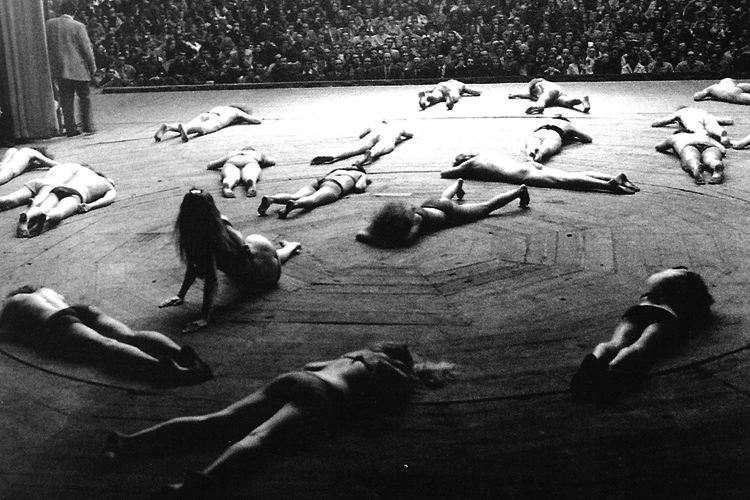
Arto suggested changing everything in the theater space, in the actor’s work and the perception of the viewer. He sought to create new musical instruments that make a strange buzz or unbearably loud sounds. Lighting should have become like the "fire arrows." Arto wanted to use the entire space of the theater, abandoning the barrier between the stage and the viewer to facilitate "direct communication" between the viewer and the spectacle. Spectators, he dreamed, will sit in the center in the rotating chairs, and the performance - to follow the edges of the hall, around them. In the most important scenes, the actors will go to the middle and approach the audience closely. The room itself, where the performance is staged (arto did not call it the “theater”), let it be “naked”, devoid of all kinds of jewelry, so that nothing distracts the viewer from actors in bizarre bright costumes and makeup. The actor, according to Arto, should become a living tool in the director’s hands: the ability to express internal bodily states is very important to him. However, an element of randomness, a possible “breakdown”, was also important for Arto, when the actor’s ability to brutal metamorphoses again turns him from a “instrument” into a person. In short, Arto's proposals were an attack on both the viewer and the invariability of the theater as tradition and institutions. Who would become his public - so far remained unknown. The theater of cruelty, Arto said, inevitably gives rise to his own audience: "First, this theater must exist."
Arto's manifesto was met for the most part by hostile. Many embarrassed, even frightened how far he was ready to go, developing ideas, alien to European culture and opposing it. In his manifesto, a threat to the language was clearly read. If by “language” we stop understanding a set of words with a certain meaning, if it turns into an indefinite set of gestures, screams, direct manifestations of bodily - will this not question all social, political, religious forms of communication known to us? The possible consequences of Arto's ideas went far beyond the theater.
Translated from English by N. Kholmogorova