
Translated material
Excellentmen against the inspections
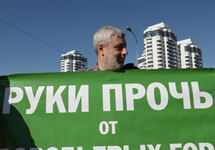
Over the past six months, Moscow has been overwhelmed by a construction boom, strange in a crisis. But, apparently, it was the crisis that served as its cause. Last year, the Moscow City Duma actually declared an unlimited amnesty of point development. Before the adoption of the new "land use and development rules," the Moscow City Duma made amendments to the Town Planning Code, according to which any projects born before the adoption of new PPZs, even if they do not correspond to it, automatically, without any public hearings, are legal. As a result, "hot spots" began to arise in almost all areas of Moscow.
Konstantin Yankauskas , municipal deputy of the Zyuzino district : "In the conditions of the growing crisis and the expectation by the authorities of some social upheaval, the emergency distribution of the city authorities of the main asset - land - began."
This happens in several directions.
We began to reanimate projects of 10-15 years ago, permission for which were issued under Luzhkov (for example, in the warm Stan and Yasenev). They were approved even without public hearings.
Transport units. Under the guise of landscaping and improving accessibility in sealing order, territories around the metro are built up. Moreover, the remoteness of the object under construction from the station can reach a kilometer.
The development of parks and green areas, including within the framework of the 200 Temples program (a well -known example - Park Peatfyanka).
Point building on the site of the PBX.
In all cases, this is sealing development, not only worsening the environmental situation, but also overloading the already suffocating infrastructure - transport, roads, kindergartens, schools, clinics. The situation is also complicated by the fact that the cadastral map of the city created in the post -Soviet years often does not correspond to reality. And at one time, the general plan of the development of Moscow at one time with such battles is now, as it were, not the general plan.
Developers are trying to act quickly and secretly: the territories will be extinguished by fences at night, there is also deforestation in green areas. Secretly, pseudo -public hearings are held, where voting statists bring. A physical confrontation is increasingly tough, attacks on protesters are becoming more frequent. But the protesters also gain experience and unite. If earlier the dissatisfaction of the inhabitants began to appear 2-3 months after the start of construction, now it is enough for self-organization 2-3 weeks. For six months, the Moscow city coalition of initiative groups is operating. A week ago, individual groups of the South-Western District united to coordinate actions in the Committee-42. On Sunday, he held the first united rally near the building of the district prefecture. On Saturday, up to 500 people gathered a rally of defenders of Dubka Park, where it is planned to build a 24-story building in a zone protected from construction. Recently, pickets were held in the Northern District at seven illegal buildings.
Elena Rusakova , municipal deputy of the Gagarinsky district : “Each time, some groups, associations are born under a specific task. For example, when the situation on the Sparrow Hills arose, a coalition appeared in defense of the Sparrow Mountains. It includes different groups that are also included in the Moscow Coalition. These are not vertical, but horizontal structures where all participants are equal.”
Most often, contacts occur through social networks and relate to consultations on the methods of struggle, joint legal actions, compilation of letters and petitions. But today they are already talking about the need for physical support for neighbors from other areas. Among the activists are many professionals - lawyers, ecologists, geologists, sociopsychologists, which helps to understand difficult matters and catch power on falsifications.
Konstantin Yankauskas : “Today, hot spots” are present in 8 regions of the southwest of 12. The number of residents, who have protested against abuse in construction in one way or another, is already measured for tens of thousands. This is no less than on the street for honest elections. Today, the movement of residents is non-political in nature, but if the terror of the city authorities will grow, it is growing, it is growing, it is growing. A purely social movement can develop into political. "
So far, however, the attitude to any "politics" among residents and activists is skeptical. However, the "politician" here is often understood as the mercantile interests of functionaries, satisfied with participation in party structures and elected bodies. So a painful reaction to all "political" is not so naive. The attitude to municipal deputies is simply determined: if you are here, near and help residents, you are your own. And it doesn’t matter which party was chosen from. They say that there are decent deputies from United Russia. But basically the ruling party is identified with the bureaucratic apparatus. There were cases when some people collected signatures under the symbols of "EDRA" and conducted surveys clearly in favor of developers.
The "beginners" who are going to the next elections perceive suspiciously. And for this there is also reason. The young candidate from the KRPF who performed at a rally in the oaks, who seemed to come to support the "Dubkovites" on behalf of the initiative group of the neighboring region, more often mentioned his party in the performance than the problems of the audience. I did not forget to remind of his exploits on Moscow fronts and apple -it -like Sergei Mitrokhin. Party flags at such rallies are usually prohibited by the organizers, but the election campaign is clearly felt. It is also difficult to blame the candidates for: everyone who is nominated not from the authorities, today is simply not of communication with the voter today.
Denial of "political" reaches imaginary. One representative of the initiative group, before it is very sensible to enlighten me in some matters, for a long time found out for a long time if my publication could "take her into politics." Most people who are faced with bureaucratic arbitrariness in any form begin to understand very quickly how everything works in the country. It seems that people consciously limit the spread of their conclusions, applying them to only the closest problems. Perhaps this is due to the methods of struggle for the urban environment that activists use today.
Their experience showed that the greatest efficiency can be achieved by combining three components: pressure on power using documents, a wide information campaign and physical confrontation at the place of development. Apparently, the most effective combination of a whip and a stick is looking for, from which it is still impossible to exclude some forms of communication with government agencies.
Contrary to widespread opinion, there are examples of a successful struggle against unwanted development. There is a known case of stopping a huge project for the "reconstruction" of Leninsky Prospekt. In the Gagarinsky district, almost all the attacks of developers were successfully repulsed. The construction of the hotel was stopped on Presnya, several projects were discontinued in the Tagansky district. In Yasenev, projects on the streets of Rokotov, Vilnius, two points on Lithuanian Boulevard have been stopped recently in Yasenev. Activists with positive experience advise beginners. For example, the ashevites actively help colleagues from the warm camp and Konkov. But the path to victory requires great and long efforts. And the victory itself does not guarantee that in six months the next investor with the next linden documents will not come to the same place.
Some municipal deputies have long been involved in the movement. However, they have different attitudes to their status.
Sergey Vasiliev , municipal deputy of the district of the Teply Stan : “Despite the fact that municipal deputies do not have direct powers to prohibit construction, I consider it important that people who will be for residents are elected, and not against. For example, all deputies from the warm camp unanimously voted against the development of today's“ hot point ”. Now we are working on the mechanism of the regional referendum, and if all of our whole The struggle will not give results, we will find a way to hold it within the framework of the law. "
Elena Rusakova : “Honestly, I don’t feel any special advantages from my deputy. To a greater extent, I act just as a resident of the district. Of course, someone who can unite people around me always. Unless the deputies can help in this-people will know to whom to participate in solving the problem.”
Most activists agree on the main tasks of cooperation:
Operational information support - about emerging projects, public hearings, etc. In order to mobilize people in time.
The control of all existing “hot spots” and the forecasting of projects that can only surfacing, so as not to act after him.
Holding joint public actions.
Physical mutual assistance of residents of different areas in the field - in round -the -clock duty, in protection from various "masked people." They even propose to create "operational detachments" of deputies that can instantly respond to any complications in order to prevent arising conflicts and power counteraction. "
Conviction and enthusiasm in combination with distance from "politics" and an attempt to use legal tools to urban defenders really reminds the movement of observers in 2011-2012. Then it all ended in swamp. I wonder where the defenders of the squares and playgrounds will come.