
Translated material
Oblivion in action

Google has rejected more than 57% of requests for the removal of links for the European "law to oblivion". This is evidenced by statistics published by the company.
The “right to oblivion” appeared in the European Union as a result of the decision of the EU court, adopted in May 2014. Then it was found that users have the right to send to search engines, including Google, requests for removing some search results by their name. Search systems should consider such requests individually, but can only be refused if the contents of the search results are of interest to society.
In total, from May 29, 2014, when Google began to consider requests for information deletion, the company received more than 409 thousand applications. As an example, Google cited 23 requests. For example, a certain official from Hungary asked to delete fresh articles about his long -standing criminal record - he was refused. He asked the teacher from Germany to delete information about the frivolous crime that he committed more than 10 years ago - the company satisfied this request.
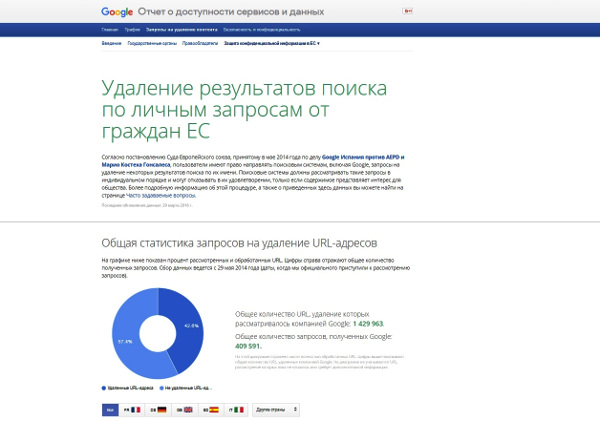 Google report on Google.com services and data
Interestingly, user requests from Russia are satisfied on average less often than in other countries. If in general, requests are deviated in 57.4% of cases, then requests from Russia are equalized in 73.7% of cases. More only for Portuguese (74.1%) and Bulgarians (79.5%).
In Russia, the law on the “right to oblivion” entered into force on January 1, 2016. In accordance with it, citizens have the right to demand from the search engines to remove from issuing a link to inaccurate information and information that is recognized as “having lost value for the applicant due to subsequent events”, including information about crimes in case of repaid criminal record.
Accordingly, statistics on the use of this law in Russia are not yet too large, but Yandex last week has already published the interim results of the new rule. By that time, Yandex received more than 3,600 appeals from 1348 people. Of all processed appeals, 27% were satisfied, 73% were refused, including 9% by partial refusal (satisfied the requirements regarding part of references from the appeal).
“The high share of failures is due to the fact that often“ Yandex ”cannot verify whether information is reliable or not, it violates its distribution of someone’s rights or any laws,” the law “Law is assigning the functions of ships or law enforcement agencies that are not inherent in their search engines. This problem is especially noticeable when working with appeals to delete links to illegal and inaccurate information, ”said Yandex.
One of the “victims” of the “rights to oblivion” was the Center “Owl”, which is engaged in the coverage of the problems of nationalism and xenophobia, the relationship between religion and society, political radicalism, etc. On March 22, Google sent an official letter to the Center, which reported to delete one of the texts from the list of issuance for a certain but not named name. This news from 2006 that Skinheads who beat Angolts were condemned in Obninsk. On March 27, a similar letter was received about the news of 2008, which spoke about the verdict in force to the eight of the Obninsky nationalists. In both news, one name is mentioned, the search results for which Yandex also filters .
“We believe that the removal of any information about these matters does not correspond to public interest, and the personal interests of the Nazi-Skinhedov (already former, one must assume) cannot be set higher than public interest,” the “owl” noted. They reported that they turned to Google with a request to revise their decision.