
Translated material
Hidden image
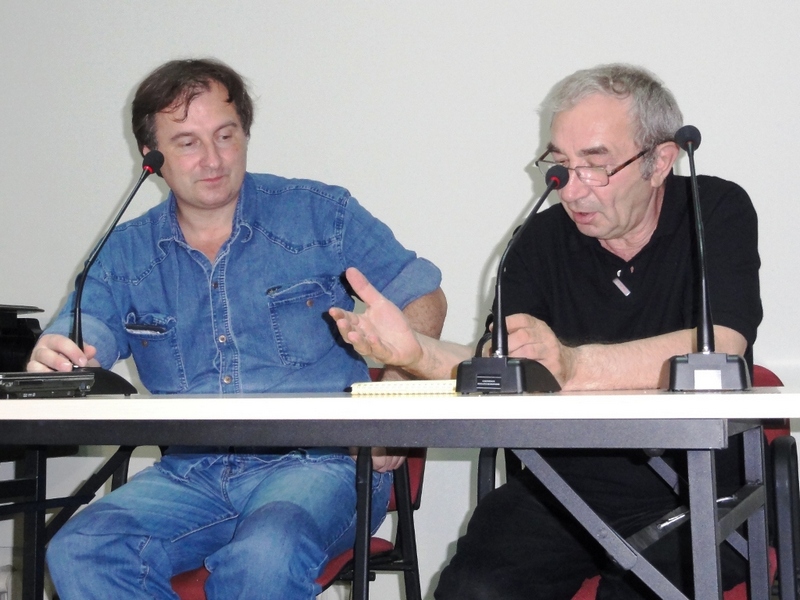
The tracker himself does not leave traces. Well, almost.
There are people for whom there is a lot of external: to appear before the public, to speak, to sign. It is easy to write about those who are most important to leave your mark.
He , who dedicated the life of the sestible traces of previous generations, he himself is not inclined to cut out the anagrams on the rocks and trees, trample the landscape of the present, which is rapidly becoming the past. Maybe because he knows how funny it looks. And maybe because there is something inappropriate in this-to apply special, unnecessarily, efforts only in order to stay in someone else's memory.
In addition to ambition, there is another. For example, priority, "scientific priority". So, no, how many times during the analysis of the "grains", when it came to documents from the archives of dissident times, about the "chronicle of current events", I heard from his friends: "Senya, but it seems that you wrote?" The Samizdat school school: Well, yes, I wrote. And the manuscripts “did not burn” - that is, there were people who read, inspired, reprinted and conveyed further. And this is the main thing. And not authorship, not a signature.
* * *
But there are still traces.
There is something in biographies, but who reads them? Place of birth - Volsk, Arkhangelsk region. The father, arrested in 1938, after the camp was defined here in exile. He died in the investigation in 1951, after the second arrest. Return to Leningrad.
Tartu University. Lotman's school, at that time - “Mecca” of humanitarian knowledge. Not just study: Arseny, when he studied, lived in the house of Yuri Mikhailovich.
Here, in Tartu, even before the word "dissident" appeared - acquaintance with the future dissident circle, for example, with the arrived Natalia Gorbanevskaya (read Ulitskaya!).
Involvement in Russian culture and history. That is, to the history of the struggle for freedom - and what else is Russian history?
Memory of terror. Terror state, and terror of revolutionary. About how yesterday's fighters for freedom become new gendarmes. As they themselves become victims of the car -created car. And how skillfully this terrible future is hiding in the most liberation movement. And - in spite of everything - the liberation movement does not come down to those winners who immediately successfully took up the extermination of yesterday's associates ...
The search and restoration of continuity is the work to which the Tartu school made a huge contribution. One - but the most important! - An example from the history of the "Narodniks" is a letter from Stefanovich Dech, found by Arseny Roginsky and his friend Lev Lurie and published by Lotman in "Scientific Notes of the University of Tartu." The publisher’s thoughts on the “revolutionary ethics”, about the hierarchy in the revolutionary environment, about the “revolutionary generals” are relevant today (and this refers to the case of Razvozzhaev-Lebedev no less than the case of Krasin-Yakir).
Maybe that's why Arseny Roginsky does not have “stripes”. Maybe from here - dislike of entering the "Councils and Commission" and to go to high offices, although they call.
* * *
The history of Russia began not in 2012, and not in 1985, not in 1956 and not in 1917. She was repeatedly rewritten by those who would like to become "the first people on Earth."
The history of Russia, including the history of “gross and massive violations of human rights” - is continuous and inextricable. This is time. Continuity is important - however, continuity that is not reduced to "hereditary diseases."
And they also like to reduce the history of Russia to Bolshoi - so that more zeros - the numbers of executed, planted, wise. But people should be considered not zeros, but units. The story, biography of an individual, is the initial and main scale of the work. These are two.
Actually, on these two “legs” now there is a “memorial”.
And the story does not come down to meetings of "city legends" - because mythologization is a little better than oblivion. And after the 1974 Moscow appeal, Roginsky with a group of the same young enthusiasts began to release an independent historical collection "Memory". Unofficial - does not mean "amateur." It turned out that in samizdat you can withstand academic standards. And random witnesses of work, suddenly guessing the ones who had the ones: "You are doing samizdat!" - You could be fenced with the answer: "Where did you see samizdat with footnotes?"
The result is logical: at 35, it seems like the cabinet scientist of the Tartu spill and gets into a criminal camp. Why in criminal? The KGB bodies, subordinated to the Party authorities, asked and received in the "authority" (in the department of administrative bodies of the CPSU Central Committee) permission to condemn the "generally" three Petersburgers: Roginsky, Azadovsky and Klein in the department. The last word of Roginsky in court was about the position of a historian in the Soviet Union ...
In the stories about the camp, Arseniy Borisovich, lastly looked like a hero (although the story about how he sat with the Chechens, as well as the stories of other dissidents, determined by the Soviet government for general regime, later helped me a lot in work in the Caucasus). Almost the main thing in these stories was not to seem to be a "leader", not to seduce the "romance of the revolution."
And - do not suppress the grandeur.
Once, Roginsky remarked: “I had two teachers of life: one-Sergey Adamovich Kovalev (it was at the anniversary of Kovalev), the other was Mikhail Yakovlevich Hifter. The first of them, when I asked him about something, immediately told me:“ Well! It's simple! .. "And the second usually answered:" Dove! In fact, everything was much more complicated! .. "
And then ... then there was a "memorial." If I had a taste, a sense of tact and style, then here I would fail.
* * *
And another view of the history of Russia, much more common. Here's Dovlatov in the "Reserve" about the Pushkin Mountains, about the director: "... wants to create a grandiose park of culture and rest. I hung a chain on a tree for a color. They say that it was stolen by Tartu students. And drowned in the lake. Well done, structuralists! .." "
One of the "fellows" is Arseny Roginsky. To be in the circle from which he came out and who endlessly described Dovlatov. And "hide" the nameless in this wonderful story like hockey.
Some are trying to make a "grandiose park of culture and rest" from domestic history. And others fight all kinds of chains. This is the life and fate of Arseny Borisovich Roginsky.