
Translated material
Victor Pivovarov: "It is much more difficult to find examples of long -term art"
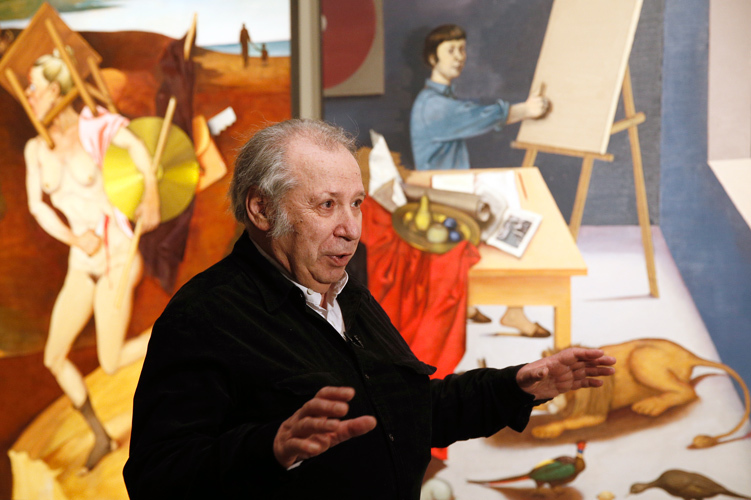
Large museum exhibitions of Viktor Pivovarov in Russia took place three times - “Steps of Mechanics” (2004) in the Tretyakov Gallery and the Russian Museum, “Ecosy Limons” (2006) and “They” (2011) at the Moscow Museum of Contemporary Art. Now in Moscow you can see a two -part project - the retrospective of the Snail Train in the Garage and its continuing exhibition “Lost Key” in the Plane named after A.S. Pushkin. Anna Komissarova talked with Viktor Pivovarov about the illusion of isolation, fidelity of painting and his discoveries in the paintings of old masters.
- Your snail is interpreted as a metaphor for art strategy. How are her relations with Moscow conceptualism and with the history of art? Does she argue with them, agree, refutes or ignores? Maybe she corrects and prescribes?
- I must immediately correct the mistake that arose in the press about the interpretation of this snail. The image of the snail is interpreted as an artistic strategy, as isolation from the world, and this is repeated in many texts. The fact that the sink of a snail as a spiral screw inward is a certain model of introvertly consciousness is, of course, a close image to me, but so that it is a kind of strategy or a way of isolation from the world is not. Yes, and the snail itself will hide into its shell, then it will stick out and shows the horns, it is in contact with the surrounding space, but at any moment it is able to leave it into its inner world. In addition, a snail for me is an image of a very slow movement. In one of the paintings from the “Lost Keys” series, which is called the “Snail Track”, a huge figure of a naked woman is depicted, in suicidal insanity piercing a knife and rushing into the abyss, and almost invisible, crawling in the opposite direction of a snail - a slow, inconspicuous, rising movement that opposes this rumble. This contrast and the image of the snail itself unite both exhibitions, both in the "garage" and in the Pushkin Museum. For a long time I could not find the name of the exhibition in the Garage. Like Surikov (I hope I will not be accused of megalomania) saw a crow in the snow and he had the image of the noblewoman Morozova, so I went out of the gate one day and saw a snail that crawled along the path. And even the snail itself struck me. The snail is my favorite image and is often found in my illustrations for children. It seems that there is not a single book where this snail would not be. I was struck by her trace. Before my eyes, he disappeared in the sunlight. And this mother -of -pearl precious disappearing trace, the feeling of fleeting, the insignificance of the time released in life - this struck me and helped to find the name. And the whole exhibition in the “garage” ends with a small picture from the cycle “Gardens of the monk Rabinovich”, where there are only two words: “A moment - and no!”
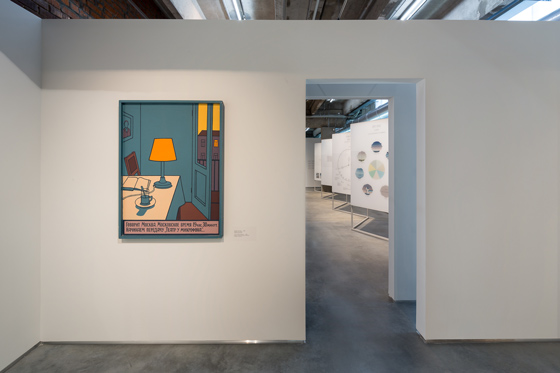 © Olga Alekseenko / provided by the Museum of Contemporary Art “Garage” Exhibition of Viktor Pivovarov “Snail of the Snail” at the Garage Museum
-And yet, the work of the Prague period predominates in the exposition of the Snails and trace the immersion vector into the internal landscapes. Is this related to the desire to isolate from the Moscow conceptualist past?
- No, I have no such desire. In the 1970s, I was part of a conceptualist circle, and the ideas that were born in it had all the artists of this circle. In Prague, I ended up almost in isolation, in complete solitude. I, like a plant, was pulled out of the soil where I grew up. But everything has two sides. On the one hand, I lost touch with the nutrient team, and on the other hand, fate pushed me to find the individual path. If in the 1970s I was part of a small one, but the community of like-minded people, in which the individual was somewhat dissolved in the general energy field, then in the 1980s in Prague I had to look for what is called myself. These searches were rather painful. My childhood brought me to myself. After a period of complete loss and wandering in the dark, I spontaneously and intuitively turned to children's memories. The cycles “apartment 22”, “teenager’s diary”, the album “Actors” and other works helped me find solid ground under my feet, the ground where I could start the roots. These roots, of course, are associated with my biography, with my purely personal life, part of which the community of Moscow conceptualism remains.
Over the past 30 years, conceptualism has been a non -alternative direction, nothing else has appeared on the horizon. The same non -alternative as modern global capitalism.
-You, like your conceptual colleagues, created installations and envarines, some of them are presented for the first time in the “garage”. But in comparison with a huge number of your paintings and albums, it still seems that you are not fascinated by non -living forms of art, even adjusted for the game and character of your works. One of your installations, which is not at the exhibition, was called “unlimited possibilities of painting”. If I am not mistaken in my impression, then what is the reason for such a dedication to the picturesque language? With substantial tasks that are more successful in chamber format? With your taste preferences or a habit of a particular technique?
- Yes, you are right, a picturesque and drawing tongue is closer to me, I feel more comfortable in it. However, when I need to expand it, I partly part with him, especially since I work with the word constantly, even when I draw or write paintings. Why is the picturesque language closer? Conceptualism generally arose from protest in relation to painting, a picture, to any artifact. For the first conceptualists, art was important that it is impossible to sell so that it was not an object and could not be instantly a product. This important and wonderful intention did not last long in art. The first “non-appropriate” conceptual experiments associated with body art, Lend Art and Hepphening arose in the 1960s. But the market quickly found the opportunity to sell photos from these shares. Thus, the main non -profit impulse and the charge no longer acted. But all this problem, all this protest against the market had nothing to do with us, since there was no market in the Soviet Union. In addition, I grew up at a classic school, and in relation to it it was possible to take two positions: either crossed out, curse it, or use it. The second path for the artist of the second half of the twentieth century is a failure. Because all the main strategies of postmodern art followed the path of denial of painting and paintings, along the path of conceptualism. The exception is only two local directions - German neoexpressionism and Italian transcavangard. They used painting in its medial purity and remained closed formations. Over the past 30 years, conceptualism has been a non -alternative direction, nothing else has appeared on the horizon. The same non -alternative as modern global capitalism. Such forms of art as corporal, political art, photorealism are branches of conceptualism, which are called “post -conceptualism”. My Milena (Milena Slavitskaya, curator, critic, art historian, Viktor Pivovarov’s wife. - Ed .) Believes that the difference between conceptualism and post -conceptualism is that post -conceptualism included market mechanisms in his artistic strategies: management, advertising, etc.. Classical conceptualism shunned this. I myself am inclined to perceive conceptualism as a single phenomenon.
The fact that I remained faithful to painting, that is, chose a strategically failure path, inevitably reflected on my biography, and if we talk about some recognition (although any recognition is a moody thing, today it is, and tomorrow it has evaporated), then it came to me late compared to my colleagues. In this sense, like a snail - I moved very slowly. And, of course, I am terribly glad that I was honored to show my work in two such wonderful museums.
And one more point why the language of painting and drawing is close to me. Yes, he is close to me in education, I went through such a school, but the main thing is that I adore classical art and perceive old artists as my contemporaries and interlocutors. I tried to express my delight and admiration for them in the new cycle “Lost Keys”.
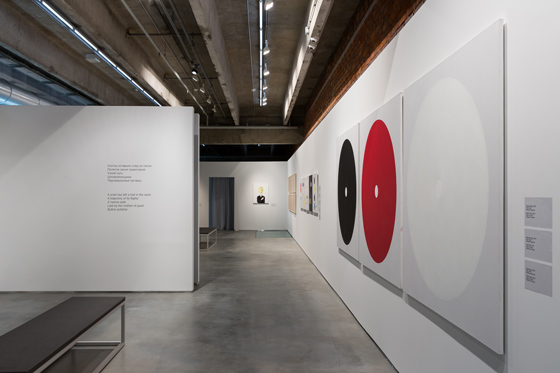 © Olga Alekseenko / provided by the Museum of Contemporary Art “Garage” Exhibition of Viktor Pivovarov “Snail of the Snail” at the Garage Museum
- Probably, your immersion in the art of the XV -XVI centuries was accompanied by discoveries and observations regarding the experience of artists of that time?
- In the series “Lost Keys”, four out of eight paintings are inspired by Kranam. In the process of work, I just fell in love with him. Like any artist of the XV -XVI centuries, Krana performed a huge number of orders. It was a standard way to exist. But he, like his other contemporaries, had opportunities for an absolutely personal and philosophical statement. He does not have so many such paintings, they are scattered into various museums in the world.
It is very interesting to compare Kranah with his closest contemporary Albrecht Dürer. Dürer next to Kranach is strict and dry, Krana next to Dürer is gentle and voluptuous. Erotism is the thread that immediately makes him close to us, he perceives the sensual side of love just like us. These women wriggle, and the lines of their bends look like he strokes them, as if under his hand the female body was taking such delicate, exquisite lines. Cranach's eroticism sometimes takes such impudent forms, as if he had read a Jung. The organizers put 18+ at my exhibition at the Pushkin Museum, but did not put on Kranacha. And there something unimaginable is happening. There, for example, there is a painting "Judith at the Feast of Olofern". At a large table, a company of elegantly dressed men led by Olofern is sitting. Nearby, Judith, who in his palms holds out a rather strange object. If you look closely, this item is more than reminiscent of female genitals. But that's not all. Olofern holds a dagger in his hand, which is directed directly to the core of this subject. Since I have been interested in Kranakh for a long time, I know these Yungsk-Freudian things. His freedom and independence in religious issues (despite the fact that he was close to Luther, the latter was even the godfather of his daughter) is very impressed with me.
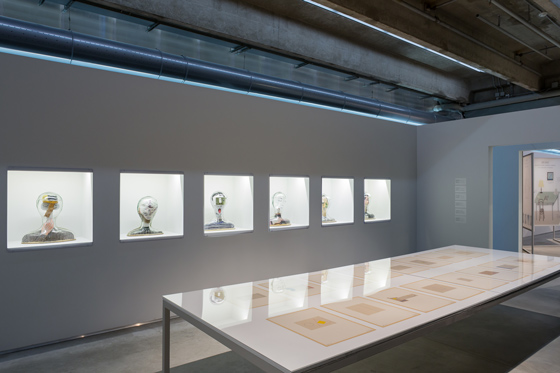 © Olga Alekseenko / provided by the Museum of Contemporary Art “Garage” Exhibition of Viktor Pivovarov “Snail of the Snail” at the Garage Museum
The “Lost Keys” cycle began with the postcard that my friend Kirill Kobrin gave me several years ago. On the postcard there was a reproduction of the "melancholy" Kranacha. It so happened that this phenomenal art and philosophical work eluded the attention of art historians. I explain this so that the German professors of the 19th century, who created the story of the art that we study in schools and universities, used only such large museums as the Louvre, Uffizi or Pinakothek, and simply did not reach small provincial meetings, where the “melancholy” Kranacha turned out to be. I did not make a reservation, Kranach has only four "melancholy" from my estimates. One in Kolmar, the other in Edinburgh, the third in Copenhagen, the fourth was somewhere in America. And all the "melancholy" are different.
So, I around this "melancholy", like a hungry wolf, walked in circles for several years. I did not know what to come up with how to get closer to it, to include it in my art space. Gradually, the idea of a cycle of paintings arose, and the “melancholy” became the first I started with. Closely considering Kranacha, I found things completely unexpected. Among those few attributes that he left from the Dürersky Melancholy, a ball, a sphere. Amazingly, there are no reflexes on his ball. After all, any voluminous object, and the ball especially reflects the colors of the floor, the ceiling, other surrounding objects, and Kranach has a ball and all other objects do not reflect anything. They together create a single space, but they themselves remain closed, self -sufficient monads. If you translate this type of image into a philosophical language, this means that every thing in the world is independent and self -focused. It does not consist of reflections and reflexes of other things, it is absolutely autonomous. And therefore, is completely responsible for itself. That is, we cannot refer and justify ourselves with some fatal circumstances that are independent of us, each of us is the world in ourselves, and the causes and consequences of our actions are completely in ourselves.
Absolutely any art can be used for any ideological purposes.
“In the book“ In love ”, you write about the fact that your creative searches determined“ The torn between boundless love for the classics and ardent fresh love in the art is the latest. ” Is this tension remaining between the two poles of love motivating? Do you feel the need to overcome this breakdown or has it remained in the past?
- In my youth, it seemed to me that between the classical art and the art of modernism is the abyss. I rushed about, it seemed to me that I had to make a choice. Now I see them as a whole, without breaking, as the same art. I think this is generally a time sign. I discover such a vision of the integrity of culture, for example, in Vladimir Martynov in his latest book 2013, where he writes about Leonardo, Bosch and Dürer as his contemporaries and interlocutors.
- There is an idea that painting today can exist only in imitation mode, because as a language it belongs to another cultural tradition. What do you think about this?
- At one of my meetings in Moscow, I proclaimed that realistic, or figurative, painting is most suitable for propaganda and all totalitarian regimes used it for this purpose. In this regard, I again turn to our recent conversation with Milena. The question stood like this: can conceptual art, art is difficult to reflect, ironic, be used for propaganda, for ideology, including totalitarian ideology? At first I was not sure of the answer, but in a conversation with Milena it cleared up: yes, maybe very easy. We can safely say that absolutely any art can be used for any ideological purposes.
To your question about the possibility of painting today, about its only possibility of existence in imitation mode: so, Milena expressed the opinion that, since the painting as an archaic language was beyond the boundaries of current movements used by the authorities, the most modern protest gesture would be if someone went with a sketchin for nature and wrote trees and streams.
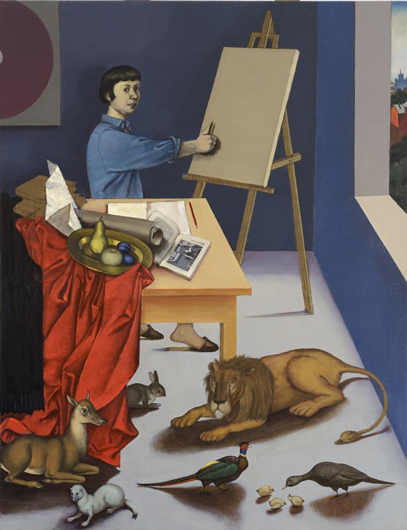 © granted by the FMI named after A.S. Pushkin self -portrait in his youth. 2015. Oil, oil. The property of the author
- If we talk about the modern art process, what names, directions, exhibitions and plots seem to you most interesting? Are you in love with, as before, the latest art and what forms this love finds?
- Of the very latest things, I am very strong in Pavlensky's gesture . The reaction of the entire art community to Pavlensky was completely unanimous. In this case, I am not original and with pleasure I join the opinion of other artists and critics. But this gesture, really strong and civilly necessary, is also a simultaneous one. It is clear that literally tomorrow he will lose his strength and energy. It is much more difficult to find examples of long -term art. I would attribute to this category Agnes Martin, whose exhibition was lucky enough to see in London last year . But Agnes Martin is already a distant past.
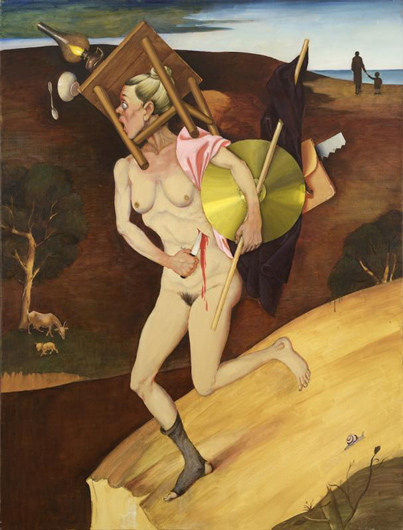 © granted by the FMI named after A.S. Pushkin's trace of the snail. 2015. Oil, oil. The property of the author
“I came across your words that“ lost keys ”are the best that you did after“ projects for a lonely person ”. By what criteria do you evaluate your work, past and current?
-When you finish some kind of work, it is so immersed in it that it seems the best. I don’t know if this is the best work, this time will tell. It seems that “Projects for a Lonely Man” withstood the test of time. When I made an exhibition in the Garage, several people told me that they were relevant. I was terribly surprised. It seemed to me that they remained in the good old existentialism.
- Not at all, your “projects” are a utopia of a modern person whose chaotic life is immersed on the Internet and turns into endless self -presentation. There was no room left where he could enjoy loneliness. However, the last question remained. Your exhibition in the Garage is arranged as a book consisting of eleven chapters. The twelfth chapter is an exhibition at the Pushkin Museum. Do you think this book is finished and integral? Are the following chapters waiting for us?
- I would like this book to always remain open, so that there are no last chapters and the last words in it.