
Translated material
Aviator Evgenia Vodolazkin
And five more books about man and time
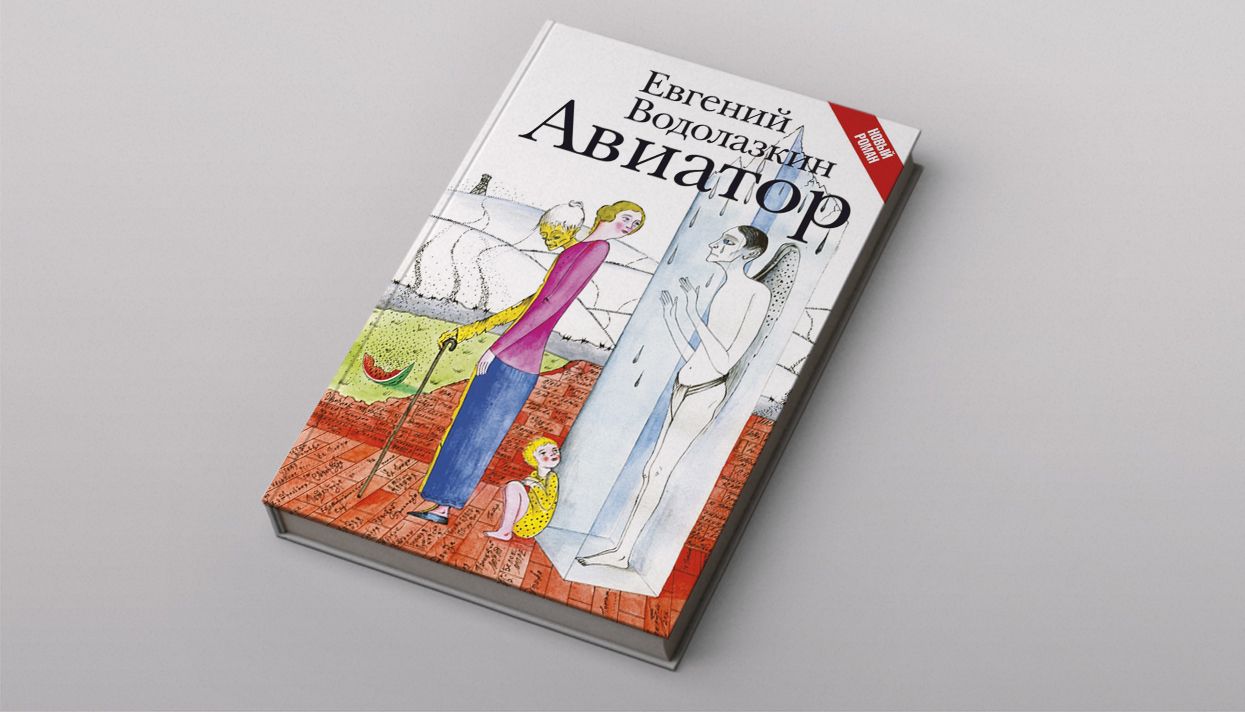
A weekly literary critic Galina Yuzefovich tells at Medusa about the most interesting and important books published in Russia. The current review is dedicated to the Aviator, the new novel by Evgeny Vodolazkin, the author of Lavra, the most popular book in Russian literature in 2013.
The novel, following a truly great success, is always very difficult. It is difficult for the writer - which is understandable, but for the reader too. The reader is waiting (most often for a long time - several years), he is looking forward to, hopes that now he will be as good as last time, and the keyword is not even “good”, but “the same”. Once having fallen in love with the author, we expect that each of his next book will be different, but at the same time will cause us the same experiences as the previous one - only cleaner, brighter, deeper.
In this case, the abstract “reader” can be honestly replaced with a specific “I”, and instead of “author”, write “Evgeny Vodolazkin”. Yes, after a living, breathing and at the same time crystal-prostrate Lavra, I really wanted to, more, and more-so that, at one time, Pavel Basinsky wrote, like a key water on a hot day.
In this sense, of course, the new Roman Vodolazkin “Aviator” is a continuous disappointment: he is different. And in order to come to terms with the fact that the new text is not a “laurel”, not his continuation and not at all about that, it takes time. Moreover, the stronger you love the previous Roman Vodolazkin, the stronger the rejection will be. However, after taking and reconciliation nevertheless happens (it happened about the hundredth - out of four hundred - page), you are likely to begin to understand that the “aviator” is not only worse than “laurels”, but in a sense better. Just completely, fundamentally different - as if written with the other hand.
This time, the story told by the author, amazes with its artificiality. In 1932, experiments on Cryonika were underway in the Solovetsky camp - good in experimental rabbits, disenfranchised, exhausted prisoners, ready for anything (even for freezing, in order to just eat and warm up once), there is no lack of. By the way, Solovki are described by Vodolazkin in Shalamov’s scary-much tougher, for example, than in the Prilepin “monastery”. One of these “rabbits” is the 32-year-old Innocent Platonov, a prisoner of the famous and terrible “sext”-a penalty camp, from where they usually do not return alive. By some miracle, the frozen body of Platonov manages to survive the heyday and collapse of the Soviet regime, and in 1999 he was successfully defrosting him, returning to life.
However, behind this through the synthetic plot, which at the same time refers to the fairy tale about the sleeping beauty, and to the satirical ballad of Alexei Konstantinovich Tolstoy about the heroic stream, the matter is purely natural. In order to help Platonov restore his memory (after freezing, he does not remember almost nothing and poorly understands who he was and how he ended up in St. Petersburg of the late twentieth century), the Geiger - a doctor who led the hero out of a coma - offers him to keep a frank diary in order to write down the impressions of today's day and the memories of the former world. This diary (gradually, to the second part of the novel, from solo it will become polyphonic - the voices of his wife and Geiger will merge with Platonov’s voice) and is, in fact, the textual fabric of the novel, lively and warm.
And here we approach the first of the most important advantages of the “aviator”: of course, compared to the “Lavr”, it is much more perfect and literally skilled. Platonov’s memories of their former life appear first in the form of a vague image, a barren picture - sometimes beckoning (images of childhood or first love), sometimes repulsive (episodes of camp life). Later, they return again - already clearer, with details, smells, halftones. Then they begin to grow into relationships, penetrate each other, build into the system-the world of the past becomes more and more dense, tangible, dense ... This is the process of recalling, gaining lost, described by Vodolazkin’s recognizable and accurately (yes, this is how we ourselves are restored by our ourselves forgotten), but at the same time, if it was strikingly slim, not dance rhythm. Each detail describes a complex circle and, as if in an old -fashioned cotillone, returns to its place again.
However, the fascinating rhythm of the dignity of the "aviator", of course, is not exhausted. First of all, this, of course, is very smart, highly intellectual text - so as not to use the wiped expression “Roman of ideas”. Based on the key images of Robinson on the uninhabited island and the Gospel Lazarus, returning from the kingdom of the dead (Platons, literally returning from the other world, but at the same time abandoned by fate at a foreign time, feels kinship with them both), Vodolazkin builds his book around the most important moral universals of the twentieth century. Can there be a retribution without guilt, and the wine without atonement? The camp, the martyr of the Gulag Platonov is sure that no (as it becomes clear to the end, he has some reason for this faith) and that any punishment has guilt in his foundation - even if the guilt is unconscious or disproportionate. From this belief, the paradoxical, hypertrophied Christian readiness of Platonov should recognize the inevitability and even partly the justification of the Soviet repressive machine - the very one that deprived him of his relatives and condemned the flour to inhumanly. Platonov’s opinion is not the only one in the novel: the opposite point of view is assigned to his friend and antagonist - the pretty Dr. Geiger. Geiger is a typical liberal, a convinced supporter of the idea, according to which, with the right - that is, correct and humane - the treatment of a person’s totalitarianism becomes not only not needed, but also impossible. He is convinced that the entire Soviet era was inhuman and, accordingly, is beyond the categories of guilt and adultery.
However, even this dialogue of two opposite principles, with an electric arc, bending over the whole novel, does not outline its boundaries. In addition to the issues of “crime and punishment” (Dostoevsky - of course, one of the most important semantic substrates of the “aviator”) Vodolazkin worries the topic of conservation, preserving the world in a word - it is no coincidence that his Platonov tries to fix his life in the most detail, in all the smallest privateities, in order to renew his existence again and leave a verbal “copy” of his own daughter, which has not yet been born. And already in this plot the theme of art is invested as such - whether it captures reality or creates a new one, and how important in this connection it is, who exactly writes, for example, about a thunderstorm or mosquitoes - will different people have thunderstorms and mosquitoes of various or unite into a single, consistent community? ..
I suspect that it is possible - and it is necessary to undress the semantic “onion” created by Vodolazkin for a long time, unfolding at different angles, considering the removed layers into the light and without experiencing neither disappointment nor boredom. Of course, a mechanistic-Bezu-Working Chinese casket, in which even a detective intrigue (oddly enough, is also here), in the end) will eventually bend down with a pleasant metal click-this is not quite what we expected from the author a delightfully spinning “laurel”. Surely now the accusations will be sprinkled on Vodolazkin that he sacrificed something high for the sake of commercial success, going down the steps from the Olympic heights to the genre prose. However, in my opinion, the “aviator” is a step not down, not up, but to the side, to the side, away from the trampled path. Moreover, only now we can say for sure that a new, large and important writer has appeared in Russian literature. Not an academic scientist who once almost accidentally wrote a good romance. Not a master of “automatic writing”, a specialist in successful reproduction of a one-found reception once, but a real writer who can each time catch and light up the reader in different ways.
Five more important books about man and time
Francis Scott Fitzgerald. The mysterious story of Benjamin Batton. M.: Exmo, 2010

Everyone knows the plot of this story Fitzgerald thanks to David Fincher with Brad Pitt in the title role. A boy who looks and behaves like a 70-year-old old man is born in the family. As he grows older, unlike peers, he only gets younger: he looks at 50 at 50 and enters the university, where he shines on sports grounds, and at 60 he is forced to call his own son “uncle”, because outwardly he is suitable for his sons. It should be recognized that in comparison with the film, where there is war and love, the story looks poor and schematically. However, it is from him that, perhaps, that all other books about people who have lost in time lead their genealogy.
Gunter Grass. Tin drum. Translation from German I. Mlechina. SPb.: ABC, 2000

The debut and most famous novel of the Nobel laureate, one of the greatest writers of post -war Germany, tells about a strange boy, or a dwarf named Oscar Matserat, who did not like his reality surrounding him so much that he stopped growing with a conscious effort of will to grow. The Oscar has paradoxically stuck in the personal timelessness, which has fallen from the category of age, is a paradoxically for the reader an ideal guide to the gloomy world of pre -war Nazi Germany.
Daniel Kiz. Flowers for Elrinon. Translation from English S. Sharov. M.: Exmo, 2009

A heartbreaking story about a mentally retarded washer of windows named Charlie, who, thanks to the successes of neurosurgery, for a while acquires a powerful, creative and versatile mind. All the changes taking place with him - from almost complete thoughtlessness to vertical intellectual take -off (with disappointments accompanying him) and from there again, to the new, apparently, already final decline - Charlie fixes in his reports. Having conducted the hero through a masterfully written out chronological parabola, the American science fiction writer Daniel Kiz has been managing to carve out a spark of acute, painful and sweet empathy from the reader for seventy years.
Olga Slavnikova. Immortal. M.: Vagrius, 2007

The main character of Olga Slavnikova’s novel “Immortal” is a paralyzed old man, the “personal pensioner” of the Soviet years, whose retirement of which the households are thinly made to make ends. However, in the courtyard the beginning of the 1990s, the Soviet Empire scatters to dust, and so that the old man does not die from the shock overnight, leaving his wife and daughter without a livelihood, they decide to fence off from the outside world. With the help of old videos and newspapers in which they correct only the number, women recreate, and after artificially divide the warm, cozy and musty atmosphere of the Soviet Union in one individual apartment. And if at first their actions have some kind of pragmatic meaning, then gradually the game becomes self-sufficient and captures all heroes without a trace.
Vladimir Sharov. The resurrection of Lazarus. M.: Vagrius, 2003

The book, closest to the Aviator, if not stylistically, then conceptually. Sharov’s lasar is, on the one hand, a Lazar Kaganovich, which is quite concrete, on the other, is a strange person with the same name, living in a cemetery and dreaming of expanding time to back and resurrect his own father, and with the third-ancient, infinitely reviving and dying, manifesting itself in its own way. Weaved the ideas of Russian cosmism with the domestic history of the twentieth century, the balls creates an epic scope of a canvas, similar simultaneously at the “hundred years of loneliness” of Marquez and “Shatuns” Yuri Mamleev.
Galina Yuzefovich
Moscow