
Translated material
Erica of the saint
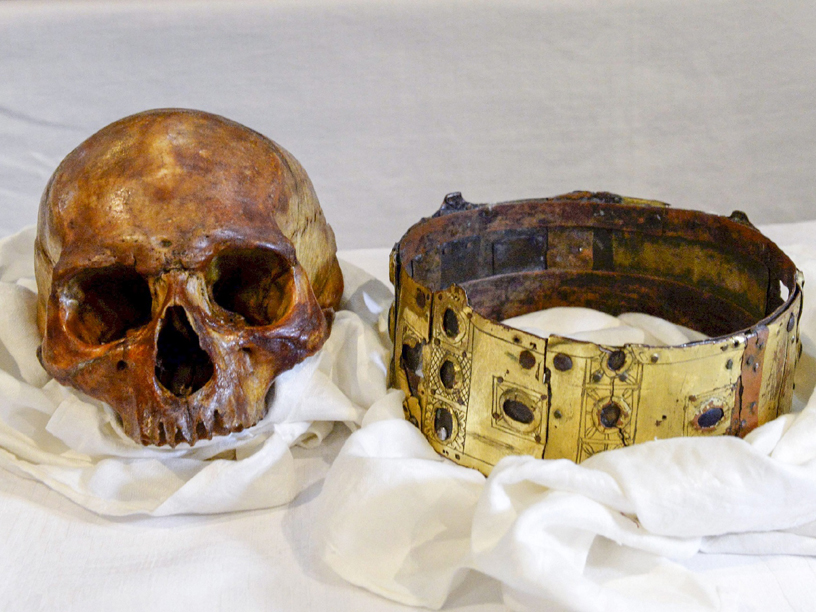
Recently, the University of Uppsalsky published the first results of studying the bones of the Swedish King Eric IX, which were stored in the Cathedral of the city.
The chance to explore the bones of the king, who was recognized as a saint and is considered the patron saint of Stockholm, fell in 2014, when the cathedral celebrated the 850th anniversary from the moment in 1164 of the Roman Pope Alexander III erected Bishop Uppskisop. Since then, a reformation occurred in Sweden, in 1523 the last Catholic archbishop of Uppsaly fled to Rome, the Uppsal Cathedral is now Lutheran, but the date still seems solid and worthy to solemnly celebrate it. Therefore, the cathedral organized an unprecedented exhibition of antiquities, to which many had never exhibited items were presented. For an exhibition from a relic with the remains of King Eric IX, a funeral crown was taken, and at the same time they provided scientists with bones for research.
The remains of Eric in Campaires
With the early Swedish kings, the situation is very difficult. To begin with, many of them simply were not. In the XVI century, Johan Monsson (in Latin - John Magnus), the very last Catholic bishop of Uppsala that he finished his days in Rome, wrote the work of Historia de Omnibus Gothorum Sueonumque regibus ("The history of all kings is ready and the Swedes"). In it, he listed quite a few kings, some of which he took from brief references in sagas or from medieval chronicles, and some probably simply invented. Now the Swedes call these kings Sagokungar , that is, "kings from the saga." The book of Johan Monsson was read by the son of King Gustav Vazi, Prince Eric, who, after an accession to the throne, counted from the book of all previous Erica and became called Eric XIV. In fact, if we consider historically reliable kings, then our Eric should not be the ninth, but the fourth, but the Swedish king, broken near Poltava, not Karl Twelfth, but the sixth. But due to tradition, the numbering still takes into account mythical kings.
Eric IX saint, although it does not apply to the “kings from the saga”, but it is known a little about him. The main source of information about it is the life written in the XIII century, more than a hundred years after his death, as well as mentioning in the chronicles of an even later time. It is believed that he did not belong to the royal family, but became the husband of Christina, the daughter of the representative of the Danish royal family, Bjorn Haraldsen and the granddaughter of the Swedish king Inge I. Thanks to this kinship, Eric was elected king in 1156 after the previous king Sverker I was killed by his own groom.
According to the life, Eric and Bishop of the Uppsala Henry organized a crusade to Finland, where Henry turned into Christianity many pagan Finns, but in the end was killed by one of them.
Robert Ekman "Holy Henry baptizing the Finns." King Eric stands behind the bishop.
It is also known about Eric that he traveled to the country in the “review trip” traditional for the Swedish kings, affirming his power, creating the court in the field and laying new churches. He created a set of laws that did not come to us, so he is sometimes called Eric the Lawyer.
Most of the details are known about Eric's death. Apparently, the murderers were supporters of the son of the previous king - Sverker I (all the next century on the Swedish throne, the descendants of Eric and the descendants of the Service and the descendants of the Sveta will replace each other). Or it was another contender for the supreme power - the Dane Magnus Henriksson. Eric’s enemies, whoever they were, supported many noble Swedes, dissatisfied with the fact that the laws introduced by Eric, consolidated the payment of church tithes.
The murder happened on May 18, 1160, on the holiday of the Ascension. Eric was in church service in the Cathedral of UPSALI. A man came to him with the news that the king’s armed enemies converge to the church. Eric prayed, overshadowed himself with a sign of the Cross and, in order to preserve the lives of ordinary citizens who were ready to protect it, left the cathedral with a small group of soldiers. He sat on the horse and rushed at the enemies, but was dropped to the ground, subjected to torture and killed.
The veneration of Eric IX began almost immediately after his death. The remains of the king were preserved in the Cathedral, next to which the murder occurred, and every year on May 18, a lacer-co-designed laurel was carried with them in a solemn procession. In 1173, his son Knut Ericksson managed to capture the throne and supported the cult of his father. There were many stories about the miraculous healings that took place near Eric's relics.
However, Pope Alexander III was not located to recognize King Eric as saints. The message of Alexander III was preserved King Knut Ericksson, in which Papa wrote that the drunk Eric was killed by a crowd of other drunkards, and also reminded that the canonization was exclusively in the jurisdiction of Rome. It must be admitted that formally Eric XIV was not officially canonized, but his veneration was preserved, and his name is even found in Roman Catholic martyrologists. And in medieval Sweden, Eric was revered at the state level. His relics were transferred to the new Uppsal Cathedral, the construction of which ended in 1273. The kings, entering the throne, took an oath, putting a hand on the casket-ruins with the relics of Eric IX. Due to use during solemn processions, the casket worn out, so in 1473 a new one, in the form of the cathedral, was made. King Johan III, who ruled in 1568 - 1592, ordered to melt the precious casket. Johangli excuses that under the peace treaty of 1570, Sweden was supposed to pay Denmark a significant amount, and funds were needed to war with Ivan the Terrible. Johan's wife, Katerina Yagellonka, soon presented the Council of a new relic, which has survived to this day.
Relics made of gilded silver containing Erica's bones of a saint
It is known that in the XIV century, some Eric's bones were transferred from the Cathedral of UPSAL to other churches, so that now an incomplete set of bones has been preserved. In 2014, scientists fell into the hands of scientists (without a lower jaw), legs, some ribs and vertebrae, collarbone and other bones. The purpose of the study was not only to clarify the details of the life of the owner of these bones, but also to study the problem of osteoporosis. Swedish scientists have long begun a project on the historical study of osteoporosis, comparing the density of bones and joint defects caused by this disease, in medieval skeletons with modern data. They studied many skeletons from burials across the country, but all these were the remains of ordinary people. Information about the bones of the representative of the highest nobility was supposed to fill out an important gap.
According to information published by the University of Upsal, the results of the osteological research surprisingly coincide with the story from the life of Eric of the saint. In total, 24 bones turned out to be in Campa, 23 of them belong to one person (one large bereta bone is extraneous). Judging by the bones, the king was a man of 35 - 40 years old, an increase of 171 centimeters, physically strong. Osteoporosis, who was so interested in researchers, did not find the king. On the contrary, the density of its bones was 25 % higher than that of an average person of his age today.
Radiocarbon analysis confirms the date of death around 1160. The content of stable isotopes helped to find out what the king ate. Its diet was not bad, it was present in both the meat of land animals and from freshwater fish, and he ate more fish, which corresponds to the mention in the life that Eric zealously observed posts.
Computed tomography of Eric IX bones
Experts in forensic medicine discovered on the skull of Eric traces of two healed wounds, presumably received during the Crusade on the Finns or in other battles. The wounds inflicted at the time of death are significantly more. According to the life, the enemies crowded around Eric who fell from the horse and inflicted a wound to him for the wound, trying to extend his torment, and then beheaded. Nine wounds were counted on the bones, of which seven are on their feet. There were no wounds on the ribs and on the remaining bones of the hands, scientists explain this by the fact that the king, apparently, was dressed in chain mail, and his legs remained defenseless. Judging by the nature of the wounds, he, falling, lay on his stomach, and the killers struck from above. The wound on the cervical vertebra, which arose when cutting off the head, could not be inflicted with the rabbound, so it remains to assume that before chopping off his head, she was pulled from the king.
The difference between written sources and data from the studies of isotopes in the bones relate to information about the place of residence of Eric in the last years of life. It was believed that his main residence was UPSAL, while the study says that he spent the last ten years mainly to Westergetland, in the southwest of Sweden. But scientists so far call this data preliminary, as they plan to collect more samples for comparison.
From the bones it was possible to highlight DNA samples, but their analysis has not yet been completed. First of all, researchers want to compare them with the samples of the DNA of King Magnus I (Rules in 1275 - 1290), who was the son of Ingeborgs, the great -great -great -great -great -great -great -great -great -great -great -great -great -great -ruble