
Translated material
The writer who died twice
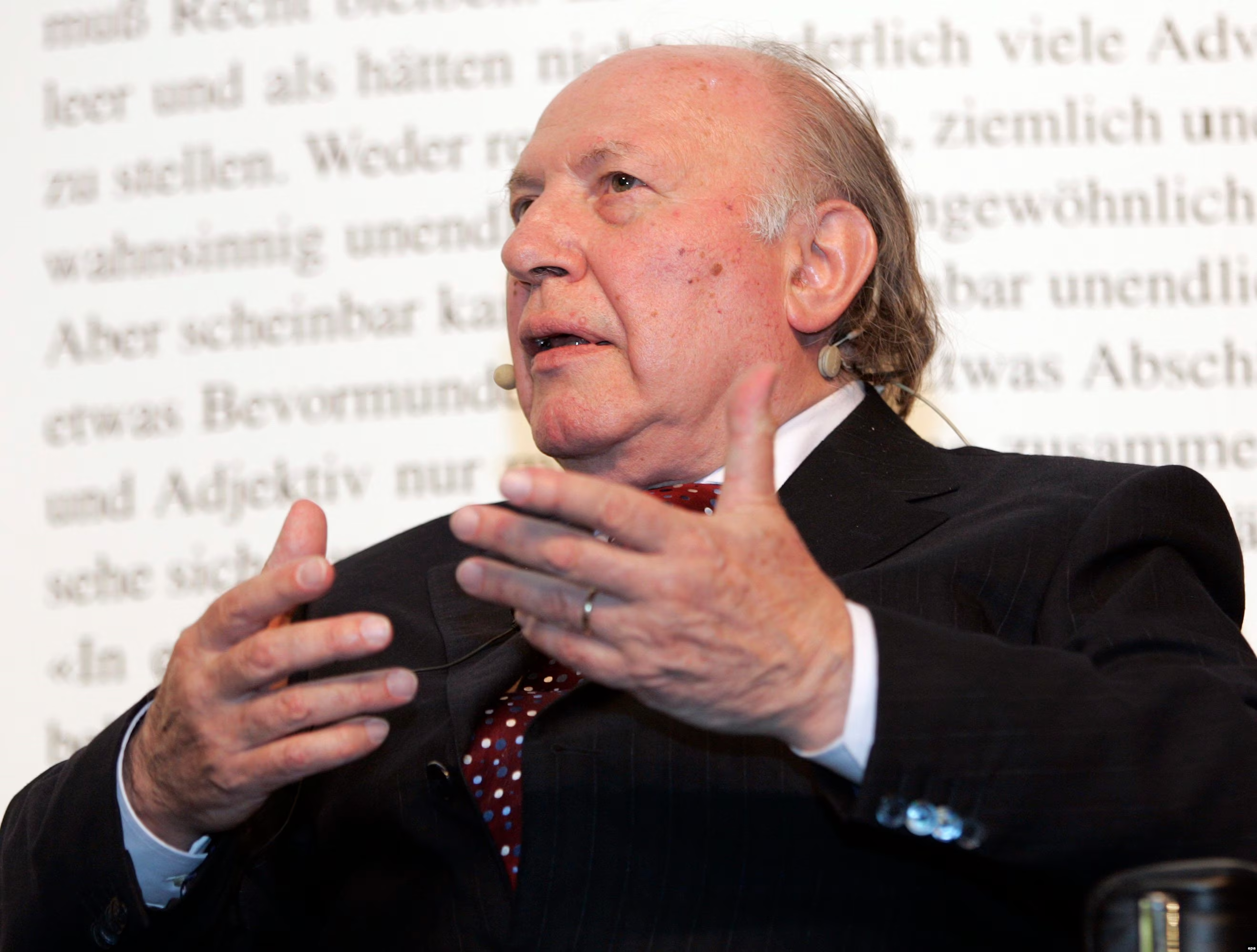
Memory of Imre Kertes
“I can say honestly: I also quickly fell in love with Buchenwald.”
These words are completed by a brief story about the camp, the hero of the most famous novel by Imre Kertes “Without Fate”, Duri Kevsh, is a 14-year-old Budapest gymnasium student, sent, among other 424 thousand Hungarian Jews, to Auschwitz. In the presentation of Dury, however, it turns out that they sent him not to death, but on a free summer tour of the sights of Thuringia. Arriving at Buchenwald after three days in Auschwitz, he argues that the Weimar famous from the cultural point of view is nearby and that somewhere in the camp there is a tree, the great author of the "forest king"-a poem that he remembers in German by hand is growing. Not every Hungarian schoolboy had to visit such a tour! Duri Kvezha was very lucky: he also returned back. Except for Tadeusz Borovsky, Kertes’s novels are the funniest of the death of Nazi camps.
The conversation about the only Hungarian laureate of the Nobel Prize in Literature (2002) Imre Kertes (1929–2016) must start with laughter, because otherwise it will have to start with the stubborn statement: Kertes is a writer of one topic. “Whatever I think about, I always think about Auschwitz. When I seem to be about something else, I am still talking about Auschwitz. I am a medium through which the spirit of Auschwitz turns to people; Auschwitz speaks of me,” Kertes writes in the Galler's Diary (1992). After reading these words, it is difficult to resist the sigh of irritation (“how much you can!”), But it is necessary to keep, because Kertes had in mind the opposite that everyone will think, having read them outside the context: the point is not that he writes only about the Holocaust is that he writes about everything in the world, but every time, due to internal necessity, his thoughts of everything in the world become thoughts of the Holocaust. Because he understands it as the main issue of being - well, or at least, the being of European. And he cannot turn away from this question - in contrast to Adorno, who once asked about the possibility of poetry after Auschwitz, and did not answer anything.
"Without fate"
Imre Kertes was born in Budapest on November 9, 1929 in a non -religious Jewish family. His father was not poor, but not a rich furniture merchant, Kertes did not have brothers and sisters. The event canvas of the first fifteen years of his life was reproduced in the novel “Without Fate” (1975). The father is sent to the "Labor Camps" (he will not return from Mauthausen), the summer holidays in the gymnasium begin in 1944 in the spring: "They said: due to the fact that the war is." Soon, the former gymnasium student is sent to work on the outskirts of Budapest, and after some time, they are removed during the next raid on Jews from the bus, sent to the overexposure point, and from there to Auschwitz. Having obeyed the advice of the old camp, who unloaded the wagon with the newcomers, Kertes, like his hero Dury Kevsch, adds to himself during the selection for two years, which does not fall into the group of children subject to immediate destruction, but into a group of men suitable for work, who are transported from Auschwalnwald to Buchenwald, and from there to the ceter. The year spent in these camps, in fact, is the content of the novel.
The novel, as already mentioned, is very funny. The British literary critic Nicholas Lezard even called him "the adventures of the Schweik-intellectual." Comparison with Schweik is very true. In the person of Dury Kvesh, we really are not dealing with a living boy who can be empathized and with which could be identified. In his face, a certain set of performances is given to us, as in the case of Schweik, iron logic and crystal clear speech. Inside, these elements are in complete harmony, but here are the circumstances in which they are demonstrated to us are so incompatible with these ideas and thoughts that the reader has no choice but to sink with laughter and wipe the tears. Here, say, Dury arrives at Buchenwald and describes what is happening to him: “Then a compatriot who lives here for a long time, with grown hair on his head, writes your name in a barn book and gives out a yellow triangle and a wide flap of matter-both of the canvas. U, and on the flap the figures of your number were printed; it was on my flap: 64921. However, the number is not applied to your skin, and if you come to mind before, for example, somewhere in the bath, with anxiety, an old prisoner, raising your hands to the sky and rolling your eyes, protest Wir sind doch hier nicht in auschwitz! (Well, God you are mine!
Funny terribly. What Nicholas Lezard is wrong (at least in relation to the first novel by Kertes) is in the definition of the Kertes Schweik as an intellectual. Duri Kevsch is not an intellectual, he is an exemplary gymnasium prayer. A schoolboy, who perceives everything that happens to him for granted, wants to fulfill the task well and get a well -deserved five.
With purely student enthusiasm, he discovers that everything in the camp is done very logically. Here, say, the requirement to remember the number of the hook on which the newly arrived in Auschwitz must hang their clothes in front of the haircut and shower. Within half an hour it turns out that it was absolutely useless to remember this number: no one had ever seen old clothes. Surprised by this circumstance and reflecting, Duri admires the elegance of the decision: "How deftly, with the help of a trick with a hanger and a number, which it was necessary to remember, we were circled around a finger, forcing us to change into a camp robe!" - And even imagines how large German bosses, gathered with cigars around the table, developed the whole system. One invented gas, the other-a bathhouse, the third something else.
From the real history of the solution of the Jewish question, we know that this is not the case: the “elegant solution” with the “cyclone B” did not appear immediately, but as a result of several years of trial and errors, that is, mass executions (who had a demoralizing effect on personnel) and the murderer (proved their inefficiency). But Dury is all unknown. It is only surprised by some inconsistency between the fact that he took place in the gymnasium in Budapest, and that mass of knowledge about the varieties of camps, the device of crematoriums and the ways of survival, which he acquired in Auschwitz in three days: “Four years ago, a significant event happened in my life: I was recorded in the gymnasium. I was well remembered by the solemn opening of the school year. I remembered. And the words of the director. Even in the gymnasium, we had to explain everything to us, openly, honestly, accessible. "
Duri is lucky: in the zeitz he will meet a person, Badri citima, who will give him everything that the teachers in Budapest did not tell him - about the “Muslims”, and about the “Finns”, and about the trading exchange between prisoners and about the final meaning of the cesspool, Latrine (Duri did not know this word, here he will find this pit, and freedom will come. Badri with a quote, like a real teacher, turned out to be right, so it came out. Only his innocence Dury was convinced when Badri was no longer nearby.
It is easy to understand that Kertes cannot be called autobiographical novel. This is a biography, yes, that is, a description of the life of a teenager who takes place by someone for him, but without his participation, a course of life sciences. But not an autobiography. Here is what Kertes himself writes about this in the Gallery Diary: “In my biography, the most autobiographical is that there is nothing autobiographical in the novel“ Without Fate ”. But what can still be considered autobiographical, this is how I omitted everything biographical in it-for the sake of the highest reliability.”
Autobiographicism, in the sense of the ability to be the author of his own life, has so much remained for Kertes the main problem. However, the first problem, which he encountered on the way home, was just a problem of reliability. The first to formulate it again by Dury Kevsh. In some Slovak city, where people who speak Venger often come across, he is surrounded by a crowd trying to find out something about his missing loved ones. Duri patiently explains that in the camps there are no names that the description of the appearance will not tell him anything, because in the camp people change much, and the crowd diverges. Only one particularly inquisitive person who was looking for reliability did not leave: “This one asked if I saw gas chambers; I even smiled a little, hearing this. And he answered him:“ Then we wouldn’t talk to you now. ”He said, he really said there, gas chambers? And I again told him, they say, among other things, and gas chambers. We heard about gas chambers ... "Here I answered again: they say, of course." But with all that, "he continued with the same motionless face, which seemed to emphasized that he puts things in order, bringing clarity to the chaos, - with all that, with his own eyes, they never had the opportunity to verify this." I could not admit, yes, thank God. He remarked: “Yeah, here's how,” and, nodding, leisurely and importantly went away, with a straight back and, as it seemed to me, a satisfied expression on my face - unless, of course, I was mistaken. ”
This "reliability" of a satisfied layman, for whom Dürin does not either exist at all, or automatically turns into "Hell of the camps", Kertes in his books contrasted a detailed analysis of the really former and experienced in all the concreteness of the camp. Which was not any hell (because hell is an empty figure of speech), but was a time filled with many consistently performed steps. Certes recreated their sequence all his life, and all his life was indignant that each step was determined not from the conditions of freedom, not by the personal choice of a person, but from the conditions of necessity imposed from the outside. This is the meaning of the name, "without fate": Kertes understands fate as the path laid by you personally; This is the only way, he writes, a tragedy is possible. Prisoners of the camps - that Nazi, that communist - lived imposed on them. From the inside of the camp world, their path seems to be by no means a tragedy, but in some reason for granted, completely logical and ordinary. To regain the right to your own fate and that means overcoming the Holocaust for Kertes. In this sense, only after Auschwitz and a real art is possible for it.
Other novels
After returning from the camp, Imre Kertes graduates from school and has been working in the Budapest newspaper Vilagossag for several years. In 1951, he was dismissed from there in connection with ideological tightening, and Kertes went to the army for two years. Upon his return, he works for some time on the radio, and then goes to work at the factory and writes at night. He could not work at all, otherwise, in the eyes of the authorities, he would be a parasite to be sent to another camp, labor. In the future, Kertes switches to the position of a translator working under contracts with publishers. Kertes translated from German to Hungarian Nietzsche, Hugo von Hoffmannstal, Elias Kanetti, Arthur Schitzler, Freud, Wittgenstein, etc.
Certes began working on the first novel fifteen years after the return of both the camp, and this (small, in general) novel demanded more than ten years from it. By 1970, he was completed, but it took another five years to achieve publication: Hungary, like all countries of "folk democracy", after the war survived a new wave of anti-Semitism, the Jewish theme was inconvenient for publishers. The complete absence of a heroic struggle with the Nazis in the novel about the war was even more inconvenient. As a result, at least "without fate" was published, he remained completely unnoticed.
The experience of the former prisoner of the Nazi camp, trying to adapt to socialist reality, is described in the next novel by Kertes, Fiasco (1988). There is no longer a school composition on the topic "How I spent the last year of the war" characteristic of "without fate". Socialist reality is always at least dual - dual and novel dedicated to it. The first narrator, the old man, begins the book with thoughts ("At about this time, the old man always showed a tendency to think") about how to write the next book for him. And not that the old man really wants to write it - the fact is that he needs to write a few more books in order to finally stop writing them. Thinking, the old man describes his literary everyday life, a beggarly life, a cramped apartment and complete hopelessness. All this occupies a third of the novel, because at some point the old man still inserts a blank sheet into the writing machine and begins a narrative that could not start for so long.
The remaining two-thirds-in fact, the novel that the old man writes-follow the event outline of the post-war life of Kertes, and their man named Kvesh lives again: work in the newspaper, in the press service of the plant and simply at the factory, housing difficulties, difficulties with documents and evenings in the restaurant "South Seas". It is significant that Kevsh, all this worried, is a stranger, a foreigner - he flew into this new life (in which the reality of socialist Hungary is easily recognized) from another, normal country. Everything is new and alien to him, everywhere he needs guides and, as it were, translators, nothing happens by itself, any step is a little victory. In the "fiasco" the Sisyphus becomes dominant; The ancient myth, which came into fashion with a light hand Camus, acquires one significant modification from Kertes: "Once Sisyph will find that a long time ago, absent-mindedly whistling, kicks a gray naked in front of him."
If in the first two novels, Kertes analyzed the device of two totalitarian systems that he had to face personally, then in the other two he understands his relations with his life as such. “Kadish for an unborn child” (1990) is a detailed answer to a woman who asks the narrator if he has a child. The negative answer that she receives puts an end to their marriage, but opens up an internal monologue in which the narrator explains to himself why he cannot take responsibility for a new life in the world where he happened - and remained incomprehensible - Auschwitz.
In the "Self -Fingering" (2003), Kertes gets scores already with his own life. In this novel, the Budapest publisher is looking for a manuscript of a certain B. - who committed a writer and translator who went through with him, who passed in his youth through the Nazi destruction camp. The fault of the survivor who should live for everyone who died is a phenomenon familiar to everyone who wrote about the Holocaust. Kertes, who, unlike Tadeusz Borovsky, Jean of America and Primo Levy, managed to resist suicide in real life, could not help but kill his narrator at least on paper.
Nobel Prize
The Self -Features was the first novel of Kertes, published after the award of the Nobel Prize. This prize itself was a surprise for the writer, and for Hungary it was a scandal. The scandal was that the first Hungarian, which received the highest literary award, was not a Hungarian, but a Jew, and that Kertes nominated for this award again not Hungarians, but the Germans.
This scandal was somewhat half -hearted. By 2002, Kertes was already a laureate of the largest national literary awards, ATILLA Yozhef (1989) Awards and Koshuta Awards (1997). Immediately after receiving the Nobel Prize, he also became an honorary citizen of Budapest. All this, however, got along quite peacefully in the post -Soviet Hungary with frankly anti -Semitic publications in the "patriotic press", which the progressive public did not always find it necessary to respond. In an interview with Die Zeit, a few days after the award of the Nobel Prize, Kertes says that he still feels an exile in Hungary. Although he loves Budapest, loves his atmosphere, his humor, it is difficult for him to work in Budapest. There, he says, "outright anti -Semitism dominates. The Nazis, aggressive nationalists openly act in the media. It looks almost as disgusting as in the late thirties." Kertes notes the split of the Hungarian society, where "liberals and nationalists implacibly opposed each other."
In the past ten years, Kertes lived more in Germany than in Hungary. A return home in 2014 was associated with the writer's disease and the need for serious treatment. Kertes knew about his diagnosis, Parkinson's disease in the early 2000s. But in 2002, he received news, obviously helping him to live on. He finishes his Nobel speech with a story about him: “I received a large brown envelope by mail. The sender was the director of the Buchenwald memorial complex, Doctor Folkhard Knigge. "убыль", я прочел о смерти узника №64921 Имре Кертеса. <…> Так что однажды я уже умер – умер для того, чтобы выжить".
Можно только надеяться, что в России, где о Кертесе и после Нобелевской премии мало кто знает, вторая и окончательная смерть автора станет началом его большой писательской славы. Тем более что романы "Без судьбы", "Кадиш по нерожденному ребенку", "Самоликвидацию", повесть "Английский флаг" и сборник эссе "Язык в изгнании" можно прочитать в отличных русских переводах.