
Translated material
Syrian knot
The liberation of ancient Palmyra showed that the strategic initiative passed to the government forces of Bashar al -Assad. Does this mean an imminent victory over the Islamic State (IG)* and what the future of Syria could be - The New Times sorted out
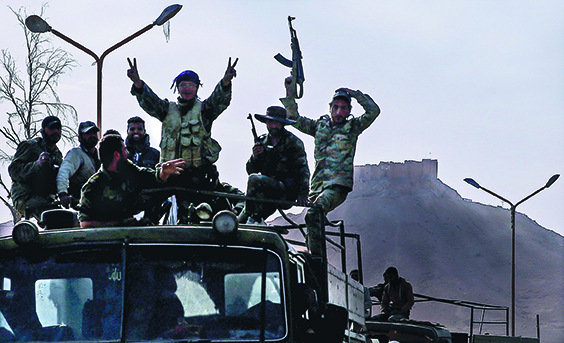
Syrian soldiers in Palmyra, March 26, 2016 . Photo: Valery Sharifulin/TASS
Palmyra (Tadmore, in Arabic-the city of Palm) was completely cleaned of IG militants * on March 27, 13 days after President Putin announced the withdrawal of the main part of the grouping of Russian aerospace forces (VKS) from Syria. Nevertheless, it was this operation that became the largest for the Russian military for the entire Syrian campaign.
Palmyra is taken. What next?
Intelligence and pre -exploration, including radio electronic, was carried out by the VKS forces since mid -February, at the end of the same month, fire support helicopters, and other equipment began to be transferred here. By March 7, the day of the start of the operation near Palmyra, the Syrian troops had accurate data on the number of the forces of the IG * (just over 3 thousand people) and their equipment (25 tanks, 23 heavy and 28 light armored vehicles). They knew for sure that not one of the groups of groups warring with Bashar al -Assad would help the ig * defend Palmyra - partly played a role in the agreement of the Russian military with the field commanders of the Sunni formations in the province of Homs, partly of the Russian agreement at a high diplomatic level - with Saudi Arabia and Qatar. An unspoken communication channel was installed with the coordination center under the auspices of the United States opened in amman (Jordan). Moreover, according to NT , the Americans in early March even proposed expanding the exchange of intelligence. “The Americans saw that Russia, despite the declared“ departure ”from Syria, was preparing an operation under Palmyra. But most of all they wanted to know what Assad’s troops intend to do further after Palmyra was taken, ”NT told NT on the condition of anonymity a diplomatic source in Moscow. Namely: whether the operation to liberate the “capital” of IG * Rakki, or at first, the government forces will try to remove the blockade of Deir Ez-Zor, a city of 100 km northeast of Palmyra, which two thousand fighters of IG * have been on the siege for almost a year now.
“The Americans believe that the Syrian Kurds, which are already 30 km from the city, Russia and the United States, are better than helping them to help them,” the journal’s source continues. According to him, the arguments in favor of this option brought at meetings with Russian colleagues during a confidential visit to Moscow in early March, CIA Director John Brennan. However, Bashar al -Assad and his environment are convinced: taking Rakka, the Kurds will begin to push the federalization of Syria with renewed vigor, which they do not want to hear about in Damascus. And therefore, they say, Rakka, with or without Kurds, should only take the Syrian army. The question is - what forces and price of what losses?
“IG * is capable of pulling 15-20 thousand well -trained fighters and one and a half hundred armored vehicles to protect Rakka,” says the Syrian military analyst in the Bassam Maalul, living in Istanbul. “Without the help of the Kurds of Racca for the Assad army, even taking into account Russian air support, it may turn out to be too strong nuts.”
“IG* is capable of pulling 15–20 thousand selected fighters and one and a half hundred armored vehicles to protect Rakka. Without the help of the Kurds of Racca for the Arma Arm, it can be too strong nuts "
The fact that the combat potential of IG * is still high is also indicated by the Iraqi Army on Mosul. It was launched on March 24, when in Syria the first detachments of the pro -government militia “The Falcon of the Desert” broke into the outskirts of Palmyra. The motives of the Iraqi command were understandable: it is better to start the liberation of the Mosul from IG * at the moment when the group, discouraged by failures in Palmyra, will begin to build the main defensive lines around Deir Ez-Zor and Rakka. However, the blitzkrieg under Mosul did not work ...
Meanwhile, on March 31, the Syrian army began regrouping forces in the direction of Palmir-Dair-Ez-Zor. On the same day, according to NT sources, several “flying tanks” were relocated to the military airfield of 60 km south of Palmyra-the ultra-modern Russian helicopters of the Mi-28 and Ka-52 fire support. So Russia has not gone anywhere yet.
Did Russia leave?
Honoring March 17 in the Kremlin of the military who returned from Syria, Vladimir Putin assured the audience: “Our bases in Syria-Tartus and Khmeimim, whose personnel will continue the service here, are reliably protected from land, sea and air.” In other words, Russia has two air base in the territory controlled by Bashar Assad, and their task is to ensure its own security.
What Russia has achieved in six months (October 2015 - March 2016) a military campaign in Syria
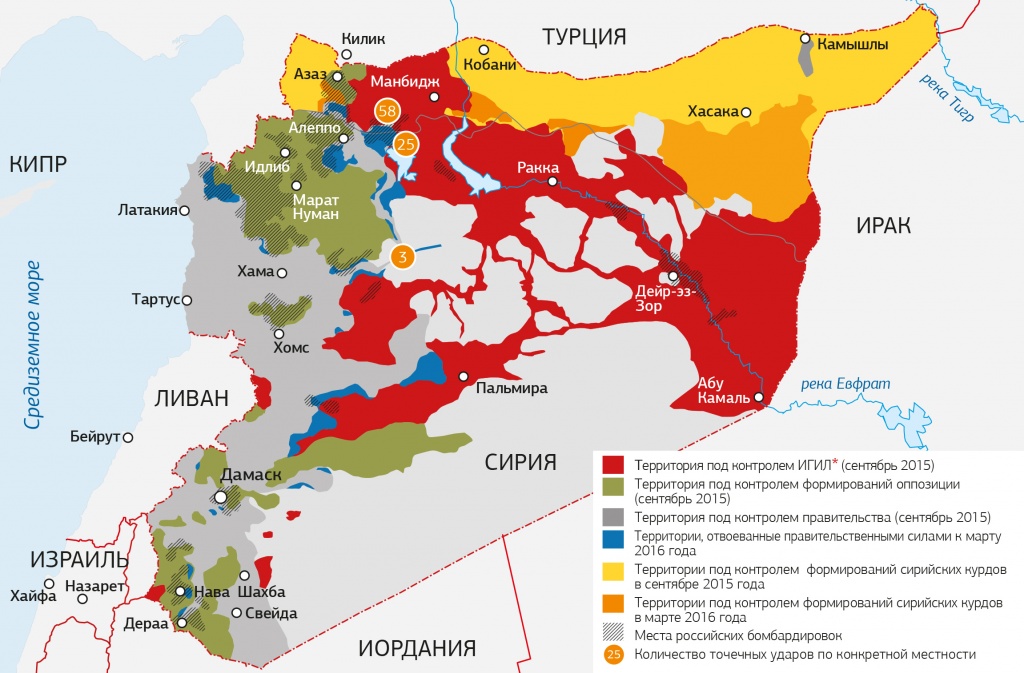

When creating the card, the materials of The New York Times and the data of IHS Conflict Monitor, March 2016 were used
And here is another excerpt from the speech: “... the components of the detailed air defense system, including the near-action complexes of the“ shell ”and the long-range“ Triumph S-400 ”, will carry constant combat duty ...” That is, we guarantee Bashar Assada protection against air strikes from the air. The Syrian opposition, IG * and Jebhat al-Nusra * do not have its own aviation, therefore, the “shells” and “triumphs” were left not for them, but for some states in the neighborhood.
And finally, the most interesting quote: "Our actions were designed by time for the period of active offensive operations against terrorists." Therefore, Putin does not expect that the forces of Bashar al-Assad will continue to conquer the territories that were under the control of the opposition, “Jebhat al-Nusra” * and IG *? Or in the Kremlin it is believed that only the part of Syria should remain under the control of Assad that he managed to conquer at the time of the withdrawal of Russian aviation (plus liberated Palmyra), and only in this zone Russia is ready to guarantee safety. But in this way, the owner of the Kremlin made the possibility of federalization of Syria, an option that just a few days before that the special representative of the President of the Russian Federation in the Middle East Mikhail Bogdanov called "complete nonsense." And Putin did not just allow federalization, but in fact announced the readiness to be a guarantor of the existence of only part of Western Syria. This potential subject of the Syrian Federation can be designated with some stretch as “Alawit Syria” - the territory where the old elite of the Baas party will retain its positions.
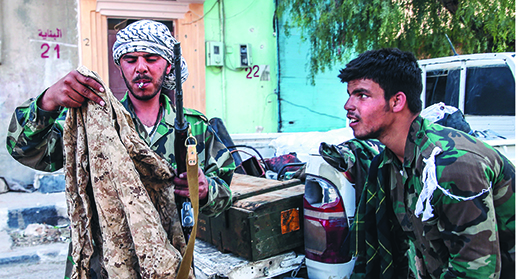
The soldiers of the army of Bashar al -Assad look at the trophy ammunition on the broken by IG* checkpoint , Palmyra, Syria, March 27, 2016
Meanwhile, the regime in Damascus does not see in such a scenario a saving exit from the civil war. “Syria is too small for federalization,” said Bashar al -Assad, accepting a group of French politicians on March 26.
Kurdish question
On March 17, on the same day when Putin actually recognized the inevitability of the collapse of Syria, the Syrian Kurds announced the creation of their federal region in the north of the country. At the first stage of the Civil War in Syria, in 2011-2012, they were against the official Damascus. Later they were united by the struggle against a common enemy - IG * . The prospects for the appearance of the “Syrian Kurdistan” will inevitably return the situation four years ago - in Damascus they already called the Kurdish “federation” illegal and warned against attempts to “undermine the unity of Syria”.
However, Assad can not actually influence the Kurds: the Syrian Kurdistan is cut off from Alavite Syria today under the control of the moderate Sunni opposition, which Russia under international pressure is forced to recognize a full -fledged participant in the political process. (see card). At the same time, in the “moderate” zone there are interspersed “Jebhat al-Nusra” * related to al-Qaeda * .
Putin did not just allow federalization, but in fact announced the readiness to be a guarantor of the existence of only part of Western Syria
Sunnis is also not enthusiastic about the prospect of the appearance of an independent Kurdish enclave. The representative of the Syrian opposition, Jihad McDisi, has already stated that in the idea of the Federation "there is some haste." Syrian “moderate” believe that the issue of the future device of Syria should be resolved only at the end of the transition period, when the country's new leadership is chosen.
Syrian Syrian Christians also supported the Syrian Sunnis. For example, Ahikar Issa, representing the Assyrians from the city of Kamyshly in the north of Syria, is afraid that the “federalized” Kurds will begin to expel Christians. Thus, all internal Syrian players, except for the Kurds, are in positions “for a single and indivisible Syria”.

Rakka girl: Life in the citadel IG* is both dangerous and difficult . Photo of 2015
Speaking about the future of the country, one must remember something else: all three “autonomy” - Alawit, Kurdish and Sunni, combined - occupy no more than half of Syria. In fact, the whole east of the country is the Islamic State * . It does not participate in any negotiations and is fundamentally ready to wage war with the rest of the “federal” Syria.
The hasty attempt of the Kurdish North “take their own” led to the fact that now for the Alavites and for Sunnis, the Kurds become the same problem as IG * .
Apple of discord
The guarantors of the existence of “Alawite Syria” are Russia and Iran, behind the “Syrian Sunnistan” - Türkiye, Saudi Arabia and Qatar. Apparently, the possible coexistence of these two enclaves does not cause large international disputes. The apple of discord is just the Syrian Kurdistan. Its main lobbyists are primarily the United States, in the second - Russia. Opponents are Türkiye and to a lesser extent Iran.
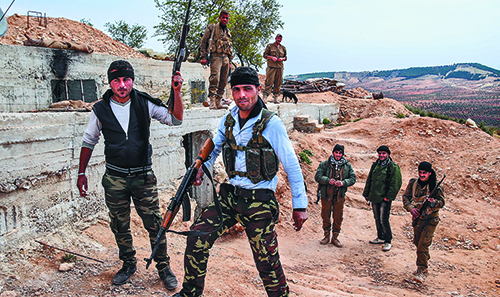
Kurdish militias on the Syrian -Turkish border, Azaz, Syria, March 10, 2016
In an article, recently published on the website of The Atlantic, American analyst Jeffrey Goldberg notes: the Turkish president Erdogan deceived many expectations of Barack Obama. It turns out that at first Obama considered Erdogan "as a moderate Muslim leader, capable of establishing bridges between the East and the West." But now he considers him a “failure and authoritarian figure who does not want to ensure stability in Syria” (BBC translation by the forces of his powerful army. This is a very indicative analysis. Indeed, in Russia they are used to believe that Erdogan only slept and saw how to introduce “the forces of his powerful army” into Syria - and did not do this only because he was afraid of a clash with Russia, which seemed to be just ahead of Erdogan, preventing Turkish expansion. In fact, since 2013, the United States demanded from the Turkish president of entering troops into Syria to combat IS * . Obama hoped that the Turkish army would begin a trip to Rakka. Erdogan by all his might evaded this role, apparently not wanting to carry chestnuts from the fire for the Americans.
Realizing this, the United States began to use the Kurdish militia as land, arming it and supporting it from the air. But the partisans could not replace regular parts - instead of the rapid defeat of IG *, a sluggish tug of rope began.
Obama hoped that the Turkish army would begin a trip to Rakka. Erdogan by all his might evaded this role, apparently not wanting to carry chestnuts from fire for Americans
For Turkey, the Americans' attempt to solve the problem of IG * for the Kurdish forces turned out to be especially painful. Kurdish militia in Syria and Kurdish separatists in Turkey are communicating vessels. Strengthening the first, the Americans strengthened the second. Erdogan began to crush his own General Staff, demanding an invasion of Syria-but not just going to Rakka, but the creation of a 60-kilometer buffer zone along the Turkish-Syrian border, cutting off the Turkish Kurds from Syrian.
Erdogan rejected this script, taking into account the negative reaction of the United States. But this did not save his relationship with Washington: Erdogan was no longer regarded in the White House as a partner. The very cold technique provided to him in Washington at the end of March is superfluous proof.
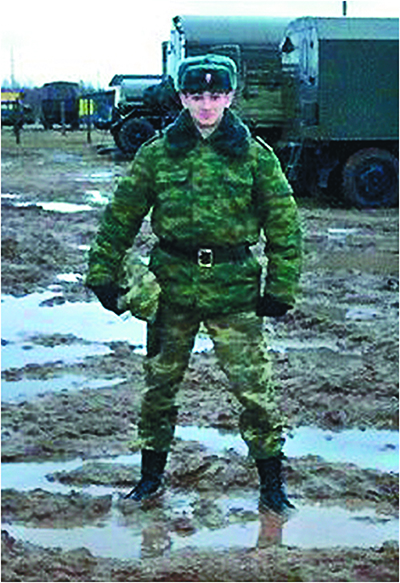
Under Palmyra heroically, 25-year-old Alexander Prokhorenko (in the picture from open sources), lieutenant of the Russian forces of special operations, died. Being surrounded by IG*militants, he caused the fire of Russian aviation to himself
Today, the American support of the Syrian Kurdistan project is not only a fee of Kurdish militia for a joint struggle with IG * , but to a greater extent pressure on Erdogan. Russia, lobbying for the Kurdish project in Syria, acts for the same reasons: after the Turkish fighter shot down the Russian bomber, Moscow actively supports all the anti -Eordogan forces within Turkey, primarily the Kurds.
But Iran, together with Russia, who spoke on the side of Assad, is not at all enthusiastic about the foreign policy of yesterday's partner. Ayatollah Khamenei already spoke out in the spirit that not all foreign policy plans of Moscow were welcome in Tehran - and he had in mind just a Kurdish question.
One way or another, the project of federalization of Syria does not clarify anything in the future of this long -suffering country. And the liberation of Palmyra looks almost the only unconditionally bright spot in its recent history.
Continuation of the topic on page 34. * “Islamic State”, IG, Daish, “Jebhat al-Nusra”, “Al-Qaeda”-terrorist organizations banned in the Russian Federation.
Photo: Valery Sharifulolin/TASS, Raqqa-sl.com, News-front.info