
Translated material
Watching from the president
How the Security Council works and what it does
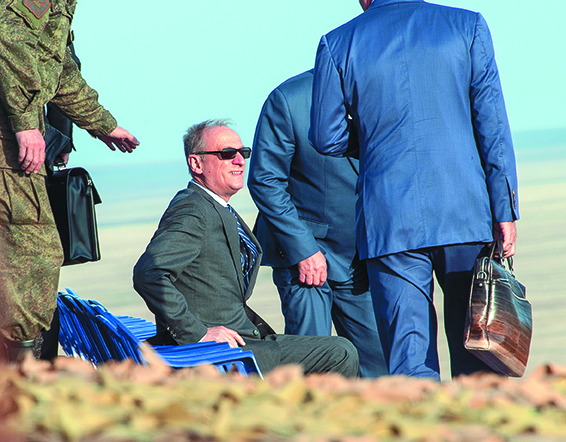
Secretary of the Security Council Nikolai Patrushev (sits) at the Donguzsky training ground during the Army exercises "Center-2015", September 2015. Photo: Dmitry Azarov/Kommersant
In his 64 years, the Secretary of the Security Council of the Russian Federation Nikolai Patrushev demonstrates that he was ready to give a head start to the young: he is constantly on business trips and, by the number of official visits to foreign countries, left the Foreign Minister Sergei Lavrov far behind. Moreover, Mr. Secretary, as a rule, travels with an impressive company from the presidential administration, the Ministry of Defense, the FSB, the FSKN, the Ministry of Internal Affairs, the Ministry of Justice and the Ministry of Emergencies. For example, only over the past six months, the Council of People's Commissars visited Japan, Angola, South Africa, Uruguay, Argentina, Indonesia, Thailand, Singapore and Vietnam.
The subject of negotiations is coordination with local special services, issues of combating terrorism, preventing attempts to interfere with a number of states into internal affairs of other countries. And, for example, in Bangkok, as the Thai press wrote, the Russian delegation acted as a lobbyist of the military -industrial complex: I tried to agree on the sale of tanks. In South Africa and Angola, she discussed joint opposition to “color” revolutions.
Nikolai Patrushev is constantly on business trips and, by the number of official visits to foreign countries, left the Foreign Minister Sergei Lavrov far behind
During the same period, Mr. Patrushev held on-site meetings in the Volga, Siberian, Ural, North Caucasus Federal District, in Crimea, and also managed to visit the Navy headquarters in Severomorsk, a liquefied natural gas plant on Yamaral and led a meeting of the State Commission for the celebration of the 100th anniversary of the formation of Karelia in Petrozavodsk.
Isn't it a lot of business trips? “ NT asked the press secretary of the Security Council Evgeny Anoshin:“ Not from a good life, ”Anoshin answered. “The president demands to see everything with his own eyes and report.”
Help NT
Nikolai Patrushev (07/11/1951, Leningrad ). He began the service in the KGB Office in the Leningrad Region. In the days of the New Russia, he was the Minister of Security of the Republic of Karelia, then headed the FSB Office of Karelia. From 1999 to 2008 - Director of the FSB.
In May 2008, he was appointed secretary of the Council of Security of the Russian Federation.
In 2016, the judge of the high court of Britain, Sir Robert Owen, during the announcement of the results of a public inquiry in the case of Polonia poisoned in London, the ex-officer of the FSB Alexander Litvinenko said that the murder was “most likely approved” by the FSB director Nikolai Patrushev and Russian President Vladimir Putin.
Family: wife Elena (housewife). The youngest son Andrei graduated from the FSB Academy. In 2006, he was appointed adviser to the director of Rosneft Igor Sechin. In April 2007, by Decree of President Putin he was awarded the Order of Honor "For many years of conscientious work."
The eldest son Dmitry worked as vice president of VTB Bank. In May 2012, he was appointed to the post of chairman of the board of the Rosselkhozbank, his wife Elizabeth is engaged in business and acts as a vocalist in the musical group "Ivan Kupala"
Special Power Bureau
In recent years, the Security Council was increasingly compared with the Politburo of the CPSU Central Committee. However, both the political scientist, the author of the book “System of the Russian Federation” Gleb Pavlovsky, and Simon Kordonsky, a professor of the Higher School of Economics and the author of the book “Power markets”, believe this comparison is incorrect.
Pavlovsky agrees that outwardly the SB - that component, which includes 12 permanent members of plus the president, who heads the SB, is arranged as the Politburo, but “the Security Council does not make decisions,” Pavlovsky notes, “he only discusses them. Members of the Politburo of the CPSU Central Committee had authority and made decisions. But the SB has no authority. There they can discuss some kind of special operation if the president wants it. ” Pavlovsky believes that if at the meetings of permanent members of the Security Council in Novo-Ogarevo and some decisions are made, then most likely they are not fixed and have the form of verbal assignments.
Simon Cordonsky notes that researchers have very little information about what SB is busy: “In theory, the security council apparatus should systematize, classify and rank threats and take it to the CB meeting. And there they must already decide what share of resources should be aimed at neutralizing certain threats. ” Cordonsky believes that the Security Council would rather perform the functions of the military-industrial commission that existed in Soviet times under the Council of Ministers of the USSR. However, it is obvious that he has much more authority: 10 departments, 7 interdepartmental commissions are hundreds of people, each of them must prove to the authorities and the neighbor that they occupy the office in the newly renovated premises of the former CPSU Central Committee in Ipatievsky Lane not in vain.
The structure of the Security Council
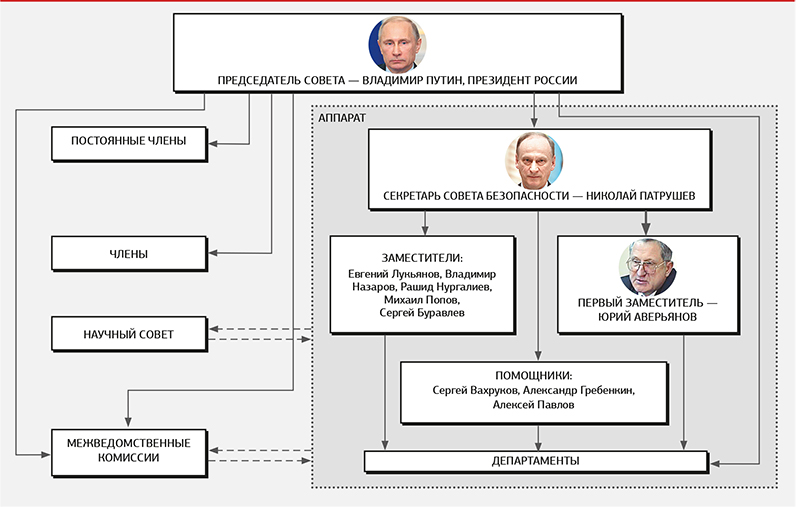

Indeed, the names of departments and commissions indicate that the apparatus of the Security Council performs, for example, the functions of the powerful department of the administrative bodies of the CPSU Central Committee - a structure that in Soviet times controlled the activities of the political police - the KGB, military intelligence - the GRU, the police, justice and so on.
The principle of appointing regular members of the Security Council is the lack of principle. On the one hand, it includes the head of the Presidential Administration (Ivanov), the chairman of the government (Medvedev), the chairmen of the Federation Council (Matvienko) and the State Duma (Naryshkin), the leaders of the law enforcement officers - defense (Shoigu), the FSB (Botnikov), internal affairs (bells), foreign intelligence services (fradov) and the Foreign Ministry (Lavrov), that is, the so -called “ministries from the ministries from the ministries from the ministries from the ministries from the ministries of the ministries from Asterisk ”, which are subject directly to the President, and not the Prime Minister. Naturally, his secretary, General of the Army Patrushev, is a permanent member of the Security Council.
Along the way, the Council of Ministers demanded that the security forces and officials use Google, Yahoo and WhatsApp. True, the prohibition has not yet been able to achieve the FSB, the FSO and officials are still “spending the night” in social networks
However, next to those whose presence in the Security Council is explainable to their position is the surname, for example, Boris Gryzlov, who was five years ago the chairman of the Duma and twelve years ago - the Minister of the Interior. In addition, he studied at the same secondary school in Leningrad with Nikolai Patrushev. Recently, in December 2015, the president appointed Gryzlov by the “plenipotentiary of the Russian Federation in the contact group to resolve the situation in the eastern part of Ukraine”, but he was also a permanent member of the Security Council when he did not occupy any formal post. The second retirement among the permanent members of the SB is the sad former head of the Ministry of Internal Affairs Rashid Nurgaliev. However, Nurgaliev, like six more of his colleagues in the Security Council (including the president), - a native of the KGB, served in Leningrad and Karelia, and is now one of the deputy secretary of the Security Council.
In the meetings of the Council of People's Commissars, 17 more people participate, which are indicated as simply “members”: these are the mayors of Moscow and St. Petersburg, the Presidential Poems in the federal districts, the head of the General Staff, the Minister of Finance, Justice, the Prosecutor General and ... Director of the FSKN (Drug Control Service), another graduate of the KGB of the KGB of the USSR Viktor Ivanov.
NT journalists calculated that out of nine plenipotents six are immigrants from power structures, and Minister of Justice Alexander Konovalov, chief drug addict Viktor Ivanov and the envoy to the Central Federal District, Alexander Beglov, began their careers in St. Petersburg.
The next meeting of the Council of Ministers took place on March 28 this year: "A positive dynamics in the ongoing struggle against terrorist groups and organizations in Syria and the importance of the liberation of Palmyra were discussed." Among other things, “the president acquainted the members of the Security Council with the results of his recent contacts with US Secretary of State John Kerry and German Foreign Minister Francom-Walter Steinmeier.”
Superfigurations
The Security Council in its current incarnation has been conducting its history since March 1992. He was conceived exclusively as an advisory body under the President, as the structure of intellectual support of the head of state - as well as the office of the president, which has now turned into a powerful administration of the president. In many ways, the SB was also something like a “paradise group”-there was such a way under the Ministry of Defense, where generals and marshals were sent to the circulation. For example, ex-Minister of Foreign Affairs Igor Ivanov, who served as the Secretary of the Council of People's Commissars from 2004 to 2007, after the resignation became a member of the Board of Directors of the Lukoil oil company and participates in the work of several international non-governmental organizations.
Previously, the responsibilities of the Security Council secretary included forecasting, identifying, analyzing and evaluating security threats, preparing reports for the head of state. In 2008, with the advent of the ex-director of the FSB, Nikolai Patrushev, the work of the Security Council changed dramatically: the meetings became regular (at least once a month), rhetoric has noticeably changed and previously open directions received the “secret” vulture. All the same press secretary of the Council of People's Commissars, Mr. Anoshin, did not name the exact number of departments, although this information is not considered secret.
In 2011, by decree No. 590 of the then President Dmitry Medvedev, the department of Mr. Patrushev received the right not only to “the formation of state policy in the field of ensuring national security”, but the decisions of the Council of Security, according to the decree, became obligatory for the implementation of all ministries and departments.
Now the Council of Ministers is also involved in the “formation of personnel policy”, “organizes control over the targeted spending of budget allocations provided for in the federal budget for the corresponding year to finance the expenses to ensure national defense, national security and law enforcement,” and the government, the Federation Council and the State Duma are obliged to annually submit a report on the work done.
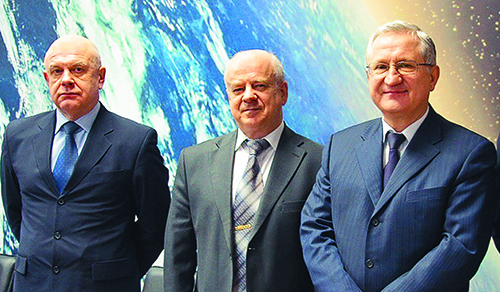
The head of the Department Alexander Vidanov (extreme on the left) and First Deputy Secretary of the Council of People's Commissars Yuri Averyanov (Foreman on the right) at a meeting on space
Along the way, the Council of Ministers demanded that the security forces and officials use Google, Yahoo and WhatsApp. True, the prohibition has not yet been possible, and the FSB officers, the FSO and officials still “spend the night” on social networks and post exclusive photos on their pages (see NT No. 8 of March 14, 2016).
The culmination of the work of the Security Council was a widely advertised new edition of the National Security Strategy, signed by the president on December 31, 2015. Among the main enemies are the USA, NATO and foreign special services. And the internal danger is called "the information impact on the population of the country in order to undermine historical, patriotic, spiritual traditions and values."
According to the economist Vyacheslav Inozemtsev, the new strategy is “an outstanding example of a bureaucratic word -block, which hides a claim of the authorities to consider everything that is happening in society through the prism of security, and, obviously, its own.”
However, another interlocutor of the former, the General of the KGB of the USSR and one of the employees of the Security Council of the times of Boris Yeltsin, believes that real power is not a council, but the “decisors”, as he called people from Vladimir Putin’s closest encirclement, also known as members of the Lake cooperative.
People of the past country
Documents for meetings of the Security Council are prepared by the SB apparatus. Judging by the official biographies, the majority of managers of the apparatus are immigrants from the KGB-FSB, the Ministry of Defense and the Military-Industrial Complex. Many under or 60, in other words, the years of their maturity fell at the height of the Cold War and the active struggle against dissent. It is encouraging that they were from that generation of Chekists, when enemies were still more searched for not in neighbors, but outside the country, when mass repressions were already considered a bend, but “deuces” and “three” - dangerous for the elite itself (and security officers including). “The mentality of these people remained still Soviet: in the first place they have conspiracy, in the second - witch,” the historian Nikita Petrov, who studies the KGB archives, says not without grin. “They are confident in their special exclusivity and still think that you can lead society only with the help of secret springs and through proxies affecting processes.”
“They are confident in their special exclusivity and still think that you can lead society only with the help of secret springs and through proxies affecting processes”
Judging by the still open sources, youth are not visible among the leaders of the departments of the Security Council-all the same immigrants from the special services, the Ministry of Defense and the military-industrial complex who went through the Soviet ideological meat grinder: the year of birth-1945, 1946, 1949, 1951, 1952 ... The youngest was the head of the Department of Problems of Defense Safety and Military Technical Cooperation Alexander Vidanov (1959), who is called the eyes “watching” behind the cosmos.
In addition, dozens of advisers, assistants, consultants and referents, as well as the Scientific Council (146 members), in which, in addition to security forces, directors of closed research institutes and enterprises, are also found, there are also civil characters are also found.
The most recognizable member of the Scientific Council is Putin's adviser Sergei Glazyev, known for his left views. The adviser himself lives modestly: in the declaration of property there is a dash everywhere. But the wife is the owner of four land plots, three expensive foreign cars, apartments (253.7 m2) and a residential building in Barvikh with a total area of 869 m2.
The press secretary of the Security Council Evgeny Anoshin could not inform NT the total number of employees and the amount of expenses for the maintenance of the apparatus. According to the source in the Ministry of Finance, from "The Presidential Administration allocated in 2016 to ensure the work of the Presidential Administration, the Patrushev department will most likely eat."
Well, the speaking detail in the end. The network has discovered a correspondence of an employee of the technical department of the presidential administration, in which he complains that most of the leaders of the Security Council are not able to handle the computer and refuse to attend courses for beginners. And it’s a pity, because with the help of the Internet it would be easy to find out that no color revolutions are expected in South Africa and Angola. And therefore, there was no need and back to drive a state -owned plane.
Comment by a lawyer
Sat and law
Text: Vladimir Zhbankov
The only mention of the Security Council in the Constitution of the Russian Federation is Art. 83, p. “F”, which indicates that the president “forms and heads the Security Council of the Russian Federation, the status of which is determined by federal law”. There is still no special law on SB. There is a more general Federal Law N 390 of December 28, 2010 “On Security”, in which it is incorporated by Ch. 3 "Status of the Council of Security." And finally, there is a provision on the Security Council, which is approved by Decree of the President of the Russian Federation N 590 of May 6, 2011.
According to the Regulation, “the legal basis of the Security Council is constituted by the Constitution of the Russian Federation, generally recognized principles and norms of international law, international treaties of the Russian Federation, federal constitutional laws, Federal Law of December 28, 2010 N 390-ФЗ“ On Security ”, other federal laws, decrees and orders of the President of the Russian Federation, as well as this Regulation”. What exactly is meant is not very clear.
Tasks and functions are enshrined in the law "On Security" and the Regulation on it. They are formulated as widely as possible, everywhere it is indicated that the president can assign other tasks on the council. Moreover, in what form he can do this - is not indicated.
Recently, the Security Council began to play a disproportionately large role: it has turned into something like a “shadow government” that has a significant impact on the main directions of state policy. However, there are no formally violations here. From the point of view of law, it is an advisory body and it can discuss anything to ensure the conditions “for the President of the Russian Federation of authority to ensure national security”. His decisions do not have compulsory power, these are only recommendations sent primarily to the president, as well as other interested parties.
The power of the Council ofores does not stem from the law, but from the hardware weight of its members and their close to the president. This situation is incompatible with the basic principles of democracy. Unfortunately, all branches of power are in a lethargic state, and some management activity is necessary. Therefore, they are replaced by such quasi -state institutions.
Photo: from open sources