
Translated material
The day of the guard
Why is another power structure to Putin, which will exceed the number of Ground Forces of Russia, and why not army, not a policeman, not a Chekister - a bodyguard at the head of it.
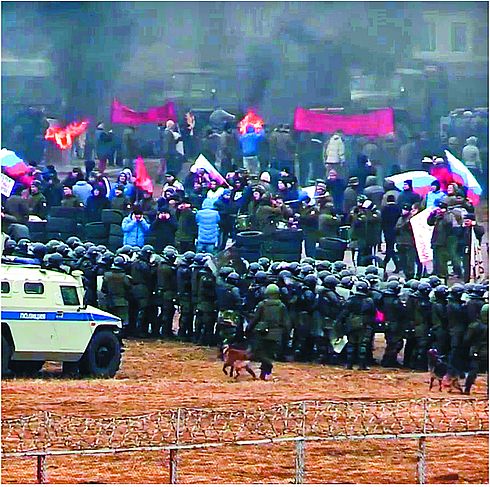
The National Guard is already training to disperse rallies, Moscow region, April 7, 2016
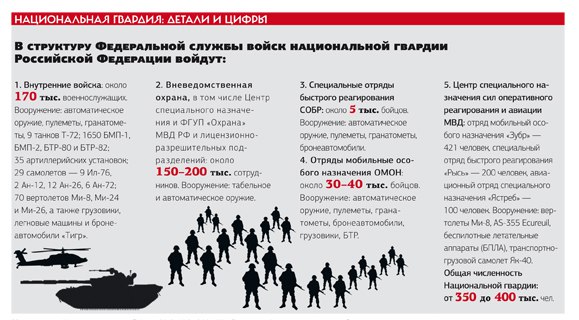
The idea of creating the National Guard of Russia, which wandered in the bosses almost since the collapse of the USSR, was implemented last week. What the head of state announced at a meeting with the leadership of interested law enforcement agencies. According to the presidential decree and the bill submitted to the State Duma, the new military police structure will include internal troops, units of private security, teams of the assembly and riot police. As the tasks of the freshly built body of the federal authorities, the fight against terrorism and extremism, organized crime, ensuring the regime of emergency, non -human protection, and even assistance to be border worshipers, were officially set. And also in addition - control over private security enterprises and for legal turnover of weapons. The national guards are endowed with almost all the powers that the police have today, including the right to shoot without warning, enter private premises, and detain citizens.
Who and what
At the same time, the chief chief of the country did not consider it necessary to explain, but why, in fact, in today's Russia it was required to create a third largest power structure. Indeed, 170 thousand people serve in the internal troops today, from police special forces, according to various sources, from 25 to 40 thousand as well as non-departmental security, FSUE “security” (this office on a commercial basis provides the services of important and very rich, whose property and its owners require a look), units of the licensing service-about 200 thousand people. Thus, the number of the National Guard will be about 400 thousand people and will exceed the number of Ground Forces of Russia.
The domestic power considers the enemy of the internal much more dangerous than the enemy of the external and purposefully prepares to fight with his own people
It is unlikely that Putin’s words should be seriously accepted that everything is done in order to fight crime. The new federal body did not become a subject of operational-search activity. With such a division of labor, they will look for criminals, and other support will be supported by others. And the investigators of the criminal investigation department of the Ministry of Internal Affairs will now be forced to apply for power support to the department of the National Guard. Anyone who has encountered the “coordination” of the activities of various departments understands well what kind of confusion this leads in practice. A year ago, Returned Lieutenant General, Chairman of the Council of Veterans of the Main Command of the Ministry of Internal Affairs of the Russian Federation, Pyotr Rivnensky, a year ago: “If the National Guard was created ... the balance of power in the Ministry of Internal Affairs between the police functions of law enforcement and the performance of their functions related to the protection of particularly important state objects and buildings.” Moreover, according to General Rivne, the Commander -in -Chief of the Interior Ministry of the Ministry of Internal Affairs Viktor Zolotov, it turns out, against “various kinds of neoplasms”, which repeatedly emphasized at meetings with personnel and official meetings.
Like them
The appeal to foreign experience does not give an answer. The term "National Guard" gives its meaning to each state. In the United States, this is the reserve of the Ground Forces and the Air Force, as well as the power structure, which subordinates the state governor, which can use it to eliminate the consequences of natural disasters and suppress the riots. That is, unlike Russia, which creates a rigidly centralized structure, subordinating exclusively to the President, the National Guard in the United States is a decentralization factor, the separation of powers in decisions on the use of force within the country. In addition, most American national guards combine service with work in the civilian sphere. In Kazakhstan - the National Guard has the function of internal troops. In Georgia, it also has responsibility for the draft in the Armed Forces. In Azerbaijan and Tajikistan, she performs the functions of presidential protection. In Ukraine, the National Guard was recreated in March 2014, when Russia annexed Crimea, in order to integrate volunteer battalions into a single military structure. The sense of this venture turned out a little. Thus, there can only be a common denominator here: the National Guard is a parallel army, which sometimes serves as an addition to the armed forces, sometimes an alternative to them. And often both - how the circumstances will develop.
The direction of the main blow
Apparently, the creation of the National Guard in Russia is the Kremlin’s answer to the possibility of a “color revolution”, which is considered as the main threat to the country's security. In May 2014, at a conference at the Ministry of Defense, it was even announced that the “color revolutions” were a new type of military operation, adopted by the West. It was logical to expect that the Russian General Staff would be designed to develop operational plans to counteract this misfortune. Minister of Defense Sergey Shoigu spoke about the need to develop several times. But it seems that the General Staff quickly realized that, whatever one may say, it would end up with operational plans for using troops against the people on the streets of Russian cities. Apparently, Russian officers decided not to take a sin to their souls and lowered the bossal initiatives on the brakes. The idea of developing the concept of counteracting “color revolutions” migrated to the Academy of Military Sciences, where she seemed to have died out.

The military from the Ministry of Defense had an iron excuse: in the end, the suppression of the people's rebellion is the task of the internal troops of the Ministry of Internal Affairs. And I must say, these troops were carefully preparing to fulfill such a task. Mechanized formations of internal troops are deployed in 46 cities of 44 constituent entities of the Russian Federation, including in 9 cities with a million population. In April last year, they were raised by alarm: Zaslon-2015 operational-strategic maneuvers were covered by the North-West, Central, Volga, North Caucasus, South and Crimean federal districts-that is, the entire European part of the country. In the exercises, 40 thousand military personnel were involved. The official representative of the department said then that “The topic of exercises is the use of troops in the complication of the operational situation in the regions of the Russian Federation. The choice of topic is associated with new threats to the internal security of the state. ” He did not hide the fact that the organizers of the exercises under these threats mean: “The events that took place in the recent past in one of the neighboring countries were taken as the basis. The participation of internal troops in the protection of public order and ensuring public security, counteracting terrorist manifestations and extremism was worked out. To create a situation close to reality, all the attributes of those events were used, up to burning tires and throwing military personnel with stones and bottles. ” The head of the press service of the internal troops Vasily Panchenkov proudly told then that the scenarios of the exercises included the application of the entire arsenal of special equipment: tear gas, water-flows, as well as military equipment and special weapons of non-lethal impact. However, the case was not limited to “non -lethal weapons”. So, it was reported that "the troops worked out the techniques of localization of a large armed gang at the training ground in the Rostov region, applying aviation and artillery against the conditional enemy." Obviously, it is precisely such a scenario that is considered as probable in plans to reflect new internal threats.
At the same time, the country's leadership did not forget the internal troops with its mercy. While the armed forces were subjected to merciless reform, the internal troops lived calmly, realizing their own, approved by the supreme commander in chief of development until 2020. As a result, their number has not changed. Moreover, all the last years, when the question of the transfer of our army to a contract has been raised, domestic chiefs immediately begin to explain what expensive it is and why it is not affordable for our fatherland. But the internal troops reported last year that contractors occupy 80% of sergeants and rank -and -file positions. Repeatedly stated that the troops faced the goal of complete contractization. Found money for this. In 2012, in order to radically increase the salary of the military, the Ministry of Defense was forced to reduce at least 135 thousand officers. There were no reductions in the internal troops at all. What did not prevent their military personnel from lifting their money in the same amounts in which it was increased for the military. Finally, the laws were changed in such a way that contractors are now recruiting to the internal troops not through the military registration and enlistment office, but each commander of the unit independently, respectively, he bears personal responsibility for the subordinate. Such a careful attitude to the internal troops left no doubt: the domestic power considers the enemy of the internal much more dangerous than the enemy of the external and purposefully prepares to fight with his own people.
But for some reason it seemed little. Probably, the Kremlin is tormented by doubts, but how all these efforts are wasted. Suddenly, these decisive cool guys in sliced berets will give slack if they receive an order to shoot at the fellow citizens. It is enough to recall 1991, when the army paratroopers and special forces of the KGB of the USSR did not receive an order to storm the building of the Supreme Council, around which Muscovites built barricades. Pavel Grachev, then the Major General and the Airborne Forces Commander, appointed a criminal order, pulled time, demanding to “clarify the task” from the members of the State Emergency Committee, and those, not wanting to take responsibility, refused to talk, dumping everything to the adjutants.
The lesson is obvious: it is not enough to have a well -prepared army. It is necessary to have a clear command system so that the performers have no chance to dull. This is the main goal of bringing the national guard to a separate power department: to remove intermediate links - for example, in the form of the leadership of the Ministry of Internal Affairs, which could slow down the passage of the order. The second, no less important - you need to have a person who will force subordinates to fulfill any team. That is why back in 2013, Putin moved to the internal troops of his personal guard Viktor Zolotov, one of the closest people. I must say that all over the past years, these troops have been led by army generals, who had at least the experience of command of large formations. Therefore, it took time before the president dared to entrust Viktor Zolotov by creating a new power structure and commanding it.
The bodyguard is obliged - this is how he was taught - in any circumstances at the cost of his life and the lives of others to save not Russia, but a protected face
The appointment of a professional bodyguard for this position says a lot. Security forces - military, Chekists, police officers - brought up in the belief that their task is to protect the people and the state (what they mean by this is another question). The bodyguard is obliged - this is how he was taught - in any circumstances at the cost of his life and the lives of others to save, but not Russia, but a protected person. He will perform this task in any situation ...
Photo: YouTube.com