
Translated material
Dutch bummer
Why do those who are rooting for Ukraine should not be upset due to the results of the referendum in the Netherlands
At a referendum in the Netherlands on the issue of - to approve or not an agreement on the Association of Ukraine with the EU, according to preliminary results, skeptics won: against ratification of the document - 61.1 %, for - 38.1 %. The turnout exceeded 32 %, which is enough to recognize the results of the referendum. The publication of the final results is April 12, but Prime Minister Mark Rutte already made it clear that the Netherlands, most likely, will not be able to continue the ratification process and now we need to look for a compromise: yes, the referendum was advisory, but we must listen to the voice of the people, especially since the plebiscite is the initiative of the people themselves.
What to do?
My advice: to everyone who was sick and rooting for Ukraine, not particularly upset.
The compromise is inevitable
Firstly, the most important part of the Ukrainian agreement with the EU is an agreement on the creation of an in-depth and comprehensive free trade zone (EVT), which has long been ratified by the European Parliament and is fulfilled by the European Commission-it is in its competence that is the implementation of everything that concerns this zone itself.
I can hardly imagine how the European Commission will now be able to almost isolate the Netherlands as a special territory, which is not extended to the Rules of the EVA between the European Union and Ukraine.
Secondly, the negative result of the referendum in Holland will not affect the positive solution to the issue of representing Ukrainian citizens with the possibility of short-term visa-free trips to the countries of the Schengen zone-and today this is almost the only practical issue that affects the momentary life interests of ordinary Ukrainians. And even then not everyone: very few can afford to go to Europe now.
Most of the Dutch, who voted against, most likely, did not really understand that the association with the EU had nothing to do with EU membership
Thirdly-and this already applies to the entire agreement, including the political part and issues of legal cooperation-in international law there is such a thing as the temporary application of an agreement or agreement, which for one reason or another has not been ratified. If the agreement does not specifically specify that it comes into force only after the parliament is approved, then before ratification it should be executed on the basis of the principle of temporary application. A fresh example of this kind: the former shareholders of the Yukos were able to win in the International Arbitration in the Hague a claim to the Russian Federation for $ 50 billion just on the basis of an agreement of the energy charter, which Russia once signed, but did not ratify. Nevertheless, the arbitration decided that Russia was obliged to fulfill this contract on a temporary basis, violated it and should compensate for the damage caused to investors.
And when the Holland government now speaks of some compromise, it is likely to mean temporary application. The Hague will hardly recall her signature under the agreement with Ukraine.
"Greece 2.0"
Most of the Dutch, who voted against an association agreement with Ukraine, most likely did not really understand what the essence of the issue was. They did not understand that the Association with the EU has nothing to do with EU membership. They did not understand that the issue of Ukraine’s membership in the EU should not and there would not be long for a long time: maybe 10, maybe 20, maybe 30 years, or maybe he will never get up at all, even if in the future Ukraine becomes an economically successful democratic country.
Not to mention the fact that - I’m sure that many Dutch people can hardly imagine what kind of country this is Ukraine, where it is and with what it is, as they say, eat.
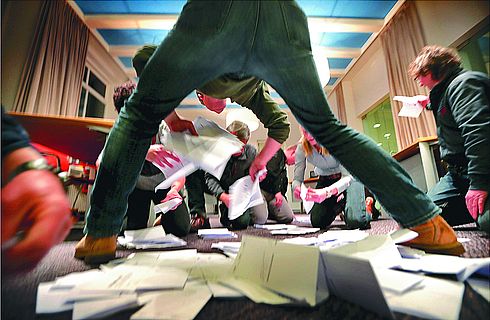
The votes are counted in the election commission on the island of the Schirmonnikog , the Netherlands, April 6, 2016 . Photo: AFP/East News
But many, probably, perfectly remember the Malaysian Boeing, shot down over Ukraine, on board of which there were 192 Dutchman. I won’t be surprised if in the memory of some of their fellow citizens this tragedy, unfortunately, bizarrely prevailed into something similar: “What, Ukraine?! This is the country that has killed our people, but now he asks for us? Yes, do not be like that! "
In fact, the salt is that throughout Europe-not only in Holland-on the rise of Euroskepticism, anti-integration moods, and there are still migrants, refugees, Islamic extremists, foreigners ... at every new country-the applicant of EU members look at the next “Greece-2.0”, a new overlap, which will sit on the neck of “old” EU members will create only problems for them. Including a threat to security.
And if in the same Netherlands or in some other country to hold a referendum on the future of its membership in the European Union, as it is ahead of June in the UK, it is still unknown what the result will be.
In the peak of the establishment
The negative result is caused, in my opinion, two more reasons. Firstly, anti-American sentiments that are common in Europe, including Holland. Some voters believe that Ukraine is an “American” project, so they vote against. And the second circumstance is an increase in the discontent of ordinary citizens with political elites, an establishment. A thing that is so clearly manifested now not only in Europe, but also in the United States during the election campaign, where Donald Trump’s grand success and the relative success of Bernie Sanders is the result of the fact that both of these politicians are candidates of the “anti -astablisch”. So, the course to support Ukraine is also perceived by some voters as something incomprehensible, unnecessary to an ordinary citizen, invented somewhere at the top and only to these tops necessary. Therefore, the bottoms vote against.