
Translated material
Collectors of expensive pictures
Who makes “chips.net”, pikabu and “I cried”: the study of “Medusa”

Russian entertainment sites with a multimillion -dollar audience are not registered as the media, but actually perform their functions: demotivators or gifs invented by users of such resources often become more popular than any articles or photographers of the media. The Special Corps of Medusa Ilya Zhegulev talked with the owners and representatives of “Chicks.net”, “I cried” and Pikabu and learned from them how the business at entertainment posts arranged how much “political” pictures are being earned on them. At the same time, the owner of Pikabu Maxim Khryashchev in an interview with Medusa first agreed to reveal his name.
Pikabu
62.9 million visits per month (SIMILARWEB data )
Pikabu’s office is small. Just one room where there is a chair, a table, a computer and microwave. Maxim Khryashchev, the owner and editor -in -chief of the community, where more than half a million people go daily from 11:00 to 19:30, and then walks home on an industrial quarter near the Elektrozavodskaya metro.
The site publishes user stories, photos and videos that they themselves post and promote upstairs. Among the most popular on Pikabu there is a story about the unfair section of the inheritance in the family, and a photograph of men's panties with the dog’s face shown on them. Khryashchev says that the main audience of the site is students.
The founder of Pikabu all these years did not reveal his name. In the Internet community, there were only rumors about the "Admin of Maxim"-closed and unsociable. In an interview with Medusa, Khryashchev first decided to tell that it was he who created the resource. We meet in the Pavlin-Mavlin Tea, Khryashchev turns out to be slender, similar to a student of a young man with a shy smile. To the question, how old he is, answers the question: "How much will you give me?"
- About twenty.
- This is my problem. Everyone considers me younger. I actually have twenty -seven, - the owner of Pikabu is embarrassed.

Khryashchev says that he really likes to be inconspicuous, this applies to both offline and online communication. On his page on Facebook (it is modestly written that he is the managing director of Pikabu) he has only four dozen friends. Previously, Khryashchev generally worked from home - until the child was born. After that, it became difficult to work at home and had to rent a room in a business center.
Khryashchev created Pikabu in 2009. He studied at the Tax Academy, and he already had one of his projects - a traffic exchange network. Then he came up with a larger idea-to create an entertainment site in Russia, something like Reddit . Khryashchev registered as an individual entrepreneur and called a familiar programmer; Together they came up with the engine for a new project. The site’s name was based on a children's game in which one child hides his face from one of the parents or another child, and then suddenly opens his hands and shouts: “Peekaboo” - “I see you!” Khryashchev decided to simplify the name to Pikabu and bought nine domain names with a similar sound.
According to Khryaschev, at first very little money was needed. Only two years later, when the audience of the community began to grow rapidly, he hired several more developers into the state. The main expenses of him began to go to maintain servers. Now 12 people are engaged in the project, including freelance employees, and spends 12 million rubles a year on Pikabu; Half goes to the rental of servers located in Germany, the rest - to the salary of employees.
According to Khryashchev, none of his employees is engaged in writing or promoting content. His main task was to come up with a motivation system for users - so that they leave more likes and lay out more posts. He also developed a program that herself would track and raise posts that cause the greatest interest.
Add a post - a text entry, a video or a picture - anyone can. Khryashchev says that the Facebook manner on Pikabu takes into account the time of viewing posts, the number of likes and other factors that contribute to their promotion, but the last word - the users themselves, which plus or minus records, determining their position on the main page. The more and faster the post is gaining a rating, the higher it is located.
There is no banner advertising on Pikabu, but you can place an advertising post on the site - for 30 thousand rubles per day (the only restriction is that it should not be about politics). Among the advertisers, Pikabu even had such serious companies as Beeline, but this does not mean that Khryashchev is a millionaire. In his own words, it is possible to earn no more than 1.2–1.3 million rubles per month on advertising.
Khryashchev assures that all profit is invested in development, and he earns about the same amount as the rest of the employees - less than 100 thousand rubles a month. The entrepreneur says that the very fact that he created is very expensive to warm the soul he created more. According to Khryashev, more than $ 2 million.
"I cried"
32.1 million visits per month (SIMILARWEB data )
"I cried" calls himself "a community of entertainment lovers." Funny gifs, YouTube videos and the ceremonial portraits of Joseph Stalin with the signature are also laid out here: "Moses led Jews from Egypt, and Stalin - from the Politburo."
According to several sources of Medusa in the market of Internet companies, Konstantin Shumov is engaged in the project, the founder of Viboom registered in Germany, which is engaged in the creation and promotion of video on social networks. Shumov himself told Medusa that he was not ready to confirm this. “I cried” does not even have a legal entity in Russia, and all advertising is sold through a friendly advertising agency.
The representative of “I cried” in an interview with Medusa asked not to indicate his name. According to him, the site was opened in May 2004 for entertainment and communicating with friends. Then the popularity was gaining office spam - with pictures and jokes, employees, perhaps, of all Russian companies, shared at work. The employee says that three graduates of the prestigious 17th Perm Physical and Mathematics Gymnasium took part in the creation of “I Crying”. History is described in a comic poem composed in 2005 by a user under the nickname SHUM. From social networks then there were not even “classmates” - they will appear two years later.
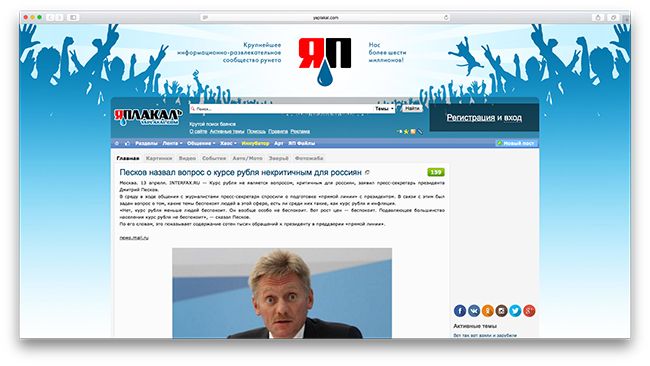
Advertising on "I cried" too little. “Advertisers do not perfectly react to our site,” the project representative shrugs with his hands. “Unfortunately, they more like social sites or super -efficient adme sites.”
"I cried" has its own ways to earn. For example, if negative posts appear on the site about the activities of certain companies, they agree to withdraw them, but only for money. The site employee assures that his team itself does not engage in writing such posts: "We are people of a non -creative warehouse."
He says that “I cried” primarily a social experiment, “an aquarium with which you can observe the moods in society.”
According to the site employee, before the conflict between Russia and Ukraine, there were about 20% of the audience from Ukraine on the site, but now only 11% are left. The topics and posts of Ukrainian users do not gain a high rating. On the contrary, they are subjected to a massive attack in the comments from Russians of a “patriotic orientation”. “The bulk among our audience is absolute“ cotton wool ”,” he says. On the site they are not going to do anything with this - I cried, according to the representative of the site, there is no educational mission. “What society is such and content,” he argues.
He also explains his incognito by the fact that the polemic on the site sometimes reaches such an intensity that his employees are afraid of revenge from enraged users.
"Chips.net"
49.2 million visits per month (SIMILARWEB data )
Like “I cried”, the site “Chinese.net” was created in 2004 - and also in May. This site was founded by the 23-year-old programmer Alexander Rybak, and he, unlike owners of other resources, was able to earn it. In 2006, he sold “chips.net” for 800 thousand dollars to RBC structures. The fisherman moved to Germany and became, along with Konstantin Schumov co -owner of Viboom.
Now the project "Chips.net" is owns by Mikhail Gurevich. In the late 1990s, he was a co-owner of the Russian-speaking Israeli agency Kurdor, then moved to Moscow, worked as a parliamentary correspondent and analyst at the Rosbusinessconsulting agency, then became deputy general director of RBC, then headed the subsidiary Mediamir, who was engaged in all third-party entertainment projects of the agency.
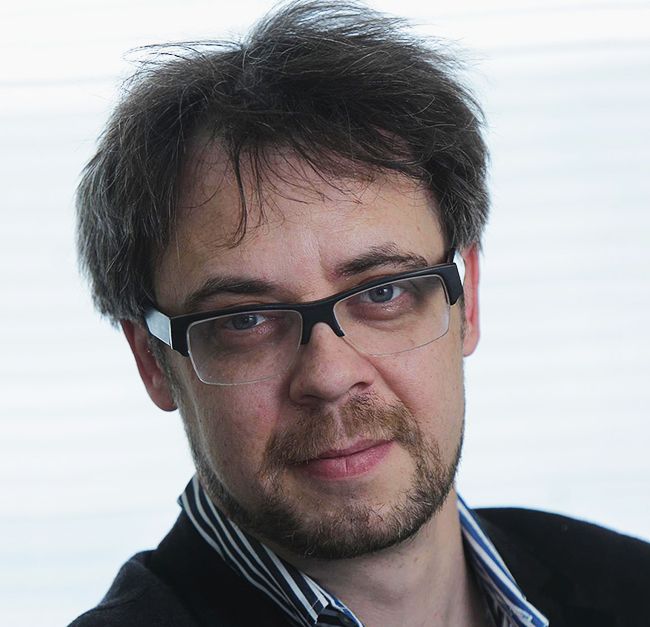
According to Gurevich, in 2006 the portal was a “promising garbage dump”, in which there was everything from politics to eroticism. Over the next two years, the site, according to him, "managed to comb and remove erotica." Gurevich says that with low expenses, the portal had 200% profitability. But in 2008, a financial crisis occurred-and the entire RBC holding was on the verge of bankruptcy.
“Chips.net” was sold to third -party investors, but in 2013 Gurevich bought it back - now as an independent investor. According to him, he partially invested himself, and partially the purchase was invested by 101startup, which he founded with his partners, having left RBC. The company acquired 25% of “chips.net” for $ 1.2 million, Gurevich does not disclose his share and volume.
Gurevich does not want to engage in journalism in the classical sense in Russia. “I always thought that the meaning of the media is to provide the voter with the right to know. Then he realized that the voter does not always have the right to know or he better not know anything at all, ”he explains. The ideal that Gurevich is striving for is to make the “CHICS.NET” by the Russian analogue of the Buzzfeed portal is one of the mainstream entertainment media with a monthly audience of more than 200 million people.
Gurevich is building a Russian BuzzFeed with one exception: he promises that there will be no policy on “chips.net” until the situation in the country changes. For fans to speculate about her, a separate section “Antifishka” was created on the site, where real battles in the comments and posts between President Vladimir Putin and their opponents are taking place daily. “You won’t see anything like that on the main page - all political posts are banned immediately,” says Gurevich.
Unlike “I Cried” and Pikabu, the content for the main page of “Fucks.net” is not made by users, but by the editors. In “Coffee House” on Leninsky Prospekt in Moscow, Gurevich holds a real glider along with the editor-in-chief of the portal Andrei Zubrilov and another colleague. Gurevich and Zubrilov decide what materials to write for the main page. They agree to write “10 recipes of barbecue”, “where to go to the May holidays” and “What do we know about Panama” (in honor of the corruption scandal “chips.net” decided to tell readers about this country). Such meetings are held every week, in daily mode, the Chinese.net employees communicate in the Slack chat, and the main edition is located in Solnechnogorsk, in the building of the former garage.
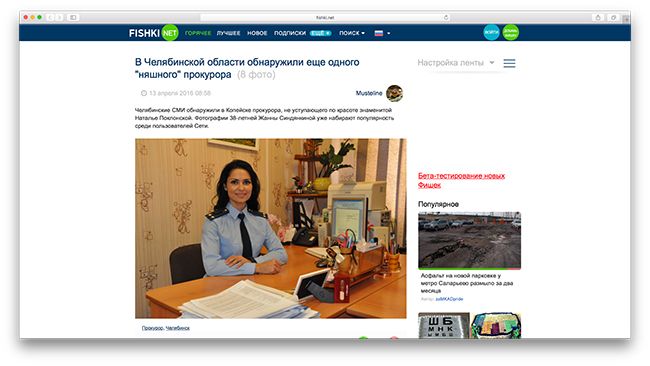
From the rigid moderation of users' messages, the site managers came to the production of their own content-because of the desire to win the audience on Facebook, where they are very closely monitored by the content of articles. According to Gurevich, after a change in policy, the project audience doubled a year.
In addition, he says, when you yourself form the content of the main page, the portal becomes clear and advertisers who will definitely understand that their banner will not be on one page with controversial content. Gurevich plans to recoup his investments in the project by the end of this year.
According to Gurevich, the audience of China.net adheres to the same patriotic views as “I cried”. “The post with humor about Stalin goes with a bang, and it does not depend on us. But we have no task to educate certain views, ”he admits.
Despite the fact that not one of the three most popular entertainment portals is registered as the media, each of them interacts tightly with Roskomnadzor. Any notice of the need to remove this or that content is implicitly executed. Typically, we are talking about mentioning drugs, suicide and the inadmissibility of incitement of national growth.
Ilya Zhegulev
Moscow