
Translated material
Hamlet machine | Colta.ru
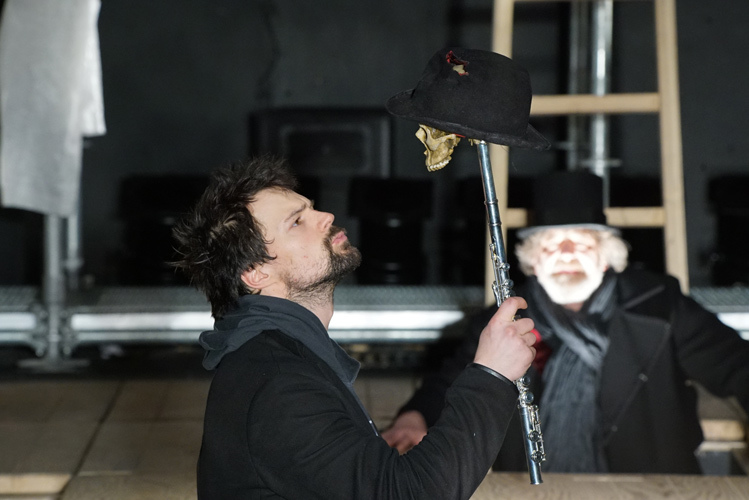
Leo Dodin released a performance called Hamlet, although Shakespeare’s play for him is not only not an object of research, but not even a reference point. This is only a kind of cultural and worldview myth, which Dodin declares already in the program, before the start of action. “Maybe there is a great revival, including one of the heights of the intellectual and spiritual enrichment of the ancient barbaric principles of revenge, hatred, murder, destruction. Maybe the whole development of mankind, which we are all so proud of, is also barbarism; Continuously intellectually enriched, intellectually and spiritually justified barbarism. And maybe all the progress that we admire so much is the intellectualization of lower human instincts, which led us to where we all, humanity, are, ”says Dodin, attracting the hall to reflect on this topic.
A series of cultural codes, declared at the very beginning of the performance, in the first minutes is built into a certain coordinate system, in which the audience will have a dialogue with all the creators of the performance, since Dodin works so that not only the artist, but the actors certainly become his like -minded people. The first of the codes is the “tango in a crazy house” by Schnita from his “life with an idiot”: it bursts into the hall because of the door with a gamlet of the doors, others opened by the prince, others, and it sounds, as Nabokov would say, “eternal refire”, hinting at the endless repeatability of history and the infinity of idiocy in one individual country. And besides, it contains a direct hint of Hamlet’s madness, because from the very first minutes there exists in two faces - those that are printed on his T -shirt: a young hero, himself, and an old man who is extremely similar to a young Hamlet. The prince-Danila Kozlovsky pronounces the text for two, for himself and for the ghost of his father, so that there is no talk of any real ghost, but goes about schizophrenia, in the image of which the prince is not too zealous and, it seems, does not really seek to succeed.
Dodin does not re -read, but rewrites Shakespeare.
The fact that Hamlet will play Kozlovsky was obvious before the start of rehearsals. As well as the fact that Ksenia Rappoport will appear Gertrude, and Ophelia is Elizabeth Boyarskaya. When it turned out that Igor Ivanov and Igor Chernevich were also busy in the play, they spoke in the near -theater circles: “Well, it will be the“ second series ”of“ treachery and love ”.” No one doubted that Ivanov would turn out to be Claudius and this would be the double of the Schiller President von Walter, invincible to anyone, including Hamlet. However, of all the prophecies, only one thing turned out to be true: Hamlet in the play does not look like a hero. In general, Dodin consistently deheroids the main film -brow of the country. And this gives Danila Kozlovsky in the images of anti -heroes - what MDT and his Ferdinand, and his Lopakhin look on the stage, and now Hamlet is to grow acting from the performance to the performance. But the matter in this case is not in Hamlet, not that it is an ordinary tyrant, behind which a train of deaths reaches out, in nothing, according to Dodin, not justified. The fact is that in the logic of this performance, Hamlet - Kozlovsky and Claudius performed by Igor Chernevich, without realizing this, are on one and not on different sides of the conditional barricades - and Gertrude and the young energetic informer of the Poloni Stanislav Nikolsky, who are not a father, but the brother of Ophelia, are sent to them. All other courtiers would have been there, if Dodin had not exhausted them, so as not to multiply the essence, and did not give their words to the remaining.
The text of the Shakespearean play is not just radically reborn - a completely new play is composed. And Dodin here is honest - it is written in the program: an essay for the scene of Leo Dodin according to Saxon Grammar, Rafael Kholinsed, William Shakespeare, Boris Pasternaku. The first two - chroniclers, historians - Dodin learned evidence of the incredible, pathological tendency to violence of all people clothed by the authorities. In the "Saga of Hamlet" the chronicle of the XII century Saxon, the Danish prince really kills incomparably more compatriots than a literary Shakespearean hero. And, having this knowledge, Dodin does not re -read, but rewrites Shakespeare. Apparently, the completely white robe of the stage, for the time being hiding the very specific image of the state (the artist is the permanent co -author of Dodin in recent years, Alexander Borovsky), is not only white clothes, which is being compared with any power, as “bloodthirstiness is dressed in the armor of Christianity,” according to the expression that sounds in the play (I will not undertake to say to whom its authorship is quite likely that it is quite likely Dodin). These are also “white pages”, on which Dodin “writes” his saga about people of power as a particular case of people in general.
 © MDT - Theater of Europe
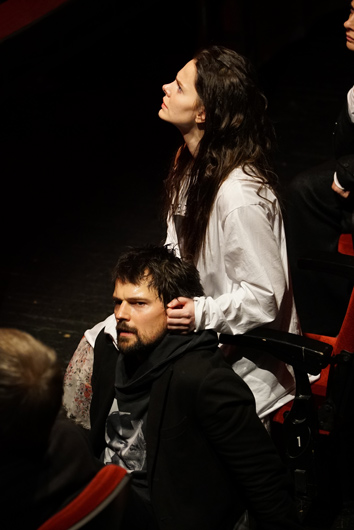
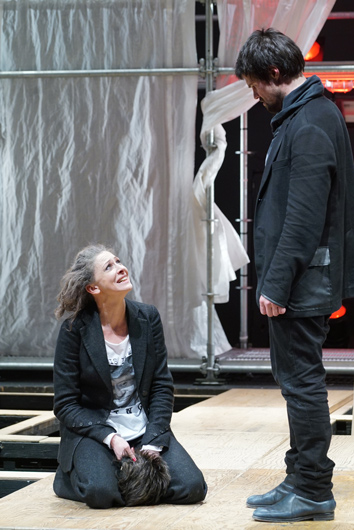
A big expert on human souls, titled in the world as a guru of the Russian psychological theater (the director himself categorically denies the legitimacy of this phrase in general), Leo Dodin in his Hamlet initially deprives the relations of the heroes of any volume-this is nothing more than a connection, the essence of which is exhausted by inscriptions on T-shirts: for example, this IS My King (at Gertrude next to the portrait of Claudius) or this IS My Prince (Ophelia has as a commentary on the portrait of Hamlet). The performance lasts two hours without intermission, and in the first quarter of an hour the viewer is made to understand that no one is not worthy of sympathy here. Dodin does not allow Ksenia Rappoport to play a drop of maternal warmth - Hamlet and Gertrude dance tango in the prologue as two enemies: each replica - exactly a blow to pain points, but those points that should be guaranteed to be painful, both characters, as it turns out, are atrophied. Gertrude almost does not deny his communications in the murder of her husband, and later he admits directly to him, accusing the deceased spouse of "narrow -minded and an insurmountable desire to humiliate." The rage of this woman, whose actions are dictated by obsession with two passions - sexy and desire for power, quickly turns Gertrude into Lady Macbeth (before death, she even pronounces one of her phrases very much to the place). The son turns out to be worthy of his mother and even more targeted - he is overwhelmed by the only passion. He explains his hatred of Claudius extremely concisely: “You are standing an obstacle between me and the throne” (Pasternak says “between me and the people”, but the category “people” in the context of the Dodin “Hamlet” is simply inappropriate). The sincere doreh in love with him, Ophelia (the tears of this girl who does not recognize her boy, who suddenly smells of power and turned around the predator, is perhaps the only thing that at least somehow touches) Hamlet forgets faster than she goes crazy. He did not care for him to be interested in the fate of the one who is buried in a fresh grave, so the absence of a Laerte and the final duel is very logical.
Here, for sure, there will be those who ask: why, in fact, Dodin in this case needed Shakespeare? I would write my play about the world that is so inhuman. These questions, which recently, has often been asked by Russian directors officials, and even critics of the “new format”, are extremely funny. And after all, it is useless to hope that the questions someday understand that the dramatic tension line in this case takes place primarily between the Dodin and the humanistic myth, the crown of which has many centuries, Shakespeare remains. Shakespeare needs Dodin, then why Hainer Muller Hamlet or Medea needs Hainer. And it is no coincidence that in a letter to the Prince of Ophelia, voiced by Polonia, the phrase “Hamlet machine” appears. Hamlet Dodin would not have subscribed under the words of the Mullerian hero: “Thoughts are ulcers in my brain. My brain is a continuous scar. I want to be a machine. Hands grab your feet to walk not to be painful not to think. ” Hamlet Dodin, like Gertrude, is already cars whose actions are predictable, how predictable of the actions of any well -known mechanism, among which state power is one of the most debugged. So, when Gertrude and Claudius, without saying a word, rush behind the unfortunate madman, whose reason could not stand the first death, and then from a height due to white curtains in the basement, a soft doll will fly into the basement, this might look surprisingly in the performance of Shakespearean, but not Dodin characters. And in the paradigm of Dodin, the star artists of MDT Ksenia Rappoport and Danila Kozlovsky, devoid of charisma and charm that their screen heroes are full of Hamlet, is an incredibly effective director's move.
 © MDT - Theater of Europe
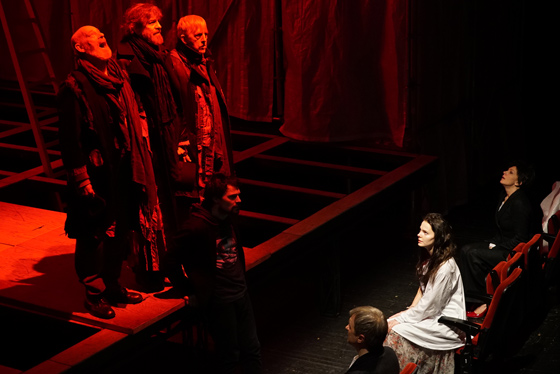
The special role, assigned to the performance of the Shakespearean “Hamlet” actually, is also impressive - a small book in the cover, copies of the one from which, by his own admission, Dodin did not part. This is precisely from her, and not at all from the XXI century unknown to the audience of the Gonzago Hamlet, obsessed with the idea of scaring the mother, and not “to ensure the conscience of the king” (the local soft -born Claudius is not able, except, probably, beds), chooses quotes for the play. It is Hamlet in it hides the lace panties of Ophelia (from which they flew from where to postpone the work for a short time for the sake of pleasure). It is from her that Ophelia, who has lost his mind, will pull out the pages and give the king and the queen under the guise of violets and rosemary. It is Hamlet in her - Kozlovsky will find a textbook monologue “to be or not to be” and try to read it, climbing the stairs, as children climb on a stool. A monologue, although the prince will read it very carefully, as they say, will not sound. Dodin Hamlet - Kozlovsky will no longer give any other famous (in order not to say - masterpieces) monologues. And not because (more precisely, not only because) that the power of these texts is so great that it will justify, perhaps, murders. The fundamental idea of the director will become clear just as soon as the Shakespearean text will sound from the lips of professional actors, who are played in this performance by unconditional masters. So, as soon as Igor Ivanov, Sergey Kuryshev, Sergey Kozyrev will take their places on three stairs rising above the stage, and, having spoke their mercantile texts about how little -talented, but pretentious youth steps on their heels, will begin to explain with Shakespearean rhymes, simple truth will be found: politicians, except for others, also disgusting, and also disgusting. Actors. Against the background of theatrical pros (politicians), combinations look like an amateur, poorly hiding the true essence of both the political defendants themselves and their actions.
So the question of who Igor Ivanov plays, almost to the premiere itself, violently discussed in the near -thermal circles, in the top ten. The answer to it is the key to action. Ivanov plays himself - the great artist and Alter Ego of the creator of the performance. It is they-Sergey Kuryshev, Sergey Kozyrev and Igor Ivanov-make Shakespeare's text as a newspaper editorial: “Buy glass eyes-and pretend to be a villain-politician, that you see what you do not see.” This is he, Igor Ivanov, who is called Marcellus in the performance of the guide from the Shakespearean “Hamlet”, suddenly, with the help of one of the monologues of King Lear, changes the angle of reflection of everything that happens in the performance, and justifies the sin of adultery with the ease with which the magician pulls out of the hare's cylinder. He does this, just peering into his empty palm, in which, supposedly at that moment, flies indulge in that very sin, which proves the absolute naturalness of such an act. However, the next second, the corner of the reflection changes again: the scream of Marcellus - Ivanova “Come in! I need soldiers ”returns everyone to a very specific reality. And then again and again - to infinity. It seems that these three actors could in this way re -read the whole of Shakespeare, transforming words, words, words into crushing today's meanings and subtexts.
 © MDT - Theater of Europe
For a political theater in a pure form, Leo Dodin, of course, is too big aesthet. And it is unlikely that he will ever agree for any revelations to exchange his multilayer theatrical symbolism for the radicalism of slogans and zoons. And the fact that real actors are the only ones who rise in his performance over the world of barbarism and violence, comfortably feeling on spectacularly illuminated stairs-verticals, and stairs, in turn, are sent to the “demons” ladder, along which Matrash desecrated by him climbs and climbs upstairs. On the stage there is not a single unreflected image, gesture or details - up to the red panties of Gertrude, in harmony with her red varnish shoes. This is not to mention how, according to the laws of the musical composition, a purely emotional stress is pumped out in the “Hamlet” by the laws of the musical composition: behind every death, behind each corpse flying into the underput, there is a deafening roar of boots, and four stately men cover the next “grave” with a wooden stove, as if it were, as if Dodin, they work impeccably aesthetically. And the whole performance you painfully recall where you heard this echoing, measured clatter - until Hamlet pulls off the white panels and the square corridors and stairs of the giant prison open behind them. Exactly, it is in these prison "wells" in many films that the sound of uniform boots is deafeningly.
And when one of these white curtains will be found semi-naked and therefore some helpless Gertrude and Claudius, the finale of the “deaths of the gods” Visconti will be remembered. True, no one will present ampoules with cyanide potassium to these heroes - they will voluntarily drink the poison from the flask, which Gertrude herself filled for such an incident. And Hamlet in the final will not freeze in the Nazi greeting over the corpses of the king and queen. Something more terrible will happen. From the screen of the plasma panel, which will be carried in front of the hall, all the same beautiful mounters, the new ruler will turn to the gathered - Fortinbrais in the civilian, shocking authentic type with a characteristic set of replicas, intonations and a characteristic expression on the face. The theater assures that this person has nothing to do with the theater. And in the logic of this performance, a similar fact is murderous.
Since the “Gamlet” of the Small Drama Theater has an amazing paradox: having declared the destruction of the myth of humanism, Dodin ultimately complies the hymn to one of the most humanistic arts - the art of the theater, the only one where a person looks directly into the eyes of another person, which is why the effects of meanings that were intensified on the scumbags intensify several times.