
Translated material
Gambit in Kievsky
The new Prime Minister of Ukraine was the ex-chairman of the Verkhovna Rada, 38-year-old Vladimir Groysman. Why exactly he and what to expect now - the New Times sorted out
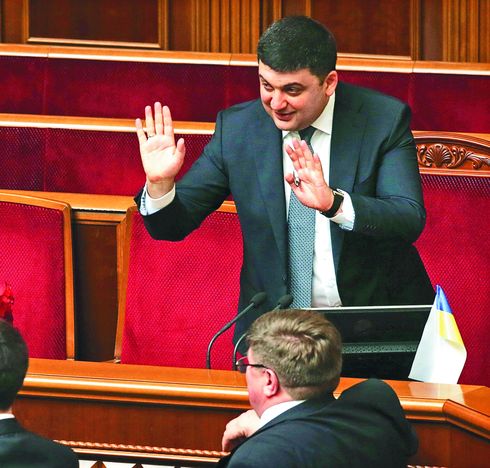
Vladimir Groysman during the Rada meeting, at which he was approved by the new Prime Minister, Kiev, April 14, 2016. FE : Ivan Kovalenko/Kommersant
In the late night of April 12, a small group of men came out of the Bankova Presidential Building Building Building on Bankova Street in Kyiv. We walked along the mulberry-tired, silent, but obviously pleased with himself: the Prime Minister (at that time) Arseniy Yatsenyuk, the head of the presidential administration (AP) Boris Lozhkin, the Minister of the Interior Arsen Avakov and a few more people ... They slowly moved personal limousines and protection machines. A walk in night Kyiv became the final of almost 12-hour negotiations on only two issues: who will change Yatsenyuk as the prime minister and who will work in the new government.
Why did Yatsenyuk go
The most powerful impetus for the requirements of his resignation is assured by NT sources surrounded by President Petro Poroshenko, the results of the sociological study of the Rating group were published on February 4: 21%of the respondents were satisfied with the presidential, the chairman of the Rada-the Prime Minister-only 8%. At the same time, almost 70% would be supported by Yatsenyuk (back in October 2015 there were 60% of them). Compared to last fall, supporters were added - from 47 % to 50 % - and the idea of early dissolution of parliament and re -election of the Rada. Poroshenko and his entourage assure NT sources in the Rada, this survey “really scared”.
Although, of course, there were other reasons among partners in the Rada, including rumors about his “corruption” * among partners in the Rada, among the partners in the Rada. "Why do you need a prime minister who does not add points to the president?" - asked a rhetorical question in a conversation with NT a high -ranking official in Kiev.
On February 18, in the Rada, a vote on the vote of no confidence in the government took place. As a result, the work of the Cabinet Yatsenyuk was recognized as unsatisfactory, but they could not resign the prime minister - 32 votes were not enough. Then the president and his entourage began to convince Yatsenyuk to resign voluntarily. Two -month -old efforts gave the result on April 10: speaking on this day on TV, Yatsenyuk announced the addition of authority, emphasizing that “the political crisis in the state was created artificially. The desire to change one person blinded politicians and paralyzed their will to real changes in the country. ”
The next stage - to approve the resignation of the previous prime minister in the Rada and appoint a new one - turned out to be no less winding. During the time that Yatsenyuk persuaded to leave, the parliamentary coalition broke up, which formed according to the results of the first elections after the Maidan: the three factions - “Fatherland” (Yulia Tymoshenko), the Radical Party (Oleg Lyashko), “Self -help” (Oleg Berezyuk) - left the majority. The motives were different, but they united them one thing: Yatsenyuk’s rejection and the desire to hold early elections to the Rada, which, as the leaders of these parties are sure, will allow them to strengthen their representation. However, the option of early elections does not suit the remaining two parties of the coalition: the bloc of Petro Poroshenko (BPP) and the Popular Front (NF, Arseny Yatsenyuk). They consider this option suicidal. For two difficult military years, there is nothing special to boast of the parliamentary majority: according to the results of 2015, inflation in Ukraine amounted to 48.7 %, utilities went up by 115 %, food products-by 44 %. With such numbers, counting on a high result according to the results of early elections at least arrogantly. As a result, BPP - NF decided to go the other way: create a new coalition in parliament, which would allow you to change the head of government ** .
Negotiations on Groysman’s nomination in the premieres were twice on the verge of a breakdown due to the fact that he set the condition: he would personally determine the heads of four ministries
To create the majority, two fractions needed at least 226 people. On the eve of voting in the Rada in favor of Groysman’s candidacy in the BPP, they assured: more than 230 deputies have already been in the coalition. True or not, no one really knows that the signatures of the deputies are not advertised. However, the vote on April 14 in the Rada on the candidacy of the new prime minister showed: most likely - not true. 257 deputies voted for Groysman, while the BPP and NF gave only 206 votes. The rest belong to non -confraction groups “Renaissance” and “The will of the people”: both associate with the former part of the regions and oligarchs who had not previously been agreed with the authorities. Now, apparently, they can ...
Loyal, but with teeth
The new Prime Minister Vladimir Groysman was not as simple as they thought about him. On the sidelines of the Rada, his main disadvantage was considered to be “political proximity” with Poroshenko-he always patronized Groysman: first, in 2006, he supported him in the election of the mayor of Vinnitsa (Groysman became him at 26), and immediately after the Maidan insisted on the appointment of Groisman to the first government of Yatsenyuk to the post of Deputy Prime Minister. Later, having passed the BPP lists to the parliament, Groysman was nominated for the post of chairman of the Rada.
The controlled, non -independent, loyal - approximately this was the political future of Groysman until April 2016. But when they began to form a list of ministers of the office, it was found that he was able to “show his teeth” even to the president. Negotiations on his nomination in the premieres were twice on the verge of a breakdown due to the fact that Groysman set the condition: he would determine the heads of four ministries in the new office (see the prone). As a result, this condition was met. Moreover, three ministries were headed by the so -called “Vinnitsa”, from among its former deputies in the city hall there. But there was another condition. Groysman did not want to take the first deputy prime minister Vitaly Kovalchuk, whom the administration of Poroshenko “friendly suggested to him”. Kovalchuk - the first deputy head of the AP, is considered a tough manager and a talented organizer, and Poroshenko, according to rumors, really wanted to see him in the executive branch. But Groysman insisted on his own. They say that during negotiations on the night of April 12, he even used the last argument: either I or Kovalchuk.
Caution reformer
The new government of Ukraine will have six deputy prime ministers (at 16 ministers)-there was no so many deputy heads of the office in Ukrainian political history. In addition to the traditional “vice” for humanitarian, social and regional policy, Groysman will have deputies for European integration issues, for ATO and temporarily occupied territories. A ministry is specially created, which will engage in Donbass, Crimea and persons temporarily resettled from there.
Kiev political analyst Vladimir Fesenko considers the “abnormally large” number of deputy prime ministers in the new Ukrainian office “Cost for a compromise when creating a government”. But the problem, in his opinion, is also that “very different people have entered the office, of which there is still a kind of single team.”
Of the prime ministers - to the presidency?
On April 14, Arseniy Yatsenyuk acts in the Verkhovna Rada with a farewell word: “... I ask you to accept my resignation, and great things and great achievements await us ahead of us. Thank you". After these words, he left the rostrum and left the hall, without waiting neither a response from the president, nor voting for his resignation. He was offended: neither his associates were appreciated by power, nor the people for whom he, apparently, will forever remain an unpopular prime minister. But he, Arseniy Yatsenyuk, was the prime minister in the most difficult years. He had to build a state machine, provide an army, establish new economic relations after the actual breakdown of ties with Russia.
Be that as it may, Yatsenyuk will not cease to be a player in the Ukrainian government. He has a party, his faction is one of the supports of the new coalition. He may, and even, most likely, will give lectures in Oxford or somewhere else. But he will not leave politics. Speaking on TV with a statement about his care, he uttered a phrase that many did not pay attention to: “From today I see my tasks than the powers of the head of government: new electoral legislation, constitutional reform, judicial reform, coalition control over the course of the new government, international support of Ukraine and its EU and NATO membership are part of my program.”
This is the program of the future president. There is no doubt: Arseniy Yatsenyuk, having a little rest, will enter the struggle and for this post.
* On April 12, the Prosecutor General’s Office of Ukraine confirmed the existence of a criminal case on the fact of Yatsenyuk to a bribe of $ 3 million for the appointment of the head of the concern of radio broadcasting, radio communications and television Vladimir Jeschuk.
** According to Ukrainian legislation, only the parliamentary majority has the right to nominate the prime minister.
Background
Tumbling ministers
For what posts in his office the Groysman fought in his office
The First Deputy Prime Minister is the Minister of Economic Development and Trade. Functions: organizing the work of the government, holding preliminary meetings of the Cabinet, the replacement of the Prime Minister in case of its absence. How the Minister of Economics will coordinate the work of NAC Neftegaz Ukraine and the previously declared privatization of unprofitable state -owned enterprises.
Deputy Prime Minister on the issues of occupied territories and temporarily displaced persons. Functions: Solving the issue of ensuring and protecting forced immigrants and restoring the destroyed territories in eastern Ukraine.
Minister of the Cabinet of Ministers. * Functions: * Organization of the work of the Prime Minister’s office, preparation of documents.
Minister of Social Policy. Functions: social policy, social protection, pension support, determination of categories that are entitled to benefits and subsidies.
Opinion
Roses and dreams
The new Ukrainian office is unlikely to be durable
The current government of Ukraine is the third after the Maidan. The first was appointed right in the square. Prime Minister Yatsenyuk read out the names of people who were appointed ministers with an ancient method of interclamation (exclamations of approval, a cry, applause). It seemed that these people would change the country in a matter of weeks. Then the first parliamentary elections after Yanukovych, following which the second government - technocrats formed. The composition was unusual: many new persons, young managers and managers from financial companies. For the first time in history, foreigners, who urgently received Ukrainian citizenship, became ministers. Hopes, serious trust - this office had everything. But by the end of last year, the prime minister’s rating has decreased to the level of error, the entire cabinet quarreled, the charges of corruption became commonplace for the government. Ukraine celebrated the New Year with a difficult, even chronic political crisis.
And three months of politicians with breaks on religious and public holidays tried to agree. The main negotiating table is located in the Poroshenko administration. For a short presidency, a new procedure for managing the country was established, a parallel decision of the decision-making system was created de facto-in Kyiv it is called the “strategic seven”. In it is the president, the head of his administration Lozhkin, the prime minister is now Groysman, the speaker of the parliament is now Parubiy, the head of the National Security Council of Turchinov, the head of the Ministry of Internal Affairs of Avakov and the head of the presidential faction in the Verkhovna Rada Lutsenko. The decision -making “Seven” attracts various kinds of communicators within the political class, not excluding representatives of the Yanukovych regime, and most importantly, representatives of large Ukrainian business take direct participation in its work.
As a result, they agreed. The result of the agreements - there is not a single foreigner in the government. Someone refused, others were not even invited. Without any explanation, several ministers-technocrats were fired, as the president and prime minister loved to call them in the recent past. But six deputy prime ministers appeared. Including the deputy head of government without powers defined by law. All these endless “vice” are direct representatives of various political and business groups.
On the voting day, the decree on the appointment of Groysman was united with a decision on the resignation of Yatsenyuk. Such a stationery was needed by everyone - so that for a second there was not a refusal, so that no one could have time to change his mind. With such shame and fragility, with such barely perceptible connections within a complex system called “Ukrainian politics” it is difficult to believe in the durability of the current government. Yes, and the rhetoric of the last weeks is completely similar to the election ...
By the way, it is in the possibility that after a while to re -elect the parliament for many - hope. Especially for the minority - the new politicians of Ukraine who came to power from civil society, from journalism, from activism. This is a very annoying tribe for power, they are popular, they are known to citizens of all ages and throughout the country, followed by the support of Ukrainian friends in the West. In the chaos of recent months, these young politicians are especially difficult. They are not sure of anything, sometimes they trust exclusively to their principles, sensations and loved ones. But they do not give up.
After some time, these people of the new wave will certainly form political force and go to parliament, to the new Verkhovna Rada. And so gradually, carefully, but persistently displacing the previous system, new politicians will change the order of things in the country. Then the duty officer, completely devoid of meaning and symbolism, will go into the past, an impressive bouquet of red roses, which the presidents of Ukraine awarded the appointed premieres. Presidents and government, factions and coalitions are changing, and the bouquet is still the same as with one old Soviet flower bed. Last week, such a bouquet received from the president and the new Ukrainian prime minister.
Photo: odcrisis.org