
Translated material
The government discussed the scenarios for returning to the growth of the economy: a year earlier or year later
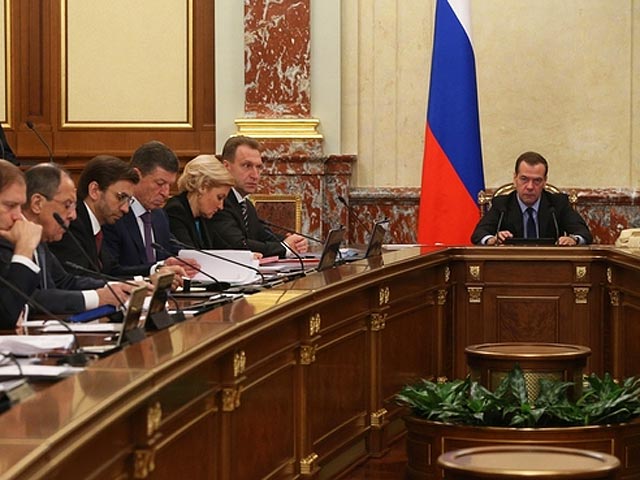
Russian Prime Minister Dmitry Medvedev on Wednesday held a meeting on the implementation of the government action plan aimed at ensuring stable socio-economic development of the country in 2016.
During the meeting, the head of government said that the basic version of the forecast of socio-economic development suggests that the price of a barrel of Urals oil will be $ 40.
In case of much more pessimistic development of events, according to Medvedev, a conservative version of the forecast was prepared, out of $ 25 per barrel.
The prime minister believes that such attitudes will force the government more critically to look at the possibilities of the budget, reports the Finmarket news agency .
“At the same time, the frontal reduction in expenses is not planned, we are not going to increase the tax burden on the budget, but the tasks of balancing the budget, improving the efficiency of the budget policy remain key, and we will continue to engage in them,” the head of government explained.
At the same time, he emphasized that when drawing up a forecast of socio-economic development of the Russian Federation, it is better to underestimate the alleged income than to look for additional reserves for budget balancing.
The head of the Ministry of Economic Development, Alexei Ulyukaev, said that a conservative scenario providing for the price of oil at 25 dollars per barrel implies the return of the country's economy since 2018. $ 25 per barrel, he explained, this is the lowest value, which "was achieved by the market as a result of the second oil shock."
The basic version of "formed with a good share of conservatism" and provides for the fall of the GDP of the Russian Federation in 2016 at the level of "almost about zero" - 0.2%, and in subsequent years - the restoration of the main factors of economic growth and GDP growth by 0.8-2.2%.
In subsequent years, Aleksey Ulyukaev assured, the dynamics "will improve, and in all these indicators the meaning will approach 2-3%." In particular, by the end of the three -year -old industrial production, growth will exceed 2%, GDP growth will be 2.2% in 2019. Export will grow by 1.7%.
"The updated forecast of 2016 suggests that it will remain, if you look at the quarterly, a small minus in the current quarter - 0.6%, the zero value of the GDP dynamics in the third quarter, and the transition to growth starting from the fourth quarter, in the fourth quarter we expect 1.2% of growth and cumulatively in a year of 0.2% of the minus, almost next to zero," - clarified it. " Minister of Economics.
"Starting since 2017, we expect the restoration of the main factors of economic growth, that is, consumer demand through the growth of real incomes of the population and investment demand. In 2017, the forecast proceeds from the fact that export will grow by 0.8%, real salaries - by 1.1%of the retail turnover, an increase in industry by 1.1%, and in general, in general GDP is 0.8%, ”he also said.
According to the government, according to TASS, the first Deputy Prime Minister Igor Shuvalov, Deputy Prime Ministers Olga Golodets and Dmitry Kozak, Presidential Assistant Andrei Belousov, Minister of Economic Development, Minister of Finance Anton Siluanov, Minister of Education and Science Dmitry Livanov, Minister of Industry and Trade Denis Manturov, Denis Manturov, Construction Minister and Construction Minister, Minister of Construction and Construction Minister, Minister of Construction and Minister of Construction and Minister of Construction and Construction Minister took part Housing and communal services Mikhail Men, Minister of Communications and Mass Communications Nikolai Nikiforov, Minister of Labor and Social Protection Maxim Topilin, chairman of the Accounts Chamber Tatyana Golikova.
In early March, Dmitry Medvedev approved an action plan for 2016, which is aimed at ensuring stable socio-economic development and provides for the support of individual, most promising sectors of the economy, as well as a large block of social measures.
Unlike the anti -crisis plan for 2015, the Government of the Russian Federation this time abandoned the massive support of the banking system, the real sector and export development have now become a priority.