
Translated material
You can’t send a general
"Medusa" studied the career of the new Commissioner for Human Rights Tatyana Moskalkova
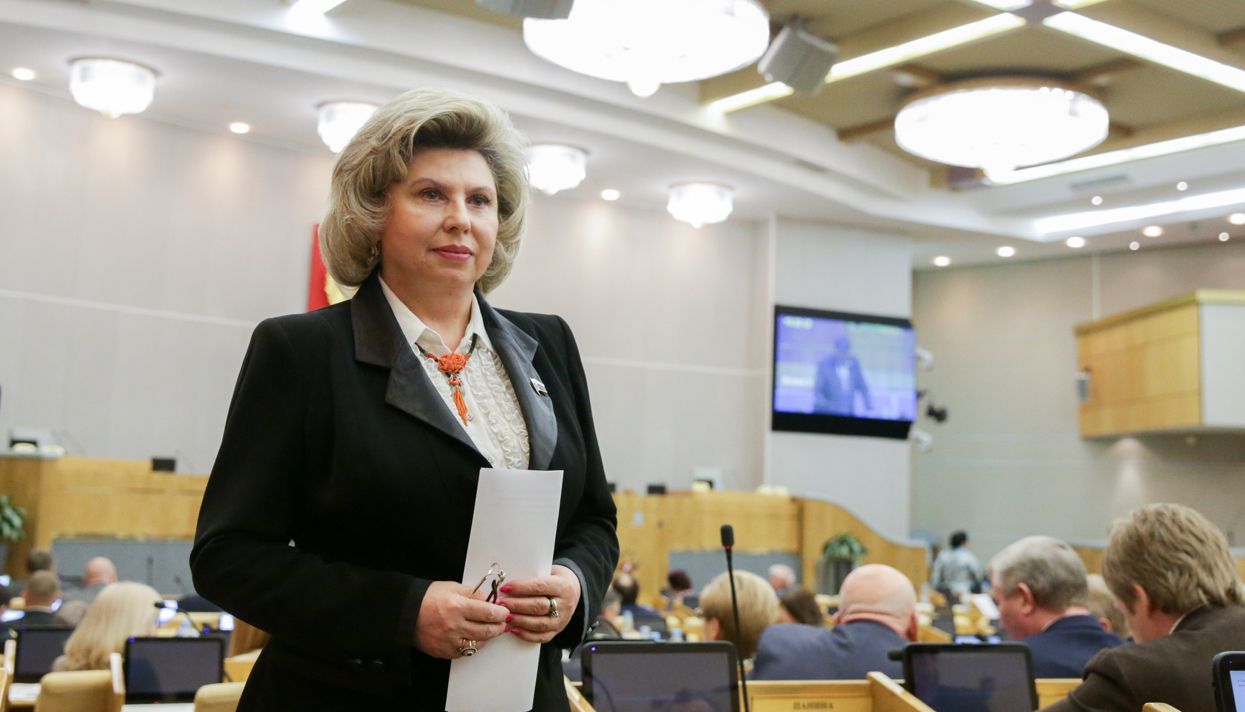
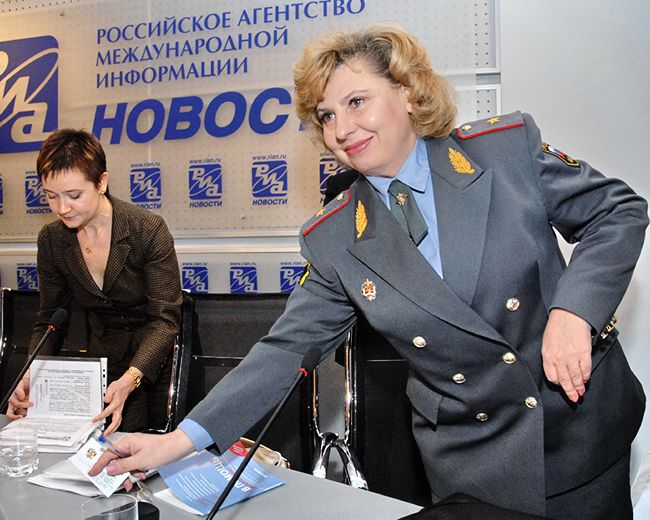
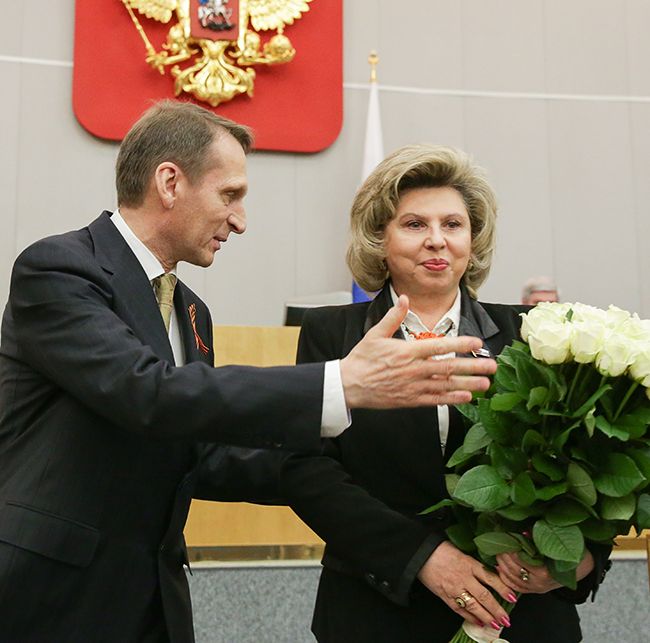
On April 22, the State Duma elected Tatyana Moskalkova deputy Tatyana Moskalkov by the Commissioner for Human Rights under the President of the Russian Federation. Immediately after the appointment, the new Ombudsman promised to defend the rights of Russians abroad, where Russian schools are closed, as well as withstand the attempts of the West to use human rights as a political tool. Prior to the election to the State Duma, Moskalkov worked as the first deputy head of the legal department of the Ministry of Internal Affairs, she is Major General of the police, a doctor of legal and philosophical sciences. As deputy Moskalkov, a number of extravagant initiatives are known, including the idea of renaming the Ministry of Internal Affairs in the Cheka. "Medusa" studied the career path of the new Ombudsman.
“To serve you, to protect your interests - so that a person of labor in free and fair Russia, having equal opportunities for obtaining goods, finds his way to the future - in this I see the main goal and meaning in my activities!” - So the deputy of the State Duma Tatyana Moskalkova turned to visitors to her official site.
On April 22, referring to the deputies of the Russian parliament as an Ombudsman, Moskalkova unexpectedly quoted the Polish poet Adam Mitskevich: “In order for the country to live, it is necessary to live rights.” And she added: “I consider this statement an epigraph to a new page of the Commissioner for Human Rights.”
In the first interview, after appointing by the Commissioner for Human Rights, Moskalkov promised to pay special attention to the fields of medical care and education, criminal procedure and criminal-executive activities, housing and communal services, migration and non-fulfillment by employers of their obligations to pay salaries.
“The work of the Commissioner for Human Rights is a creative work. After all, good by nature is the creative beginning of man. I see my goal to strengthen the authority of the Commissioner for Human Rights in the International Arena. This is necessary, since today a human rights topic has become actively used by some Western and American structures as a tool for blackmail, speculation, threats and attempts to pressure Russia. And the Commissioner for Human Rights can and should resist the false, inadequate accusations that come to the Russian Federation, ”Moskalkova General Major General described her tasks in the new post.
Moskalkov does not foresee special difficulties, it is optimistic. “You won’t refuse a woman, you won’t send a general,” she said on the radio “Moscow says”.
* * *
Major General Moskalkov only at first glance seems to be a man who is not very suitable for the work of the Ombudsman, because she was always vividly interested in the topic of human rights. Back in Soviet times, from 1974 to 1984, Moskalkova worked in the department for pardoning the Presidium of the Supreme Council of the RSFSR, where she held the posts of a consultant, secretary and senior legal adviser.
Moskalkova spoke about her work in the pardon department in an interview with the Orthodox magazine “Thomas”.
- What was it to you, a believer, to work in a Soviet law enforcement system? Did you have to stand up in front of the dilemma: to act according to the law or by conscience? - asked her journalist.
- From the employees it was precisely required to evaluate a person in conscience, that is, to look at him from the side with which the impersonal law sometimes cannot do this. In the certificate that we prepared for a pardon commission, we had to write about our understanding of the essence of what was happening, look at everything through the prism of the highest law - the law of morality, ”Moskalkova answered.
In 1984, she began working in the structure of the Ministry of Internal Affairs, where "she went from an ordinary referent to the first deputy legal department of the Ministry of Internal Affairs of Russia." The biography on her official website says that Moskalkova "by the generus of his activities is engaged in the development of laws and other legal acts aimed at protecting human rights and freedoms, the fight against crime." “It was our units who were considering violations of people's rights by employees of the internal affairs bodies, and took appropriate measures,” she explained after her appointment by the Ombudsman.
Moskalkova testify to the names of her candidate and doctoral dissertations about the long -standing and deep (even scientific) interest of Moskalkova in the topics of human rights and moral. In 1988, she defended the candidate “respect for the honor and dignity of the individual as the principle of the criminal process”, and in 1997-the first doctoral “moral foundations of the criminal process: the stage of preliminary investigation” (the second doctoral-“culture of counteracting evil in the work of law enforcement agencies”, it is dedicated to sociocultural models of opposition terrorism).
While working on the candidate, Moskalkova told Thomas, she came to Vera: “I realized that it was impossible to comprehend the foundations of law without knowing moral values and began to study religious literature deeply and seriously, began to meet and talk with Orthodox priests more often.”
“In my first dissertation, I am one of the first [in Russia] I propose to introduce into the law the norm that no one has the right to testify against himself, their close relatives. Now - Article 51 of the Constitution, and I am still five years before the adoption of the Constitution I propose this norm. This [also] I propose a norm that prohibits the recognition of any evidence received under pressure, threats, and blackmail. And ten years later, this norm appears in the Code of Criminal Procedure, ” said the Ombudsman to TASS.
By the end of the 1990s, Moskalkova received the title of Major General of the police and first tried herself in politics. In 1999, Moskalkova tried to go to the State Duma, and from the Yabloko party (this is explained by the fact that in the party three there was then the former Minister of the Interior and former Prime Minister Sergei Stepashin), but lost single -mandate elections in Rybinsk, gaining 19% of the vote.
In 2007, Moskalkova, as the first deputy head of the legal department of the Ministry of Internal Affairs, managed to publicly speak on the side of citizens,proposing to bring criminal liability for consumer deceit and the sale of poor -quality products to the Criminal Code, after which, on the second attempt, she elected to the State Duma.
* * *
Moskalkov was held in the parliament in the fall of 2007 on the list of “Fair Russia” in order to “protect the law and achieve justice with the help of a fair regulatory act.” There, she immediately received the post of deputy chairman of the CIS committee and relations with compatriots. In this capacity, Moskalkov was responsible for Russia's policy in the near abroad. In 2008, she argued on Radio “Freedom” with human rights activist Sergei Kovalev about the actions of Russia and Georgia in the war in South Ossetia.
Mikhail Sokolov, presenter: Tatyana Nikolaevna, do you support separatism? You must then admit that Chechnya has the right to withdraw from the Russian Federation, since there are also some strange plebiscites.
Moskalkova: It all depends on the wisdom of the largest state. These problems of separatism concerned almost all future republics, but Russia was able to solve the issue of the North Caucasus.
Kovalev: How is it?
Moskalkova: through negotiations, by applying force against people who committed criminal actions.
Sokolov: When doing the same thing that Saakashvili did, you want to say?
Kovalev: Are you serious?
Moskalkova: I believe that here the parallels are completely incorrect. Because not Georgian citizens live in the territory of the North Caucasus, but citizens of the Russian Federation, connected with us thousands of political, economic, moral, cultural threads, which were impossible to break. And we put things in order there.
Sokolov: Can Georgia “restore order” or not? And there are ties between Ossetians, Georgians, Abkhazians, Residents of Abkhazia? It just seems to me that there is a certain double standard, but maybe I'm wrong.
Moskalkova: In relation to Russia, I believe that we are taking a very consistent, clear and tough position, unlike the United States of America, which lead a double standard. In relation to Kosovo, independence is recognized, and in relation to Abkhazia and South Ossetia, this is separatism.
But even in this area of work, the parliamentarian with the general epaulets did not escape the topic of human rights. So, in March 2014, she proposed to create a court in the CIS, similar to the European Court of Human Rights (ECHR). “The ECHR demonstrates double standards and engagement,” Moskalkova said , and she explained the necessity and “timeliness” of the creation of a new body.
The deputy has repeatedly taken care of the rights of the inhabitants of Donbass. For example, in the same 2014, at the presentation of the second “White Book of Nazism”, dedicated to the manifestations of neo -Nazism in Europe, Moskalkova said that thanks to this work one can “understand the whole genesis of the formation of evil under the name Nazism” and “prevent the terrible events that the world has encountered after and during the first and second world”. “We see how the boat is swinging. Today in Ukraine, the main enemies have been announced corruption and Russia. Is this not large -scale nationalism, racism, xenophobia, ”said the future Ombudsman.
* * *
But most of all, Moskalkova became famous in the media in the struggle for the morality of the Russian people (which, of course, can also be understood as human rights activity). After the shares of the War and Punk-Molebna art group, Pussy Riot in the Cathedral of Christ, Moskalkov, proposed to punish "for the attempt on morality and gross violation of the rules of the hostel, for actions encroaching on the honor and dignity of citizens, the moral principles of society."
“We do not want to send need in our presence, we do not want to observe the copulation of two bodies at the entrance to the entrance. Society should know that such actions are recognized as socially dangerous by the state. There is no norm in the Criminal Code. So, a person can walk naked along the street, express himself with obscene abuse in public places and remain completely unpunished, ”Moskalkova was indignant then.
In July 2012 , a remarkable dialogue on this topic took place on the Radio of the Russian News Service at Moskalkova in July 2012.
Budkin: Many suspect you of what you want, participating in a certain public campaign, to achieve the punishment of this woman who did what she did in the supermarket with the chicken.
Moskalkova: I support the statement [at that time of the State Duma deputy Elena] Mizulina about the need to hold accountable for these vulgarities.
Budkin: can it be punished in retroactively?
Moskalkova: You can’t punish in retroactively if the statute of limitations expired. But society gave an assessment, gives an assessment that this phenomenon is disgusting to us all. Our soul, our consciousness, our inner Russian structure.
Homeland: There are those who call these events art.
Moskalkova: Is this chicken art? I think that there are a little Russian citizens who will call these personnel art.
Budkin: We cannot decide by a majority of votes: this is art, but this is not.
Moskalkova: This is developed by judicial practice, and legal consciousness, and many other levers. How we were able to separate pornography from erotica. How we were able to separate prostitution from the freedom of action of women. There are concepts that are clear today for everyone. And the majority of manipulation with chicken will perceive as a vulgar, completely disgusting phenomenon that is different from a naked woman on the screen.
However, Moskalkova’s proposal for liability for attempted morality was not supported even by its one -party members.
In addition, in 2013, together with other deputies, the Prosecutor General and the Investigative Committee asked for extremism an article by political scientist Stanislav Belkovsky, in which he criticized the Russian Orthodox Church for serving the interests of the authorities. “I consider the publication a challenge to the whole society, an Orthodox state, which calls for to stop the activities of the Russian Orthodox Church. He encroach on the moral values of our society. Fraighting any denomination is immoral and anti -corporate, ”she said.
* * *
For almost ten years of work in the State Duma, Moskalkov became the author of many bills. On April 22, 2016, in the State Duma, Moskalkova said that she was considering her new post as “one of the links of a unified complex law enforcement system”.
She generally sympathizes with the policemen in the old memory. When in 2010 in the State Duma they discussed the reform of the Ministry of Internal Affairs, the union deputy Andrei Makarov spoke about the then police officers very unflattering. “The adoption of this law and the expansion of the rights of law enforcement agencies will lead to the creation of a new concentration camp, whose name will be“ Russia ”and which will be managed by a new criminal group - called“ police ”or“ police ”. The internal affairs bodies are waging a war against their people! ” - said then Makarov.
As the Gazeta.ru wrote , “at the end of his speech, part of the hall applauded, some employees of the Ministry of Internal Affairs left the hall. Makarova, Tatyana Moskalkova, who said in a trembling voice, told Makarov very close to the heart that she was “sad to observe” how some applauded the “false and charlatan speech of Makarov”.
In 2015, Moskalkov at a meeting with the participation of the Minister of Internal Affairs of Russia Vladimir Kolokoltsev proposed renaming the Ministry of Internal Affairs in the Cheka (the All -Russian Emergency Commission, the head of which was Felix Dzerzhinsky). “And it is necessary to give him [the ministry] the corresponding powers to restore order, to preserve the country alone and security,” she said .
Major General advocated an draft in the army of girls who had reached 18 years. “With the help of these personnel, we could create medical or psychological services in Russia - those structures that would have been serving in the army more humane,” the deputy said in 2012.
However, Moskalkova supported not only dragon or ambiguous initiatives. She (according to her own, though words) has done a lot to protect the rights of prisoners. With her participation, supposedly back in Soviet times, a law was written on the detention of suspects and accused. “Then it was just a revolution, when the press was allowed to receive a TV of a TV, a TV, a refrigerator. We have achieved walks for those who are contained in the IVS, ”she said. “It was a revolutionary bill that gave people real rights. Access of the defender from the moment of content is all in my work, ”Moskalkova said.
When the so -called “Sadist Law” was accepted in the State Duma to expand the premium of force by the FSIN by employees, Moskalkova went to the “apple -bans” picket and promised to vote against the law. Moskalkova also supported proposals obliging the FSIN to choose a colony-settlement as close to the house of the convict. In addition, in 2008, Moskalkov was one of the authors of the bill, offering to count one day in the investigative insulator in a day and two in a general regime and two in a colony-settlement.
In 2014, she proposed to oblige the police to start searching for missing children three hours after their disappearance, and adults after 24 hours. Moskalkova was outraged by the content of migrants in tent towns that do not meet the requirements of morality, morality, law, and the norms of the sanitary and epidemiological supervision.
* * *
“A beautiful woman with impeccable manners and organic rejection of rudeness. Caring wife, mother and grandmother. And also-Major General of the police, a deputy of the State Duma, a scientist, a public figure who has an aggravated sense of civil duty, ”this was represented by Foma magazine Moskalkov to readers in 2011. The magazine "Profile" completely called it the "sex symbol" of the police.
On her 50th anniversary, Moskalkov became the first woman in Russia, which was awarded with personalized firearms, since the summer of 2012 she heads the public organization “Women-officers of Russia”.
Moskalkov and culture are not alien to (as can be seen at least from a conversation with the journalists of “Freedom” about the art group “War”). During an interview with the Eurasian Law Journal, journalists asked her:
- Beauty will save the world. Dostoevsky expressed this through the mouth of Prince Myshkin. And in the “Karamazov brothers”, according to Mitya Karamazov, the same author claims: worship of beauty can generate the cult of Madonna or the horror of sodomy. Which of these statements do you agree with?
- I cannot agree with any of the above statements. The beauty of Elena Beautiful did not save Troy from the war and turning to dust. The expression on the salvation of the world is attributed to Fedor Dostoevsky with beauty, and he put it into the mouth of the heroes of his works on the judgment of readers. The world of the "eternal world" by I. Kant will save, not beauty. Другое дело, что, по мнению И.И. Винкельмана, красота и совершенство античных скульптур детерминировано совершенством государственного управления и общественных отношений в государствах Древней Греции. Не красота порождает мир, а мир способствовал рождению красоты. А мир создают люди, вместе взятые и каждый в отдельности. Мир между женщиной и мужчиной, мир в семье, мир в обществе, мир между государствами. Давайте все будем стремиться к миру и согласию! — ответила генерал-майор и будущий омбудсмен.
* * *
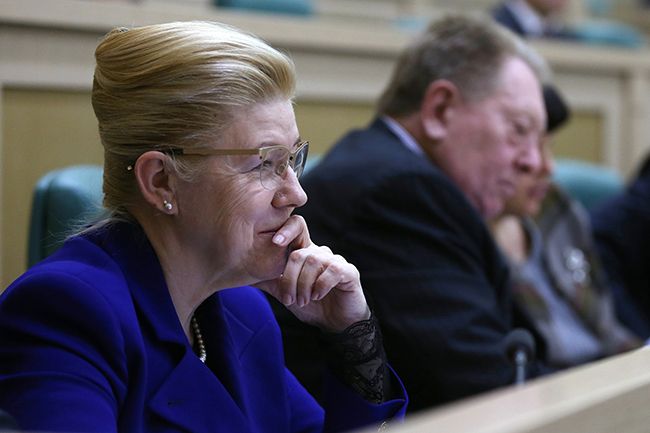
Большинство бывших коллег по Госдуме встретили назначение Москальковой позитивно. «Все зависит от человека, у нее есть такие возможности, она неглупая, с хорошим юридическим образованием. Я желаю ей удачи», — сказала Елена Мизулина. Бывший омбудсмен Владимир Лукин высказался куда осторожнее: «Время покажет, я считаю. Через полтора-два года я смогу сказать, правильно это или неправильно».
Правозащитники же опасаются, что генерал-майор для этой должности совершенно не подходит. «Человек она хороший, но многие ее законодательные инициативы не говорят о ее приверженности к правозащитной тематике. У нее не правозащитные мозги, генеральское звание и правозащитная деятельность несовместимы», — заявила «Газете.ру» юрист и правозащитник Елена Лукьянова.
Руководитель Комитета по предотвращению пыток Игорь Каляпин отметил, что после слов Москальковой о том, что правозащита может использоваться западными структурами как орудие шантажа, на этом институте можно ставить крест. «Сейчас из МВД приходит генерал-уполномоченный, и первое, что она говорит, — что престиж уполномоченного поднимать. Поэтому мне сразу стало как-то не по себе», — заключил Каляпин.
Ilya Azar
Moscow