
Translated material
At first - about Sentsov and Kolchenko, and then - about everything else
At first you deny that the colony exists. There is no colony, there is a single extended space, perhaps somewhat diverse, possibly even speaking in different languages. Then you move from the denial to the explanation: there was our territory, now the stranger has become-someone else came, made it its colony, enslaved the local population, and we did not enslave anyone, these are our people, our land, and there was no colony here. Then you begin to understand that the direct rule of this territory is far from the only way to leave it in its subordination. That there is no need to abolish the state border, if you can simply install the desired system of tariffs and duties, as well as a certain networks. But the unexpected: the local population, their own people on the board, suddenly declares that he is not satisfied with either the proposed tariff system, and even more so the TV show. And then you start a war with this former colony.
But waging a war with the colony is not so simple, especially if you constantly deny its existence. It is necessary to maintain a certain degree of tension all the time and diligently burn all possible points of contact, which are not reduced to the line of contact on the military front. And there are many such points between the colony and the metro. Including art.
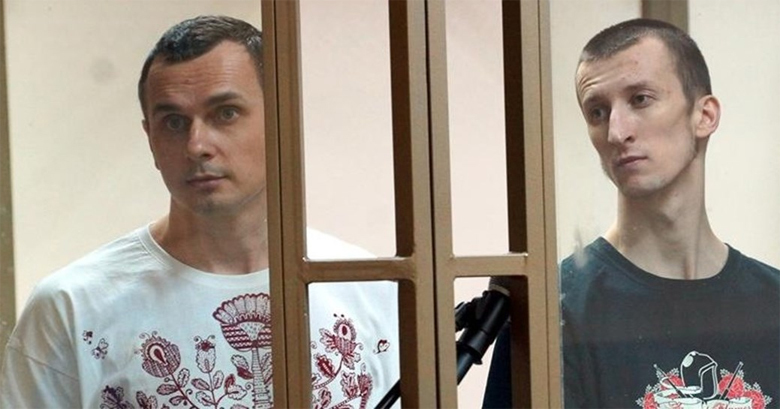
The day of the rupture in the history of the art of our part of the world was the day of May 11, 2014, when film director Oleg Sentsov and anti -fascist Alexander Kolchenko were detained in the Crimea, who were subsequently sentenced to 20 and 10 years in prison during the indicative process in the Russian Federation. You can analyze this story as much as you like in its colonial dimension. People of art have repeatedly become prisoners of empires and symbols of anti -colonial resistance around the world. But the case of Sentsov and Kolchenko adds at least one new bar to the picture of modern colonialism. We are talking about an attempt by law enforcement agencies during the investigation to turn the suspects to Russian citizenship in return for Ukrainian, which they never refused. This happened during (and under the pretext) of the mass circulation of the Crimean population to the citizens of the Russian Federation - therefore, on each freshest passport of the Russian Federation there was a symbolic seal of two “Crimean prisoners”.
Working with the colony is not so simple, especially if you deny its existence.
Let us return to the world of art and the disagreements that the process of Sentsov and Kolchenko drawn in it. My thesis is simple: until the director Sentsov and activist Kolchenko are in the Russian prison, any interaction between Ukrainian and Russian people should begin with a phrase made in the name of this text. Want to talk about something? Then, first, we will talk about Sentsov and Kolchenko, and then about everything else.
Naturally, first of all, about the interaction of institutions, about the so-called intercultural cooperation (at the interpersonal level and everything is more or less clear: even if Nikita Mikhalkov realized that Sentsova needed to be released, this means something). There is no sense (even when there is such an opportunity) to “restore the bridges of cooperation”, engage in “intercultural dialogue” and other nonsense, without raising the issue of Sentsov and Kolchenko. Why? The conclusion of Sentsov and Kolchenko is an episode of the Russian colonial war, directed directly to people of art. It is they who are his “target audience”: according to the logic, “ “ crucified boy ” we will make the housewives tremble, and Sentsov will plant, so that cultural figures sit quietly.”
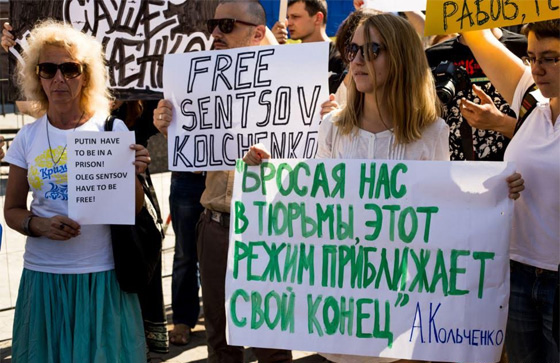 © Stanislav Yurchenko Picket at the Embassy of the Russian Federation in Kyiv
But this is not limited to this. The prison term by the leading Crimean film director is also an attempt to make an insurmountable split in any possibility of full -fledged cultural interaction between the metro and its former colony. And in order for this attempt to fail, such a split must not be smooth out, but aggravated. The challenge was adopted, an act of war was committed, and this act was aimed at a specific group - people of art - in order to create enmity between them (“What if they really are terrorists? After all, the Nothing Is True and EVERYTHINGS POSSIB LE ”). But the abduction and process of Sentsov and Kolchenko were performed so mediocre that the enmity did not really work out, everything perfectly understood - up to the aforementioned Mikhalkov. Such a situation must be used.
It should be understood that Ukrainian citizens Sentsov and Kolchenko are hostages of the colonial regime, for which their imprisonment is one of the guarantees of order established in Crimea. The hostages can be released, but how to achieve this? For example, Nadezhda Savchenko can be exchanged for Russian soldiers detained in Ukraine, and for whom to change Crimean hostages? After all, Ukraine will not be captured by Prilepin with Porechenkov. There remains a desperate, perhaps hopeless strategy - over and over again, reduce any conversation about culture or art to talk about Sentsov and Kolchenko. There is a public platform, there is the presence of the Russian side (in any form) - everything, the topic of the conversation can only be one. Let it look like fanaticism, narrow -mindedness, "unwillingness to conduct a dialogue." There will be no dialogue while Sentsov and Kolchenko in prison.
An attempt during the investigation by force to turn the suspects to Russian citizenship.
How can it look in practice? A little personal experience. For some time, to the best of my modest efforts, I practice the formula “At first - about Sentsov and Kolchenko ...” with any contact with the Russian environment. The result surpasses expectation, because this practice immediately means a field of possible. When I was invited to the “Long Happy Life” conference in the Moscow “Garage”, instead of the expected speech about architectural colonialism, this forum managed to voice political theses about Sentsov and Kolchenko. It was precisely that this speech had nothing to do with the subject of the architectural conference that gave a certain semblance of meaning. By the way, this text for “disagreements” was originally ordered on a completely different topic-but I do not find the opportunity to write in the Russian publication about anything else. Interestingly, Russian institutions are still more susceptible to such an approach than Western organizations that support close ties with Russia. Example: at the request to show my film at the exhibition organized in London by the Calvert Journal , I answered with a proposal to include a video work about Sentsov and Kolchenko in this exhibition. The answer was simple: “Open support or criticism of someone else's imprisonment will put us ( Calvert 22 Foundation , the strategic partner of which, according to information on its website [1] , is VTB Capital . - A.R. ) in an awkward position, negatively affecting many other areas of our work. ” At the same time, it was not about trying to impose a political theme where it does not smell. After all, the work about Sentsov and Kolchenko would be quite organic at the exhibition, which (I quote her description) “studies the relationship between the public space created for utopian ideology, people who live among her heritage and the search for new national identities.”
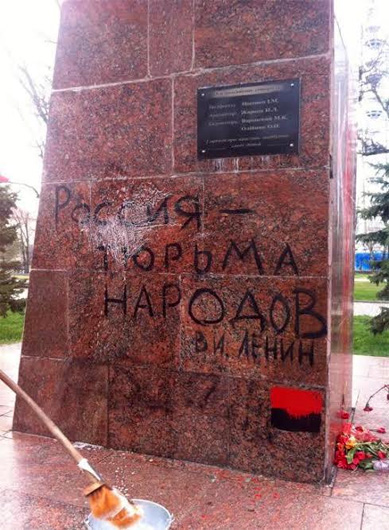 A pedestal of the monument to Lenin in Berdyansk with graffiti
By a strange coincidence, it is this formulation that exposes the obscene political imaginary, standing behind the logic of the process of Sentsov and Kolchenko. Let me remind you that the key point of their charges was an imaginary intention to destroy the monument to Lenin in Simferopol. It was this idea that Sentsov and Kolchenko had to designate the unambiguous enemies of society and rally the population of Crimea around the symbols of the new government. The result was a rather paradoxical situation. On the one hand, the myth of the terrorism of Sentsov and Kolchenko is a reaction to the wave of Leninoclase, which began in Ukraine in 2014: its outskirts were astronomical prison terms to try to destroy the monument, which not only was not undertaken - in fact it was not even planned. The monument to Lenin becomes a sacred object: for one supposed thought of causing harm to him, you can get 20 years of prison. On the other hand, in Russia now the most antilenine regime over the past 99 years of its history. It is Lenin, according to official ideology, that is a source of all Russian troubles. Listening to Putin’s speeches, we can conclude that Lenin is a much greater problem for him than Western sanctions or Ukrainian Bandera. What is not surprising: the political structure in Russia begins to very much resemble a system that was defeated during the 1917 revolution.
In Russia, now the most antilenine regime over the past 99 years of its history.
In ignoring this, of course, there is a tragedy of Ukrainian decommunization: instead of fighting the granite sculptures of Lenin, it would be worth paying attention to those elements of his heritage, which - at least temporarily - helped to stop Russian imperialism in due time.
In the center of Kyiv is now there is a monument to Lenin - a work of spontaneous abstract art. After the overthrow of the granite figure of Lenin in December 2013, her pedestal remained standing in place, reminding his shape with his shape. Having lost his figure component [2] , for some reason, this monument ceased to annoy the anti-communist feelings: a stone block, on which Lenin is clearly written, is perceived as a completely natural part of the public space-although, according to barbaric “decommunization” laws, and it should not be here. At the end of the pedestal there is a key component of this spontaneous radi-mide. A quote is carved in the stone: “With a single action of the proletarians of the Great Russian and Ukrainian, free Ukraine is possible, without such unity of it there can be no talk of it.” It is difficult to find a more accurate description of the circumstances of the Russian-Ukrainian colonial war. By the way, the same description applies to the conditions in which “free Russia” is possible.
[1] After the publication of the article, the link was deactivated, since, according to the comments of the representative of Calvert 22 Foundation , their cooperation with VTB Capital ended in 2015.
[2] I owe this thought to Vasil Cherepanin.
Download the entire issue of the magazine "Disagreements" (No. 3) "Empire and colony. Borders and invasions ": PDF , MOBI , EPUB