
Translated material
Mariinsky Scythian
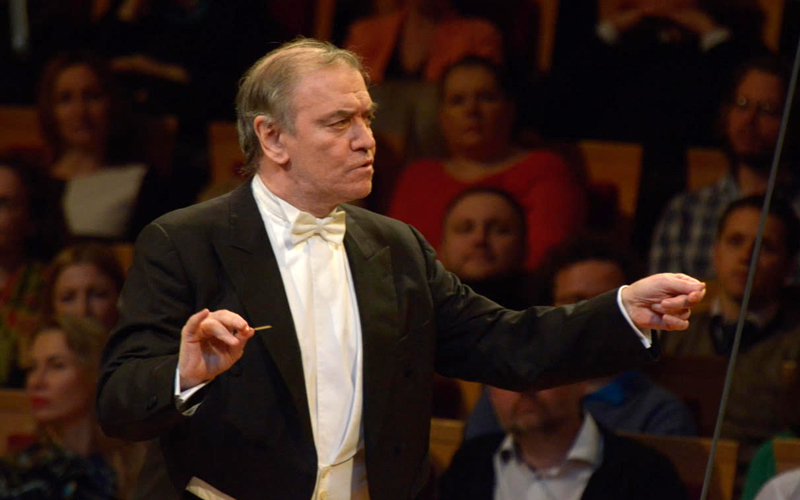
On April 23, the world celebrated the 125th anniversary of Sergey Sergeyevich Prokofiev. Hergiev did the largest most of all. In the evening before the birthday, the conductor and his Mariinsky team are quickly, only three and a half an hour and a half, they performed the war and the world at home in an abbreviated form. Then the night train to Moscow. April 23 at 11:30 - Tchaikovsky’s concert hall, two and a half hours of music of early Prokofiev without an intermission in the format of the virtual hall of the Moscow Philharmonic with a broadcast of several dozen cities of the country, including those where they had already dinner. With the triumphal square - immediately on the daytime "Sapsan" back, surrounded by cameras of the MEZZO television channel. While the orchestra was on the road, in both capitals, eight pianists (Daniil Trifonov, Katya Skanavi, Ilya Rashkovsky, Denis Porukhin, Alexey Melnikov, Denis Matsuev, Sergey Redkin, Andrey Korobeinikov) was dangled by Prokofievsky sonatas: from the first fifth in Moscow, with the sixth to the ninth in St. Petersburg. From St. Petersburg there was a broadcast on the website of the Mariinsky Theater. By 21:00 on the same day, the orchestra ran with the Sapsan performed in the Mariinski concert hall the third symphony, the second violin concert, the second piano concert and almost never sounding for obvious reasons, but completely out of the “cantata for the 20th anniversary of October” on the texts of Marx, Engels, Lenin and Stalin. The Mezzo channel led the live broadcast.
That's not all. After the night, April 24, in different halls of the Mariinsky complex - five more events related to Prokofiev, three of them - at 13:00, 17:00 and 21:00 - with the participation of the Mariinsky Orchestra and Gergiev. In the afternoon they played the mature Prokofiev, late in the evening. For me personally, the main shock in the schedule of the theater on this difficult day, somehow, the two more (!) Trubadura Verdi, at 14:00 and at 19:00, became there. True, without Gergiev.
But the maestro is in the ranks when it comes to the operas of the anniversary. In the Mariinka repertoire there is a selection of almost all the main operator’s main operator, and the Fire Angel was generally put in Russia for the first time in the Gergievsky era of the Kirov Theater, by the centenary of Prokofiev, in 1991. In these days, in addition to the aforementioned “war and peace”, Gergiev conducts “player” (April 20), “Bringing in the Monastery” (April 26) and “Semyon Kotko” (April 27). It goes without saying that all year he plays Prokofiev from St. Petersburg to the very outskirts even more than usual. In addition to the usual Europe and the United States, Gergievsky Prokofiev has already gifted China, Chile, Mexico and Cuba, in anticipation of the city of the beginning of the Easter festival, from Vladikavkaz to Votkinsk.
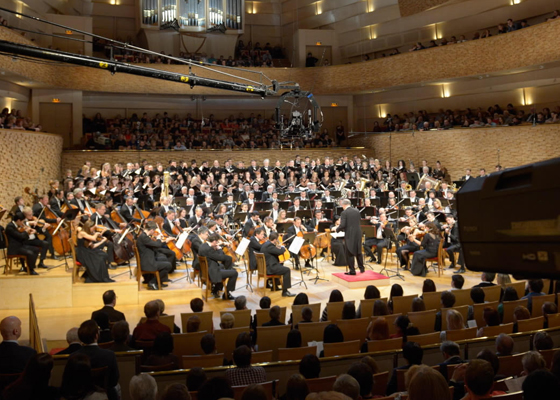 © Press Service of the Mariinsky Theater
Of course, the miracles of logistics and endurance have long been an indispensable component in the description of the Hergiev phenomenon. The maestro wants to cover the entire globe, overcome kilometers of music and roads, building the trajectory of the next crazy performance. In combat order, new technologies are involved. Now a living listener in the hall is only a background for cameras broadcasting what is happening to thousands and millions, which today are invited to hug to Prokofiev’s music. Did the composer himself wanted this? It's hard to say.
And it would be possible to finish this, if not for one - the most important thing is the circumstance: Gergiev really plays Prokofiev very well. These scores are very good for his muscular orchestra - tasty and healthy even when they are talking about madness or war. Of the two days of the marathon, I could have once again check this fact, the morning Moscow series was enough with the first piano concert (confident solo Denis Porukhin), the first violin concert (the gentle solo of Leonidas Kawakos), the Scythian suite and the cantata “Seven of their seven”, securing the young writer for the young writer of the Enfant Terrist Renoma, The first, playful, “classical” symphony and the second symphony is completely not classic, but a kind of deafening mongish of gears from the twenties. These are all the works of a very young author, very different - the bubbles, mysticism, joker spraying the energy. And each role is extremely convexly painted with an orchestra, everything bounces off from the teeth. And every now and then luxurious sound lava, which is enveloping the listener, is from the post-scrubs and modernist-urban utopias-destroys time and space. Actually, that the maestro Gergiev was required to prove.