
Translated material
"Stand on the path of escalation"
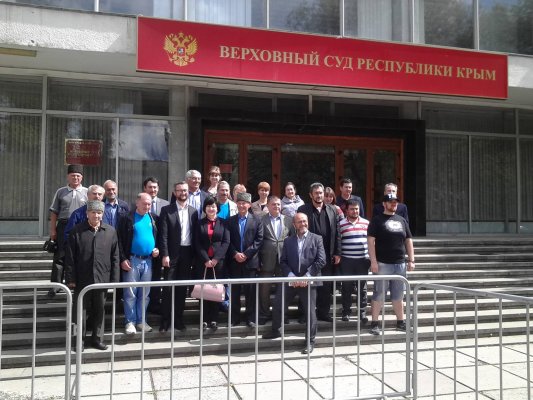
The Majlis of the Crimean Tatar people was recognized as an extremist organization and is prohibited. Journalist Yevgeny Kruglov attended meetings in the Supreme Court of Crimea on April 25 and 26, on which the fate of the Mejlis was decided.
“Crimea is not Russia,” the crowd is chanted on the screen installed in the courtroom, and the impenetrable faces of Themis ministers for a moment take a confused expression. Then the voice behind the scenes begins to talk about the mass riots that occurred under the walls of the Crimean parliament more than two years ago, and the judges settle peacefully in their seats.
In the Hall of the Supreme Court of Crimea, things are often voiced, for which in everyday life, the inhabitants of the peninsula can easily receive (and are already actively receiving) who are troubles at work, some preventive conversations in the center of counteracting extremism, and who are real criminal charges of violation of territorial integrity.
Aksenov as an alibi
The judge interrupts the comments of the participants in those events, referring to the deputy head of Medzhlis Nariman Gilyalov, who is an administrative defendant on the claim, with the question of why he asked for demonstrating this video. He explains that the news story precedes the comments of one of the organizers of the action.
“A group of provocateurs near the Supreme Council of Crimea, which gathered without a reason, to the arrival of deputies of the State Duma, who wanted to arrange a show-off situation ...”,-so the ex-leader of the Blessed Party “Russian Unity”, and now the head of the Republic of Crimea Sergey Aksyonov responded to pro-Russian activists involved in the clashes on the eve of the appearance of “green ones in Crimea Mags ".
After watching the entire video, Jelalov emphasizes that among the list of illegal actions, which is imputed by the Majlis, there is an accusation of organizing riots under the walls of the Crimean parliament. At one of the previous meetings, the defense representatives were already severely criticized, since the criminal case on these events was returned to the investigation and say that Majlis was involved in this, until all the circumstances of the case and the sentencing, to put it mildly, prematurely.
With the help of this video, Majlis representatives showed that in those events there were two organizers - Refat Chubarov from the Crimean Tatars and Sergey Aksenov from the Russian Unity party. Moreover, the last few times he emphasized that, jointly, they managed to prevent serious clashes and numerous victims among the participants. The prosecution is silent. How can I dispute the opinion of the "very", even that time?
Who is to blame for the escalation
Next, the defendant asks to demonstrate a video in which Refat Chubarov urges all the military to return to their garrisons, translate the solution to the problem of diplomatic negotiations, and regulate the situation not to politicians, but to the “moral authorities” of the Crimean society. As Nariman Dzhelalov explains, the demonstration of this video is designed to reinforce the thesis that Majlis initially took a peaceful position in the events of the Crimean Spring and tried to call all the parties to the dialogue. “This video demonstrates that we have not taken the path of escalation of relations, one of the stages of which is today's court session!” - emphasized the deputy chairman of the Mejlis.
The prosecutor, obviously, felt that with objective trial, such a video does not threaten any separate element of the prosecution, but the entire structure, grouped around the thesis that Majlis always adhered to an exceptionally aggressive line of behavior in his activity. This is probably why the representative of the prosecution jumped up how stung, and demanded to name the date of the appearance of this video, and when Jelyalov hesitated, he became excitedly excited: “That is, you don’t know when this video was shot - two years ago or yesterday?” Although, probably, the excitement of a young prosecutor, who is periodically breaking into the falsetics, can be understood - he was provided with an active work in such a loud business.
Meanwhile, Chubarov again appears on the screen, which holds a press conference dedicated to the incident on the border of the peninsula, when the Russian authorities banned the entry of the Crimean Tatar people Mustafa Dzhemilev. In the indictment, the Crimean prosecutor’s office claims that Majlis was involved in the power breakthrough of the border strip, and this, of course, is a sign of extremist activity.
In the presented video, Chubarov explains that there were no cordons, no signs denoting the demarcation line, but there was an ordinary road, which in some place Crimean Tatars was blocked by some people with weapons in their hands, dressed in the form of incomprehensible affiliation. At previous meetings, Jelalov also explained that the clash was provoked by unknown in the form of employees of the Ukrainian "Golden Eagle", who began to shoot into the air. And initially the action was peaceful and was designed to demonstrate respect and support to the leader of the people, who once again deprived of the right to live on their native land.
The name of the Mejlis
After long debates about whether it is possible to recognize the specialist’s linguistic conclusion about the presence of calls to extremism in the texts of the specialist, if there is no information about its qualifications, the degree and other regalia in this document, there is a queue to watch the discs represented by the prosecutor's office. At the same time, many of the materials broadcast the same thesis - the Crimean Tatars of Mustafa Dzhemilev, Refat Chubarov and Lenur Islyamov are organizers of the food and energy blockade of the peninsula.
The defendant notes with the same perseverance: no one argues regarding their involvement, but what does Majlis have to do with it? Of all three, only Refat Chubarov is related to the Majlis, but in his statements he never mentions what he speaks on behalf of or on behalf of the entire Majlis of the Crimean Tatar people. “You never know what and what says on behalf of Majlis,” comments one of these fragments Nariman Jelalov. The representative of the prosecutor’s office with a calm sequence continues to demonstrate dozens of information messages, including with the participation of the “Ozlodlisov” Islyamov.
However, those present in the hall are no longer surprised - even at lunch the plaintiff introduced to the case the case of the Mustafa Dzhemilev pamphlet “Polyana Protestes in the Crimea”, which was published in 1988 - a few years before the appearance of Majlis as such.
In aggregate
Nine and a half hours after the start of the meeting, when he begins to get dark outside, the judge announces that the hearing is tolerated the next day. And for most those present it becomes obvious that this will be the last day of the Mejlis.
This conjecture is confirmed in the morning when it turns out that the enhanced forces of law enforcement officers are pulled to the building, and at the meeting there is a Crimean prosecutor Natalya Poklonskaya. She certainly would not allow the triumph of the sentence.
In the debate, she traditionally does not really think about the legal weight of her words. Majlis is now accused not only of extremism, but also of cooperation with terrorist organizations, although nothing was said about this during the administrative process.
Nariman Dzhelalov reacted very Kolko to this, who in his speech emphasized that international organizations - the UN and OSCE, as well as the governments of Turkey, the USA, and the European Union expressed the support of the Majlis. “Based on the logic of the plaintiff, all of them also relate to terrorist organizations,” Jelalov said.
The decision turned out to be predictable: to recognize the extremist organization, to prohibit activity.