
Translated material
Demetrius | Colta.ru
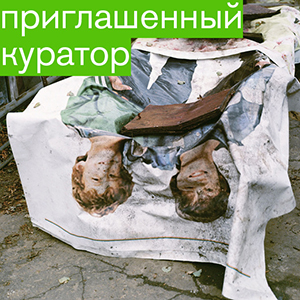
This year, Colta.ru decided to go to the experiment and invited to temporary curators over the section “Photo projects” of young and talented representatives of leading Russian photocurium. We divided the calendar year between six curators and asked them to select the most interesting samples of modern Russian photography for publication.
Invited curators
Katerina Zueva , center of photography named after Brothers Lumier
Nadezhda Sheremetova , "Femicip"
Sergey Lostev , "House of Metenkov"
Daria Tuminas , Freelance Curator, Amsterdam
Anastasia Bogomolova , The Blog This a Photobook
Svetlana Taylor , British Higher School of Design

Second resident: Nadezhda Sheremetova. The curator, a photograph, a photographic photoler, director of the Femaland Foundation - an organization engaged in the development of modern photography in Russia. The editor-in-chief of the online magazine about modern photography "F." .
She acted as a curator of group and personal exhibitions of Russian photographers, which were held as part of the Backlight 2011 festivals (Tamper, Finland), “Fashion and Style in Photography 2015” (Moscow), “Photo Parade 2015” (Uglich), in the center of the photograph named after them. Brothers Lumier (Moscow), Museum of the photo "Metenkov House" (Yekaterinburg), the Krasnoyarsk Art Museum and on other sites.
Curator Nadezhda Sheremetov about the photographer Julia Borisse
The book is a natural “packaging” for photography, and even many experiments with the transformation of photo images appeared in this format of presentation of projects. Photographer Julia Borissova, using his designer’s background, about three years ago she became an active participant in the international process Self -Publing , immediately hit with the photographs published on her own (“Far Coast”, “Embell on the edge”, “D.O.M”, etc.), in the short lines of book competitions and premiums, including one of the most famous -one of the most famous Photobook Dummy Award in Kassel. Her images are balanced between a direct photograph and its definition in the concept of “so it was” - and a collage, which presents something that was not. Working on this border, Julia Borissova raises the memory layers of both individual and divided collectively, mythologized in its base, confused and never clear, involving the audience in an even more confused journey, addressing the question “What have we have now led to this?”
Dialogue of Nadezhda Sheremetova with Julia Borisse
- Julia, call me the tags you work with.
- The main tags are a memory, a book, and one way or another I turn to the archive. I can not even use archival material in my work, but as a source of inspiration, the starting point - it can be an archive. And it can be not only photographs as material media, but also some topic.
- Then what is the archive?
- The archive is a memory. This is the struggle against oblivion.
- But is the archive only what we remembered, learned and determined? Structured, for example. Or, conversely, the archive is what breaks out of memory?
- The archive is what could be, but it might not be.
- And how does it happen and does not happen?
- Depending on your attitude, as you determine. You can relate to what was found in the archive, as a pattern, given and use as a fact that has taken place in the past. And you can question this and work already through it quite critically, looking for your point of view, your view of history and your interpretation. And you only follow your imagination, it turns out. What is important to me is to speculate of history, to supplement it with some kind of one’s attitude, my vision. That is, that which exists in reality, and what exists in my head (my fantasy) is in parallel.
- In parallel? Or do you find a joint between these modes of memory of memory?
-Yes, there is some kind of face. Zesta. And on this tip, everything that I do is happening. Like a peak.
- Let's get back to the archive. You still talk about the archive as a place in which the story is recorded - photography, text, memories, documents.
- I would not want to specify. This is some kind of field, a volume, a source from which I can draw something and skip through myself.
“But the source formed by someone?” Or do you form a field as an archive, give it a form?
- We can say that this happens later. From the source I can draw something, sift and from what remains on the surface, I can collect my own archive, which I do-throughout my life I smoke some memories, details, images. And this will already be my archive.
- Will the archive always have a material basis for you?
- No, the memories are intangible. If they are not fixed on paper, they live in my head.
- I understand how the material artifacts of the archive move to your projects - how it was in the book “The Far Coast”: as objects. This is what you are addressing, borrowing. And what is an intangible archive? In addition to memories.
- This is how I work with him. Look: I take a photo, I look at it - it is a material. But here the imagination turns on, and I already represent some kind of field of associations, I begin to interact with them, and something new is born from this. And this is already an intangible archive. That is, I cannot take and touch what was before - I can only imagine it. And with my imagination, I can already do something.
“But look: what was before is some foci of memory, foci of events with which contact need to be made.” This is some kind of stream that exists, accumulates, but it is not classified by anyone. However, he consists of something. In the field of the past there is a memory of the country, a social or cultural group, and there is also a personal memory.
“You cannot but be built -in in the field of common memory, you will always be in it.” For me, history and in general time are not linear, but cyclical. Why do I work so easily, moving into different time segments? Because it seems to me that they are not far away there, but around me. I do not feel the distance separating me from some 16th century-it seems to me that he is near and I have to pierce the layers that surround me like rings.
- Memory accumulates in different layers, expanding from personal to collective. But she accumulates in some ways, not only in material media. How to determine the memory intangible?
- Like your consciousness. Awareness of oneself. That you lived, not someone else.
- Now I will translate my theory, about which I am thinking about the texts read. It seems to me that “I” are formed on the basis of streams, and this streamness can consist of what happened to me, of what I did - bodily experience, from what I walked, moved in the physical space (born in one place, then crossed in the physical space a certain route. I am in virtual in parallel with the real, and this is also a kind of archive, intangible, forming thanks to data and digital codes, and it is my memory, but the one that I discard, and not just approaching myself. The flow of what I forgot, or what I did not know, is unconscious, my unconscious, my desires are another stream that is associated with the segment in the past. And he, of course, is connected not only with my personal history, but also with the general past.
- It turns out that memory is you. The memory does not define itself. Whatever it is - real, imaginary - you enclose it in yourself.
“You may not know something or physically cannot be part of a common memory, bearing in mind a segment of the 16th century, to the event in which you turn in the Demetrius project.
“You can because you are on this earth, you already have a connection with this.”
“But this is not personal experience.” This is the experience of the stream of history that you can turn to, and this is your Link, this is a new assembly of yourself and thinking about the question “What are you? " And here I agree: memory is you yourself.
-Yes, this is a question of appeal in which you make a choice-take something or leave a white spot, exclude.
- Then your task is what? Return the memory?
- On the contrary, in this work I thought not about the creation, collecting or creating memory, but about its destruction. Trying to imagine something from the distant past, I only destroy, because I can not remember anything. I can only imagine. And, determining the visual response to the story, I understand that I am even more destroying what could be. It is impossible to restore, it is impossible to turn to material sources of events or find some evidence-they are not, they are all also imaginary. And you can find visual references to Demetrius only on icons, on frescoes, which are also imaginary works - the representation of the artist or the power that wanted to present a certain way. The preserved frescoes are covered with a layer of Soviet plaster, and when they try to clean them, this process illustrates what is happening with the memory-something has broken down and carried away more with them than it remained.
- And it became unreliable.
- Absolutely inaccurate. Or came a restorer and tries to correct some fragments.
“And you act like this restorer?”
- Not at all. I show how in vain attempts to restore something. I look at the surrounding world, at the actual reality, I try to somehow observe it and create something at that intersection when the past appears under the present. But this is the past - is it a real past? Can I believe him? This is also someone's image or a piece of it, and these pieces are never folded in truth. There is no task here to show what happened - I can show only what was not.
- You turn into the past to understand today; What exactly?
- I pushed away from the picture - the coat of arms of the city, which depicts a figure with a knife in my hand. And then curiosity moved me. This story is almost detective, it interested me with her plot - as in the 16th century there was an investigation of the murder (alleged). This could develop into a detective novel or fiction. But I never initially know where my own road will lead me, and the detective story did not work. An anecdote that could have developed also did not work out, and I would not want to. And gradually, through shade and printouts, recorded impressions, an investigation developed. In my notebook, this story is recorded as “Tragedy”. And followed by Troubles, and sadness, and trouble. Pushkin, Mussorgsky turned to this plot, fairy tales formed. Departing from the detective and evidence like the knife found, I realized how this event developed in a terrible state for the state - in Trouble, the destruction of the city (Uglich), which was ruined, burned to the ground and only 500 people remained. But this is due to the tragedy of Tsarevich Demetrius or with another reason - it is only possible to assume. And further the com History is becoming more and more confusing, and it is increasingly difficult for me to imagine the main character of the tragedy, Tsarevich Demetrius. Contemporaries could not even describe it really - how he looked, and even the features of his character vary all the time. Everything is so implausible. And it turns out that the very absence of this person caused all further events. Then I realized that I was working with a removal. I can show his portrait, but by leaving his face with something, or in today's reality to place what was not-that is, create some kind of intersection.
And this is not the boundary of the actual and imaginary, but everything around the surrounding seems unrealistic. Some chaos around, from which I try to collect this world together. I ask questions, but the answer can be any depending on the circumstances.
- What are these questions? And you ask them today, the close area of what is happening?
- Who can I believe? Are I able to believe at all? Can I believe the image?
- To your eyes?
- After all, eyes see what they want to see that experience suggests. If I have not encountered something before, if I haven’t seen anything like it, then I may not notice it and, therefore, not believe, I can just pass by.
- And you can be inside the framework ...
- Yes, the framework of my experience, someone else's experience, what I absorbed or let into myself. If I look at everything with a blurred eye, what can there be? Try to abstract. Including in artistic work - there is always the task of abstracting and finding your solution, creating what is inherent in me. I work with forms, and the form is impossible without awareness of the information received.
- Or, trying to join different material - history and reality, you in the process understand that you construct an image from the images, but chaos is created. This is a capacious word, an important point of this story, like your process. Do you lead the viewer through this word by today? And do not you think that you made a political project?
- It is difficult to explain the whole process. I can identify tags from which I did not leave in the process-red, the feeling of tragedy, a break, also an internal, foreboding that something will happen, but that it will be a riot or execution is unknown. But this foreboding is what our today connects with that moment: it is anxiety, it is a feeling of trouble and a desire to protect himself.
- Prevent?
- No, I can’t prevent it, I can only try to create for myself the possibility of existence in today's situation. And I cannot explain the logic of the process of my work, because it is like explaining my dream.
- It seems to me that in the Demetrius project there is a place for questions about who rule, who controls the process, who has the means to present evidence, influence the media or other transmission channels. Or is small human life also important?
- It is important for me not who dominates, why and in what ways, but how we relate to this. This is what bothers me the most. The way we ourselves allow ourselves to relate - believe, understand, reject, get used to. It is important to try to create your picture of the world from this chaos, and not the one that is imposed on you. In collages, I work with those elements that I can afford, which are only available in reality. But from them I create my point of view.