
Translated material
Fast -and -soluble articles
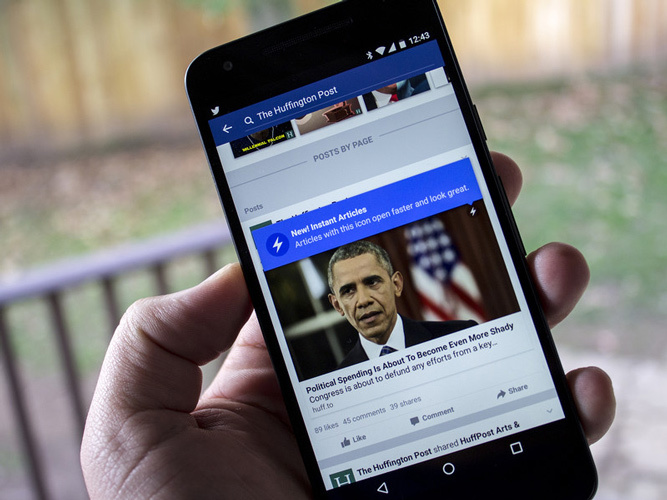
“Instant Articles” (I don’t know how to translate into Russian “Instant Articles” ) appeared on Facebook a year ago. Then the social network gave a dozen American and British publications the opportunity to publish articles that can be read without leaving the application on the phone. A year has passed, and at the F8 conference this technology was given this technology.
In Russia, it has so far been introduced only the Elephant business magazine and the Medusa website, but in the near future, the logic of the Arms race will lead to the fact that other media will not be able to use articles with the sign “Lightning” to the right. The course of thought is not difficult to reconstruct here. If your competitors have this and it’s easier to read them, then you obviously lose, staying with the junk.
In addition, such posts will be predictably more likely like and haste. Facebook does not even need to twist the algorithms (by the way, he has already promised not to do this), just with them, by virtue of their nature, they will perform more interactions at a unit of time - if only because in many cases ordinary articles simply will not open with a weak signal, they will be closed without reading, which means that they are not shy and without having known.
The spread of Instant Articles in Russia is delayed only because (I suppose, based on its own example) that their inclusion requires some preliminary work of full -time programmers; If it were not for these obstacles, the proportion of instant articles in our ribbons would have long grown at times.
And then a curious paradox. Most are now preparing for this, but prepared without joy, rather, on the contrary, with irritation. And they can be understood. The reader will not need to leave the limits of the social network: after all, each Instant Article is, in fact, a pop -up message inside Facebook. I went in, read, returned back to Facebook.
If your competitors have this and it’s easier to read them, then you obviously lose, staying with the junk.
Everything is as convenient as possible. The word Instant in relation to coffee into Russian is translated as "fast -soluble." So here this is precisely what are fast -soluble articles. Convenient as watching a movie in the bathroom or ordering pizza by phone. In the center is a consumer, not media.
And the media, of course, is insulting. Once upon a time, newspapers or radio and TV presenters (all in strict costumes, of course) seemed celestials and dictators of tastes and mod. It was they who led an unreasonable audience behind them, and not the audience behind themselves.
Then the digital age came, and all these people have long and painfully for twenty years have moved to the Internet, mastered there, building a carefully branched communication system with readers-listeners so that they ultimately always get to the site. After all, the site seemed to be almost as sacred as paper or ether once.
Now-and we get closer closer to the cause of frustration-it turns out quite on what. It turns out that the article of a respectable business newspaper in format is no different from the record in a popular public about pets. Moreover, it becomes clear that for hundreds of thousands of people this brand exists only on this social network. Well, they never go to the site.
And what to do? There are two ways.
The first is to resist the general course of things and row against the current. Search for all new ways to drive effectively from social networks and from partner sites traffic to a “maternal” site. Press and crush clicks, convincing themselves that only they are the only measure of efficiency today.
The second is to break the picture of the perception of reality in my head and build it again. To abandon the far -fetched contours, where everything is closed on the publication’s website, and see another principle: when the same team is represented on several platforms equally. That is, R AISON D'ANTRE , the newspaper’s account on Facebook is not to encourage people to switch to the newspaper’s website, but to be its embassy in this space so that it is comfortable to be there. Everything else is only side effects.
No one prevents a couple of talented students from starting a Facebook account, which will look exactly the same at the exit as the page of the publication, where a thousand people work, or maybe better.
This thought, of course, is revolutionary and does not immediately fit in my head, because for too long the media managers in Russia were taught to focus on traffic, traffic and again on traffic. But you will have to get used to it, because the time of hegemony of sites passes. They are only one of the many platforms, and not the fact that the most important in the future.
Instant Facebook articles only accelerate this natural process. No more clickbeat is needed. It is only interesting to tell. In principle, today, in 2016, the cost of entering the media market in Russia decreased more than ever, despite not the best state of affairs with freedom of speech in the country. Following the boom of the "public" "VKontakte" (quasi-SMI) now Facebook is erasing this line. No one prevents a couple of talented students from starting a Facebook account, which will look exactly the same at the exit as the page of the publication, where a thousand people work, or maybe better. With the zero budget, of course.
By the way, about money. All the fears that Instant Articles will kill the business, of course, are far -fetched. Facebook has symbiosis with publicboats. All talk about user content (user Generated Content) remained conversations, for the most part ordinary people do not create amazing materials, and for this we need professional media. So the social network will not allow them to die. Here is the built -in own advertising, which has already been mentioned, and the excellent prospect of native materials only for Facebook. This is generally the advantage of any successfully developed media site, from Instagram to Snepchat, - advertisers begin to break up.
Words about losses and all other thoughts about how Instant Articles kill the industry-this is rather a resentment of the final debunking of journalism as something separated from the mass society and at least a little exalted.
There is no more aristocracy. Total meritocracy has come. The one who is more interesting wins-and it will not always be an millionaire investor, but very often a schoolboy from a neighboring entrance. It is not surprising that many do not like it. Now it will be necessary to work more and better.